Log in
Sign up for FREE
arrow_back
Library
Integumentary and Urinary System Wrap Up
By Katelyn Owens
star
star
star
star
star
Share
share
Last updated almost 2 years ago
22 questions
Add this activity
5
1
1
1
1
1
1
1
1
1
1
1
1
1
1
1
1
1
1
4
1
1
Question 1
1.
Match the desription to the correct tissue. You must use all the descriptions
The most abundant tissue, it supports, protects, stores lipids, and binds structures
Allows for movement
Forms the body’s communication network. It relays messages in the body to help maintain homeostasis
Blood, bone, cartilage, and adipose tissue are all types of this tissue
Covers the body surface (in the skin) and lines hollow organs
Epithelium
Connective
Nervous
Muscular
Question 2
2.
Which correctly states the level of organization in the body?
organ, organism, tissue, cell
cell, organ, organ system ,tissue
cell, tissue, organ, organ system
tissue, cell, organ system, organ
Urinary System Review
Question 3
3.
State one function of the urinary system
Question 4
4.
Which organ is NOT part of the urinary system?
kidneys
ureter
bladder
rectum
Question 5
5.
What are kidneys composed of?
nephrons
adipose tissue
neurons
melanocytes
Question 6
6.
What is the function of the bladder?
moves urine outside the body
filters blood and makes urine
holds urine
transports urine from the kidneys
Question 7
7.
What is the function of the kidneys?
moves urine outside the body
filters blood and makes urine
holds urine
transports urine from the kidneys
Question 8
8.
What is the function of the urethra?
moves urine outside the body
filters blood and makes urine
holds urine
transports urine from the kidneys
Question 9
9.
What structure is labeled A?
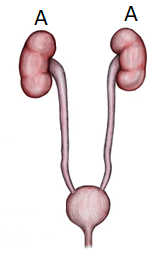
Bladder
Ureter
Kidney
Urethra
Question 10
10.
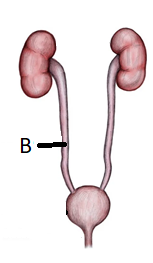
What structure is labeled B?
Bladder
Ureter
Kidney
Urethra
Question 11
11.
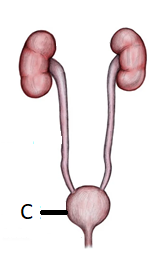
What structure is labeled C?
Bladder
Ureter
Kidney
Urethra
Question 12
12.
If there is a lot of water in the blood, the kidneys
release insulin
remove excess water and make urine
release glucagon
reabsorb water making less urine
Question 13
13.
How do the kidneys and the urinary system help your body maintain homeostasis?
Integumentary System
Question 14
14.
Identify structure
A
in the diagram
Nerve
Dermis
Epidermis
Hair Follicle
Subcutaneous Layer
Sweat Gland
Sebaceous Gland
Question 15
15.
Identify structure
B
in the diagram
Nerve
Dermis
Epidermis
Hair Follicle
Subcutaneous Layer
Sweat Gland
Sebaceous Gland
Question 16
16.
Identify structure
C
in the diagram
Nerve
Dermis
Epidermis
Hair Follicle
Subcutaneous Layer
Sweat Gland
Sebaceous Gland
Question 17
17.
Identify structure
D
in the diagram
Nerve
Dermis
Epidermis
Hair Follicle
Subcutaneous Layer
Sweat Gland
Sebaceous Gland
Question 18
18.
Identify structure
E
in the diagram
Nerve
Dermis
Epidermis
Hair Follicle
Subcutaneous Layer
Sweat Gland
Sebaceous Gland
Question 19
19.
Identify structure
F
in the diagram
Nerve
Dermis
Epidermis
Hair Follicle
Subcutaneous Layer
Sweat Gland
Sebaceous Gland
Question 20
20.
Which layer of the skin contains the following structures. You must use all the descriptions
Hair Follicles
Keratin filled cells
Melanocytes (cells that make melanin)
Sweat Glands
Dermis
Epidermis
Question 21
21.
The pigment found in the epidermis, which protects against UV rays is called
Keratin
Chlorophyll
Melanin
Sebaceous
Question 22
22.
State a function of the integumentary system