Review of Wednesday's tree of life activity: Describe what the following diagram portrays.
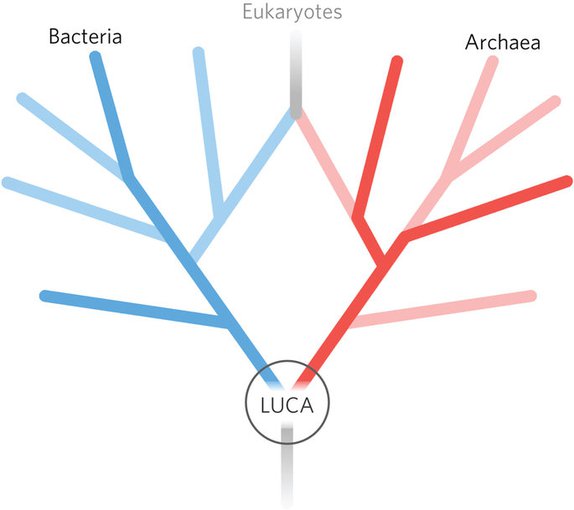
Review of Wednesday's tree of life activity: Describe what the following diagram portrays.
Review of Wednesday's tree of life activity: Describe what the following diagram portrays.
Review of Wednesday's tree of life activity: All of the following have a bony skeleton EXCEPT....
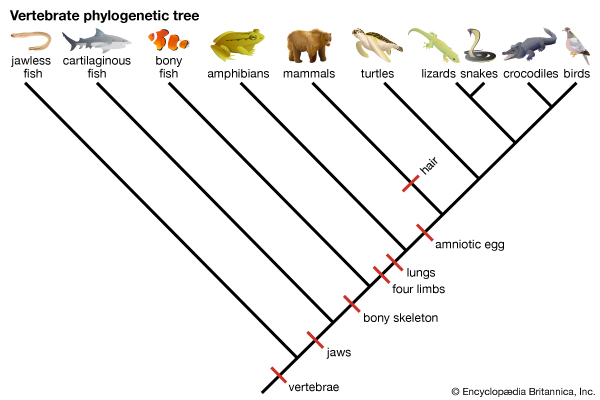
Review of Wednesday's tree of life activity: Which of the following share the most recent common ancestor?
Despite the different shapes in pupils, all the organisms below have pupils of some type. Why are are all these species so similar in general eye structure?
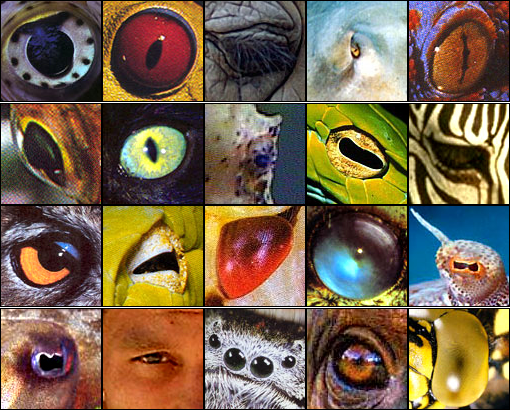
Despite the similarities, all the organisms below have pupils of some type. Why are are all these species so different in general eye structure?
Review of Tuesday's Animal Activity.
Circular pupil holes- we commonly see in the center of human irises. Since humans are typically daytime creatures and are not commonly exposed to the dark for extended periods, it is enough for us to have pupils that dilate and contract, allowing us to see at both bright and relatively low illumination levels. The minimal diameter of the human pupil is 2 to 4 mm, while the maximal diameter (dilation) is 3 to 8 mm. Other animals with circular pupils are also mostly predators who tend to hunt in low light conditions, but predominantly during the day. Also, these animals are not preyed upon by other animals, so their visual systems do not need to be adapted to help them flee.

Based on the benefits of circular pupil holes, and the sample student response to Tuesday's grouping activity...which of the following do you think have circular pupil eyes like us? (SELECT 3)
Review of Tuesday's Animal Activity.
Elongated slit pupils afford a greater amount of dilation and contraction, due to the involvement of two additional muscles in these mechanisms that circular pupils do not possess. More flexibility helps animals with vertical pupils to see better in the dark, even with minimal amounts of illumination, as their pupils are able to significantly expand. They also prevent these animals from getting dazzled by bright lights, as their pupils can turn to narrow slits, greatly reducing the amount of light entering the eye. Such vertical slit pupils are commonly found among those animals whose hunting activities are restricted to very low levels of illumination. Nocturnal animals. Vertical pupils also increase the acuity of judging distances and reducing blur, which helps predators gauge the exact distance between them and their prey.
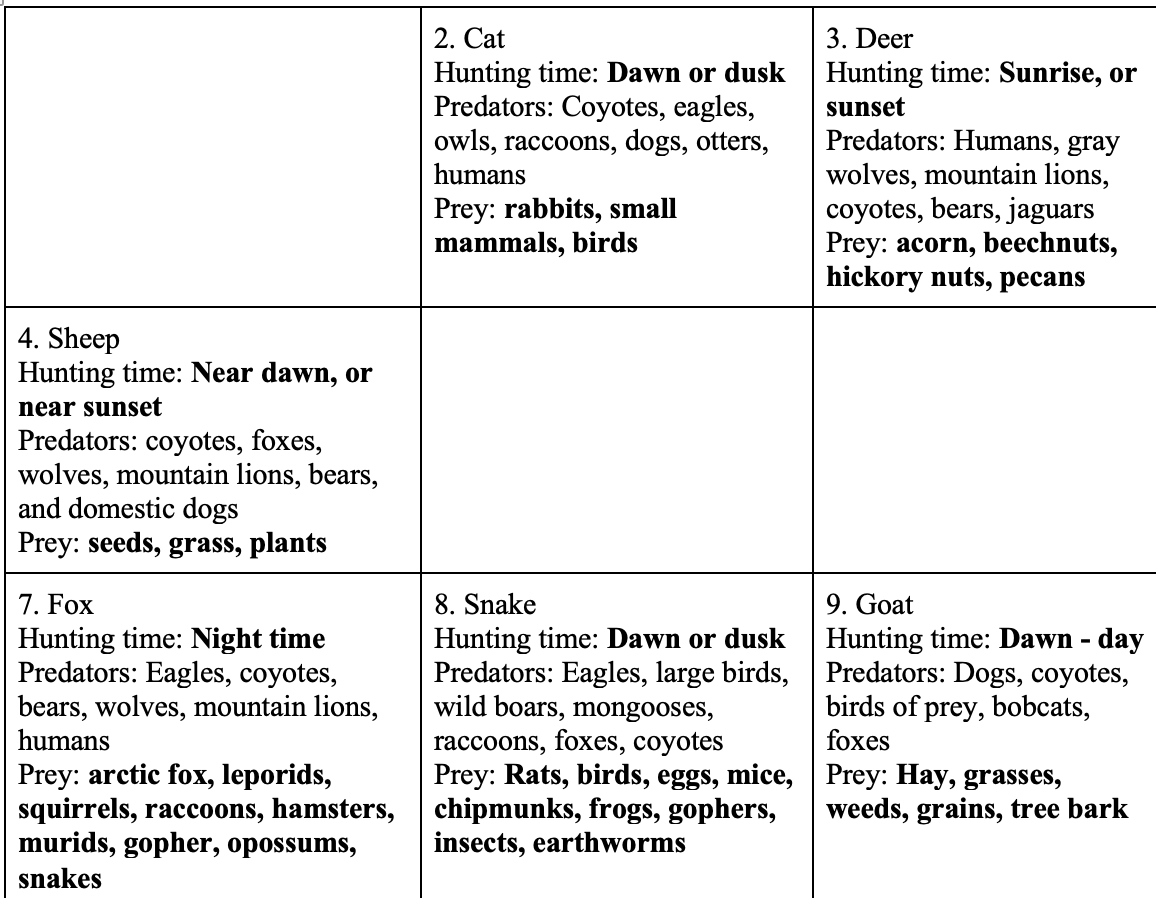
Based on the benefits of vertical pupil holes, and the sample student response to Tuesday's grouping activity...which of the following do you think have vertical pupil slits (keep in mind both the bolded sentences above) (SELECT 3)
Review of Tuesday's Animal Activity.
Most grazing or herbivorous animals have almost square or rectangular slit pupils, and are also normally the animals that are preyed upon. They mostly have laterally placed eyes (on the sides of their head), which gives them panoramic vision. These rectangular pupils, along with the lateral placement of their eyes, gives these animals about a 320- to 340-degree field of vision, as compared to cats, who can only see about 200 degrees around, and humans, who can only see in a 180-degree field.

Based on the benefits of horizontal pupil holes, and the sample student response to Tuesday's grouping activity...which of the following do you think have horizontal pupil slit? (SELECT 3)