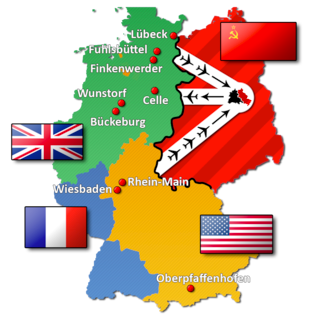
The Berlin Airlift marked the first major confrontation in the Cold War. For 11 months,
beginning in June 1948, the Western allies took part in an unprecedented attempt to keep a city
alive -- entirely from the air.
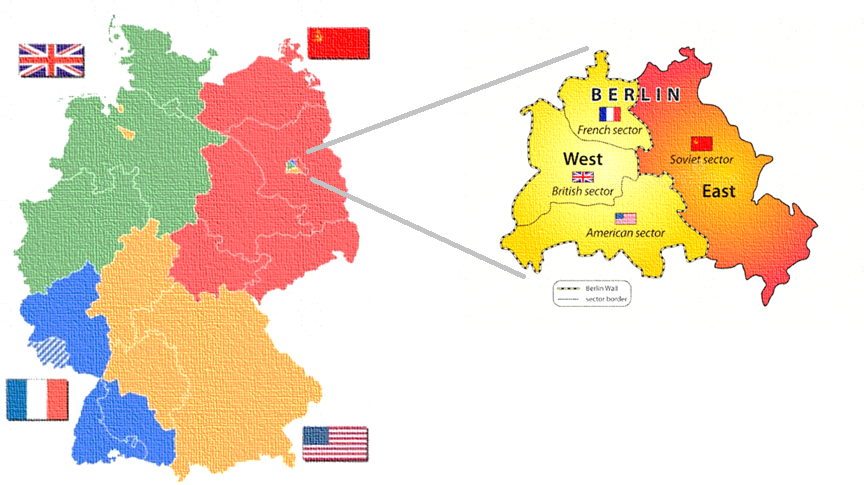
Following World War II, Germany is divided into four zones of occupation -- Soviet,
British, French and American. Germany, and Berlin in particular, are the only places where
communist and capitalist forces come into direct contact.
In June 1948, an announcement by the Western Allies brings a crisis to Berlin. They
establish a currency reform meant to wipe out the German black market and further tie the
vulnerable German economy to the West. The Soviets are not told and are infuriated by the
action.
On Thursday, June 24, 1948, West Berlin wakes to find itself under a Soviet blockade --
and in the midst of the first major confrontation of the Cold War. The Western Allies impose a
counter-blockade on the Soviet zone. The Soviets hope to starve the West out of Berlin.
In West Berlin, the airlift brings people sustenance and hope. In one memorable instance,
the airlift rains candy on West Berlin's desperate children. As it became evident that the Soviets
are not going to back down from their blockade, the Western Allies considered how to expand
their airlift operations. Larger cargo planes were brought in, as well as bombers with cargo
capacity
The Soviet Union ended its blockade of Berlin on May 12, 1949. A month earlier, at the
airlift's peak, Western cargo planes were landing at one of Berlin's three airports at a rate of one
every 62 seconds. By the time the airlift ended, more than 275,000 flights had carried 2.3 million
tons of supplies to Berlin -- an effort that went down in history as an aviation and logistical feat.