Cold War: Sputnik
Inquiry activity on Sputnik for the Cold War Unit 10
Sputnik
In August 1949, the United States finds itself shocked to discover the Soviet Union has broken Washington's atomic monopoly. The new Soviet bomb was developed quickly, thanks to the acquisition of U.S. atomic secrets by Soviet agents. The bomb also signals the start of the nuclear arms race between the Cold War rivals. By 1952, the United States develops and tests the first hydrogen bomb. The Soviets match that milestone several years later. Meanwhile, American children watch as bomb shelters are dug in their backyards and learn in school to "duck and cover" should nuclear bombs fall in their neighborhoods.
In 1952, Dwight Eisenhower was elected to succeed Harry Truman as U.S. president. Less than a year later, Soviet dictator Joseph Stalin was dead, starting a power struggle among the Kremlin leadership. In 1955, Eisenhower met with a Soviet delegation in Geneva and proposed an "Open Skies" policy -- giving both sides the freedom to fly over each other's territory and observe for themselves military developments on the ground. Nikita Khrushchev, then emerging as top Soviet leader, announced his delegation's refusal.
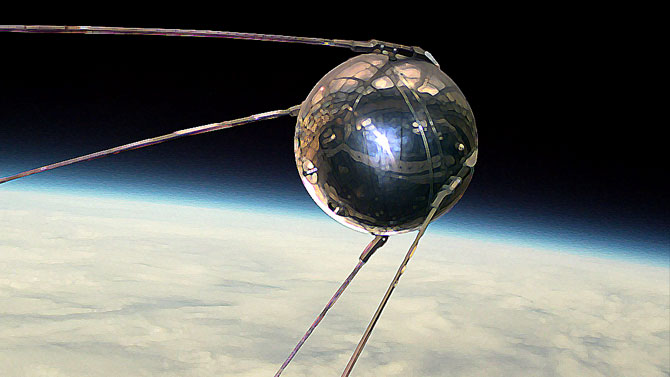
Soviet engineers, meanwhile, had been busy developing missile technology. They tested the world's first intercontinental ballistic missile in May 1957. And on October 4 of that year they surprised the world by launching Sputnik -- the world's first satellite.
Sputnik came as a shock to the West and especially the United States, which realized the Soviets now had the ability to send not only satellites around the world, but nuclear weapons as well. The U.S. military tried to push forward with its own satellite, called Vanguard, but the first attempt to launch Vanguard was a spectacular failure. Eventually, with the help of German scientist Werner von Braun, the Explorer satellite was fired into space on top of a military Redstone missile.
In 1959, Khrushchev became the first Soviet leader to visit the United States. While he and Eisenhower spent part of the visit discussing ways to slow the arms race, Khrushchev's visit is best remembered for his ideological sparring with then-U.S. Vice President Richard Nixon.