Cold War: Berlin Airlift
star
star
star
star
star
Last updated over 3 years ago
5 questions
Note from the author:
Inquiry activity covering the Berlin Airlift for the Cold War unit 10
The Berlin Airlift marked the first major confrontation in the Cold War. For 11 months,
beginning in June 1948, the Western allies took part in an unprecedented attempt to keep a city
alive -- entirely from the air.
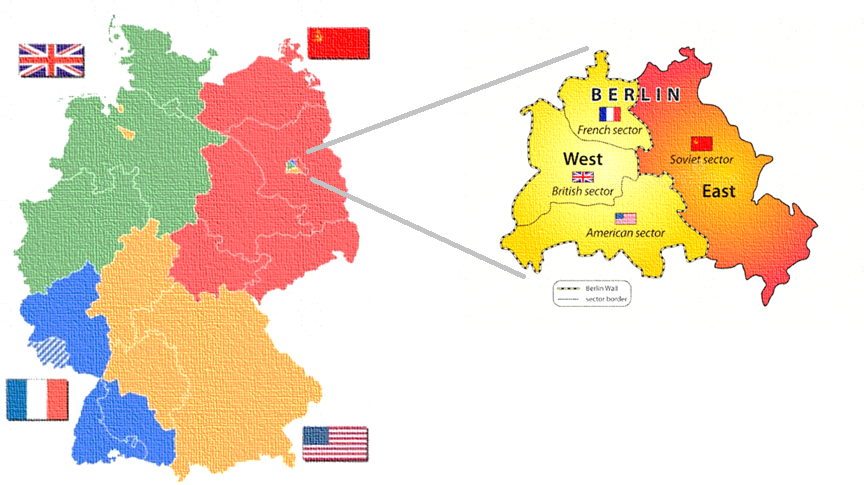
Following World War II, Germany is divided into four zones of occupation -- Soviet,
British, French and American. Germany, and Berlin in particular, are the only places where
communist and capitalist forces come into direct contact.
In June 1948, an announcement by the Western Allies brings a crisis to Berlin. They
establish a currency reform meant to wipe out the German black market and further tie the
vulnerable German economy to the West. The Soviets are not told and are infuriated by the
action.
On Thursday, June 24, 1948, West Berlin wakes to find itself under a Soviet blockade --
and in the midst of the first major confrontation of the Cold War. The Western Allies impose a
counter-blockade on the Soviet zone. The Soviets hope to starve the West out of Berlin.
In West Berlin, the airlift brings people sustenance and hope. In one memorable instance,
the airlift rains candy on West Berlin's desperate children. As it became evident that the Soviets
are not going to back down from their blockade, the Western Allies considered how to expand
their airlift operations. Larger cargo planes were brought in, as well as bombers with cargo
capacity
The Soviet Union ended its blockade of Berlin on May 12, 1949. A month earlier, at the
airlift's peak, Western cargo planes were landing at one of Berlin's three airports at a rate of one
every 62 seconds. By the time the airlift ended, more than 275,000 flights had carried 2.3 million
tons of supplies to Berlin -- an effort that went down in history as an aviation and logistical feat.
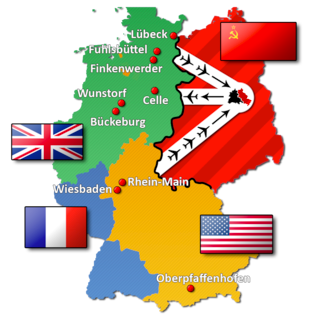
Examine these visual sources and map of the Airlift.
1) Beginning June 18, 1948, Soviet guards began stopping and searching all passenger and supply trains, traffic and freight shipments that were required to cross through the Soviet occupation zone of Germany. This included Berlin, which was entirely within the Soviet occupation zone.
2) On June 24th, 1948, Soviets severed land and water connections between the non-Soviet zones and Berlin. They also halted all rail and barge traffic into and out of Berlin.
3) Although ground routes to Berlin were never negotiated after the war, the Allied Powers did negotiate free access through 3 air corridors to Berlin.
4) To combat the Soviet blockade, the United States devised a plan to fly cargo aircraft through the 3 air corridors to supply Berlin's non-Soviet sector of over 2 million people with food and supplies. And because only cargo aircraft were used, the Soviet Union couldn't attack them as a military threat.
5) An air supply was no small task. Over 1,500 tons of daily supplies would need to be flown in to keep the city fed. In addition, over 3,400 tons of coal and gasoline were needed to keep the city powered. In total, over 5,000 tons of supplies needed to be hauled each day.
6) The US and Great Britain didn't have nearly the air power to ship the 5,000 tons per day initially. But they started anyway, and on June 26th, 1948, they sent 80 tons of food and supplies to Berlin. 32 C-47s were used for the shipment.
7) Because so many airplanes were flying into Berlin, a schedule was developed for aircraft to take off every 4 minutes, and fly 1,000 feet higher than the flight before it. This pattern was repeated 5 times, across three 8-hour shifts.
8) By July 1st, 1948, an average of 1,000 tons of supplies were being shipped each day.
9) At the end of July, Major General William H. Tunner, who had significant experience in airlift operations, took over the operation. Within a month, he had a fleet of C-47s and C-54s delivering more that 4,500 tons of cargo to Berlin every day.
10) On Easter Day, April 15th, 1949, Tunner held a competition among the airlift units to see who could haul the most coal in a 24 hour period. In 1 day, nearly 13,000 tons of coal were delivered to Berlin. And only 1 week later, more food and supplies were being flown into the city each day than were previously being delivered by rail.
11) Because it was clear that the airlift was working, the Soviets lifted the blockade on May 12, 1949. Rail supplies began the same day. However, air supplies continued through September 30th, 1949, to ensure a surplus.
12) The airlift lasted for 15 months, with a total of over 2.3 million tons of supplies delivered to Berlin by air.
13) At the height of the airlift, a plane reached West Berlin every 30 seconds.
14) C-47s and C-54s flew a combined 92 million miles during the airlift - nearly the distance from the Earth to the Sun. It was an incredible feat that prevented Berlin from falling under communist rule - and possibly all of Germany.
1 point
1
Question 1
1.
What are your observations about the pictures?
Watch this short video (17:06)
Visual Sources: Political Cartoons
Look at Cartoon A and Cartoon B.
Answer the following questions. Be sure to address BOTH cartoons.
1 point
1
Question 2
2.
What is the artist's purpose in these two cartoons?
1 point
1
Question 3
3.
What do you think the artists thought about the Berlin Airlift in these cartoons?
1 point
1
Question 4
4.
Do you think that this feeling is similar to the opinion of the rest of America? Why or why not?
1 point
1
Question 5
5.
Which cartoon do you think is more accurate? Why?