Gr. 8- Light & Optics Section 4.0 Quiz
star
star
star
star
star
Last updated 5 months ago
15 Nsɛmmisa
Ɛhia
1
Ɛhia
1
Ɛhia
1
Ɛhia
1
Ɛhia
1
Ɛhia
1
Ɛhia
1
Ɛhia
1

Ɛhia
1
Ɛhia
1
Ɛhia
1
Ɛhia
1
Ɛhia
1
Ɛhia
1
Ɛhia
4
The eye and the camera can be thought of as image-producing technologies. One (the eye) is a natural technology, while the other (the camera) is a ...
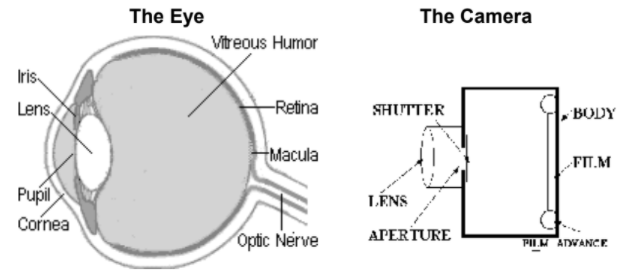
When comparing the eye and the camera, different parts have similar functions. The hole in the human eye that lets light in is called the pupil, whereas the hole that lets light in the camera is called the...
The retina in the eye has a thin layer of light-sensitive cells. These cells are called
photoreceptors. There are two kinds of photoreceptor cells. The types that detect color are the...
Surgeons use laser surgery to correct vision problems. The doctor will use a laser to reshape this part of the eye. Is this part of the eye...
Night vision goggles or scopes are used to see images in the dark. When light particles hit them, these things glow green, forming a green image on the screen. Are these things called...
The human eye and most other vertebrates have eyes that can be compared to cameras. They are called camera eyes. Fish also have camera eyes, but instead of an oval-shaped lens, they have a...
Humans have 3 types of cones, each sensing a different wavelength of light. Birds tend to have much sharper vision than humans because they have...
Nocturnal animals, such as cats and owls, have huge pupils that allow them to collect as much light as possible. The thin layer inside their eyes, the tapetum lucidum, is to act as this inside their eye...
An ommatidium is a long tube-like structure with a lens on the outer surface, a focusing cone below it, and a light-sensitive cell below that. Insect eyes have ommatidia facing in almost all directions because their eyes tend to have a ...
One drawback of the compound eye is that it has difficulty focusing a single, coherent sharp image. This is because of its ...
Digital information is stored by a computer converting the information into ...
The process of creating a big picture out of smaller pictures is similar to the process of digital imaging. The small elements that make up a picture are called pixels. The more pixels that make up a picture, the higher the ...
CCD is a grid similar to a piece of graph paper. As light falls on a square of the grid, it creates a small amount of electricity in that square. This is then converted into digital information. CCD stands for ...
The most significant advantage to digital imaging is that the pictures don’t have to be...
The Eye and the Camera have a lot in common.
• They both have compound lenses - which are converging lenses refracting the light to a focal point on the light-sensitive layer to record an image.
To focus a camera, you move the lens backward or forward.
The eye is focused by the ciliary muscle, which stretches the lens,
changing its shape.
• To control how much light gets in.
The iris in your eye changes the size of the pupil - the dark spot in the
center of your eye, which controls the amount of light that enters.
Cameras adjust to let different amounts of light in by using the aperture and
the shutter controls how long the light is allowed to get through.
• The retina is like the film in a camera, covering the back of the eye
Match the function with the correct part of the eye & camera responsible for the function.
| Draggable item | arrow_right_alt | Corresponding Item |
|---|---|---|
Regulates the amount of light coming in | arrow_right_alt | pupil, aperture |
Focuses the refracted light. | arrow_right_alt | iris, shutter |
Light-sensitive layer that records images. | arrow_right_alt | lens, lens |
The Opening for Light | arrow_right_alt | retina, film |