Log in
Sign up for FREE
arrow_back
Library
APUSH Period 7.1 (Ch. 30-31) Quiz - SY2021
By Haiyen Truong
star
star
star
star
star
Share
share
Last updated over 1 year ago
11 questions
Add this activity
1
1
1
1
KC 5.2.I
NAT 4.0
1
1
1
1
1
1
0
Question 1
1.
Review:
In the 1840s, the view that God had ordained the growth of an American nation stretching across North America was called
included no expectation that planter aristocrats had any obligation to serve the public as
Divine Mandate.
continentalism.
isolationism.
Manifest Destiny.
Chapter 30:
American Life During the “Roaring 20s” (1920-1929)
Question 2
2.
A significant cloud that hung over the prosperity of the 1920s was the
technical problems in the production of radio and films.
large accumulation of consumer debt.
growing strength of labor unions.
heavy load of taxation on the middle class.
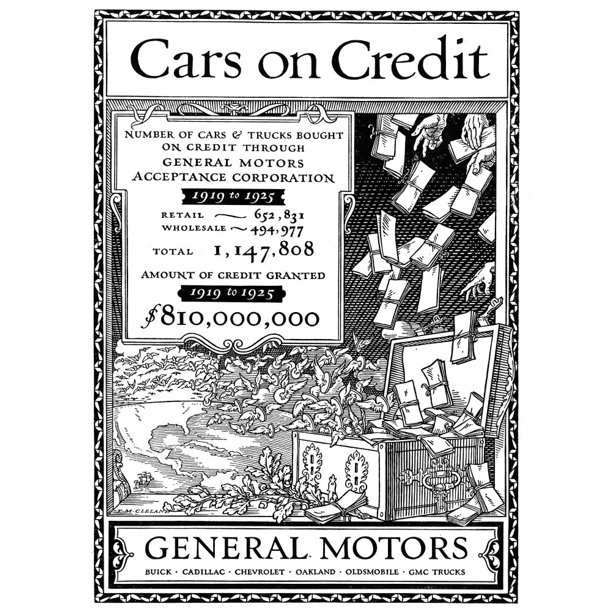
Questions #3-4 refer to the following image.
Question 3
3.
Which of the following trends of the 1920s is most clearly portrayed in this advertisement?
The use of extended payment plans to purchase consumer goods.
The growth of middle class incomes.
The emergence of General Motors as the largest company.
The expansion of auto dealers throughout the country.
Question 4
4.
Many historians criticize the economy that developed during the 1920s. Which of the following statements best supports that point of view?
Consumerism weakened the moral character of the nation.
The boom was based on speculation and borrowed money.
The growth of the auto industry badly hurt the railroads.
Advertising was based on gaining status and popularity.
Question #5 are unrelated to the previous excerpt.
Question 5
5.
Which of the following was
NOT
a prominent African American figure during the Harlem Renaissance?
Louis Armstrong
Zora Neale Hurston
Ralph Ellison
Langston Hughes
Chapter 31: The Politics of Boom and Bust (1920-1929)
Question 6
6.
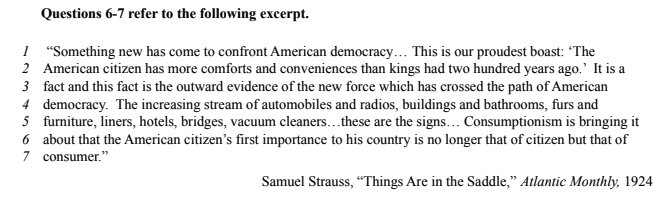
Which of the following economic developments most directly contributed to the situation described in the passage?
The expansion of the nation’s resource base
The development of new manufacturing techniques
The success of Progressive reforms
The decline of large corporations
Question 7
7.
The rise of the society described in the passage occurred amidst a general
reduction of business profits.
expansion of civil rights.
rise in the standard of living.
decline in social conflict.
Questions #8-10 are unrelated to the previous excerpt.
Question 8
8.
The Dawes Plan temporarily solved the financial tangle of the mid-1920s
allowing U.S. investors to loan money to Germany so it could pay war reparations to the Allies, who could then repay the United States.
accepting British bases in America in lieu of loan repayment.
permitting British and French gold reserves in Switzerland to serve as guarantees for eventual repayment.
persuading France and Britain to reduce Germany's war reparations.
Question 9
9.
Which of the following groups faced the most difficult economic conditions during the 1920s?
Assembly line workers in factories.
Farmers and many rural areas.
Businesses that did not accept credit cards.
Non-unionized workers in older industries.
Question 10
10.
In the United States, the onset of the Great Depression in 1930 caused
an increase of foreign investment because prices for American goods were so low.
Wall Street to accept the need for federal regulation of financial markets and business practices.
American people to blame, at first, the economic system rather than their own personal failings.
a decade-long decline in the birthrate as people did not have children during economic challenges.
Question 11
11.
Halfway through Period 7 (1890-1945)! How are you feeling? Any feedback, questions or concerns about this unit?
visibility
View drawing