Log in
Sign up for FREE
arrow_back
Library
APUSH Period 7.2 (Ch. 32-33) Quiz - SY2021
By Haiyen Truong
star
star
star
star
star
Share
share
Last updated over 1 year ago
11 questions
Add this activity
1
IICI.01
1
IICI.01
1
IIUR.01
1
1
1
IIUR.01
1
1
1
1
0
Question 1
1.
Review:
With the Mexico cession in 185, the South grew increasingly worried about the future of slavery because
the Supreme Court might issue rulings against slavery.
the admission of California might permanently tip the political balance against them.
it was unsuited to the "rugged individualism" of the Western frontier.
popular sovereignty would almost certainly prevent the spread of slavery.
Chapter 32:
The Great Depression and the New Deal (1933-1939)
Question 2
2.
Franklin Roosevelt’s New Deal was most notable for
attacking the American capitalist system.
undermining state and local governments.
providing moderate socioeconomic reforms and relief to address the Great Depression.
undoubtedly ending the Great Depression.
Question 3
3.
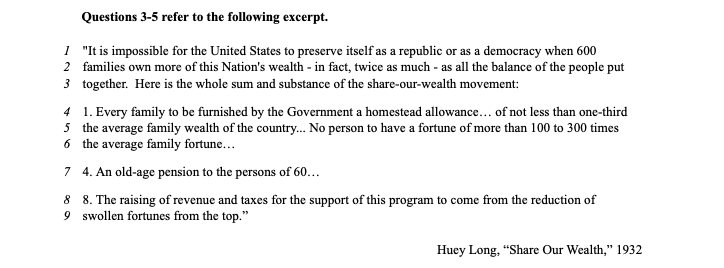
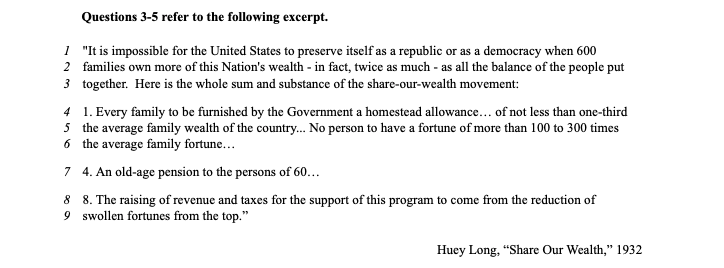
Which of the following events prompted the reforms called for in this passage by Huey Long?
The rise of segregation
The Great Depression
The Gilded Age
The Red Scare
Question 4
4.
Calls for reform such as the one in the passage would lead to
calls for federal regulation of the environment.
conflict between urban and rural interests.
the expansion of New Deal reforms.
official restrictions on freedom of speech.
Question 5
5.
Statements such as this one reflected the concerns of some Americans that
the federal government’s reform efforts were not extensive enough to address the crisis.
the Democratic Party had gone too far to advance the interests of the working class.
the financial regulatory system needed to be strengthened significantly.
corporations had too much power in national politic
Chapter 33:
Franklin D. Roosevelt and the Shadow of War (1933-1941)
Question 6
6.
America’s fervent isolationism in the 1930s can best be attributed to
failure to recognize the gravity of the militaristic and expansionist threat posed by the Fascist dictators of Germany, Japan, and Italy.
All of the answers are correct.
their regrets about participating in WWI.
the totalizing impact of the Great Depression and the need to focus on getting out of it.
Question 7
7.
Franklin Roosevelt declared that he would run for a third term in 1940 because
America needed his experienced leadership during the international crisis.
he believed that the two-term tradition limited democratic choice.
he had a close personal friendship with British prime minister Winston Churchill.
there were no qualified Democratic candidates.
Question 8
8.
In sharp contrast to WWI,
during
WWII, Americans were
nearly unanimous in support of the war.
nationalize major industries.
weakened by constant isolationist criticism of the war effort.
ready to use conscription, if necessary, to raise an army.
Question 9
9.
The popularity of the message delivered by Huey Long reveals that many Americans believed the government’s first responsibility was to protect
the free market.
the Constitutional limitations of government power.
the financial security of the people.
the equal rights of African-Americans.
Question 10
10.
Calls for reform such as the one in the passage would lead to
calls for federal regulation of the environment.
conflict between urban and rural interests.
the expansion of New Deal reforms.
official restrictions on freedom of speech.
Question 11
11.
Aside from Chapter 34, that's it Period 7 (1890-1945)!
How are you feeling about the APUSH exam next Thursday? Any feedback, questions or concerns about this unit?
visibility
View drawing