Cold War: U-2 Spy Plane Incident
Inquiry activity on the U-2 Incident for the Cold War Unit 10
U-2 Spy Plane Incident
President Eisenhower was concerned about how big the "missile gap" was between the United States and Soviet Union. U.S. reconnaissance planes, designated U-2s, secretly flew over the U.S.S.R., looking for evidence of missiles. On one such mission, a U-2 was shot down by the Soviet military.
Despite public U.S. denials, the Soviets presented as evidence the plane's wreckage -- as well as its pilot, Francis Gary Powers, who had survived the shoot-down. The U-2 incident undermined a Paris summit several weeks later between Khrushchev and Eisenhower. Powers was sentenced to prison but was later exchanged for a Soviet spy.
Khrushchev feared the American U-2 flights had exposed his claims of missile superiority as a bluff. At the Baikonur Cosmodrome, engineers under the command of Marshal Nedelin were ordered to create a new missile. During the rush to production, a fire erupted -- killing nearly 200 people. While the Soviets were behind in the missile race, they still had one card to play: Yuri Gagarin. On April 12, 1961, Gagarin achieved international acclaim when he became the first human to be launched into space.
Give THREE reasons for your decision in the previous question.
Give THREE reasons for your decision in the previous question.
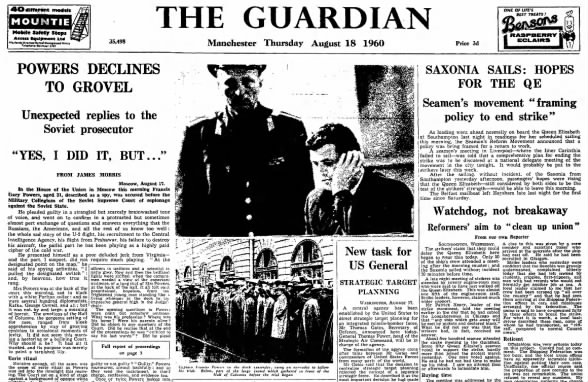
Khrushchev's Actual Response
•Francis Gary Powers went on public trial August 17, 1960, on charges of espionage. Powers pleaded guilty, confessing to "a grave crime," and was sentenced to prison for 10 years.
•The trial was embarrassing for Washington, but probably less of a propaganda coup than Moscow had hoped. In the West, it was usually portrayed as a show trial.
•Powers was released to the United States in 1962 in exchange for the Soviet spy Rudolf Abel.
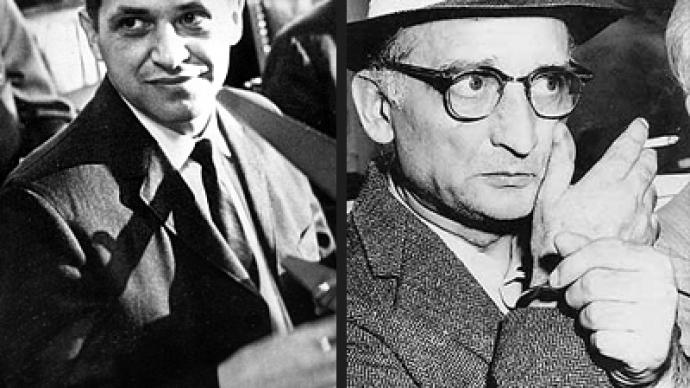
(l to r) Powers, Abel