Given the graph below, which equation would BEST match the graph?
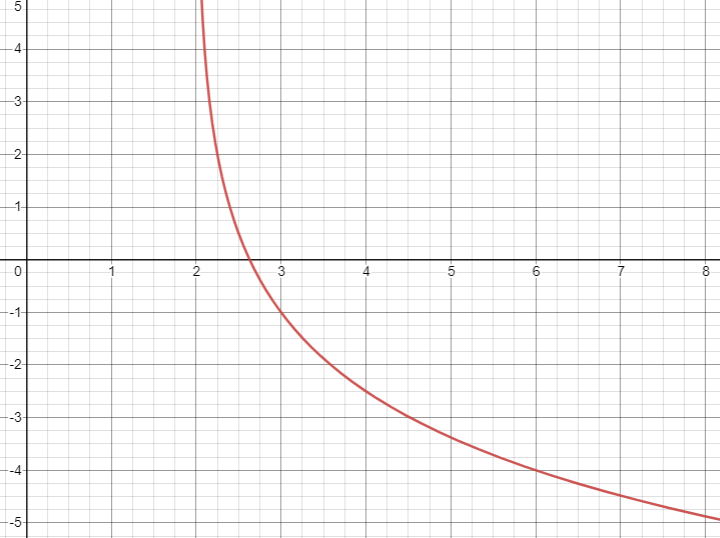
Given the graph below, which equation would BEST match the graph?
Evaluate:
Solve. Make sure to check for any extraneous solutions. You should type the EXACT answer. A ROUNDED ANSWER WILL BE GRADED AS INCORRECT!!! You must show ALL work to receive full credit!
Identify the domain and range of the function.
Given the graph below, which equation would BEST match the graph?
Write the following log equation as an exponential equation. Click on the BLACK KEYBOARD to write in math type.
Write the following exponential equation as a log equation. Click on the BLACK KEYBOARD to write in math type.
Match each expanded logarithmic expression to the CORRECT condensed logarithmic expression.
| Draggable item | arrow_right_alt | Corresponding Item |
|---|---|---|
| arrow_right_alt | ||
| arrow_right_alt | ||
| arrow_right_alt |
Solve the following equation. You must show ALL work to receive full credit! You should type the EXACT answer. A ROUNDED ANSWER WILL BE GRADED AS INCORRECT!!! (An EXACT answer will HAVE a logarithm in the answer!)
Solve the following equation. You must show ALL work to receive full credit! You should type the EXACT answer. A ROUNDED ANSWER WILL BE GRADED AS INCORRECT!!! (An EXACT answer will HAVE a logarithm in the answer!)
Solve the following equation. You must show ALL work to receive full credit! You should type the EXACT answer. A ROUNDED ANSWER WILL BE GRADED AS INCORRECT!!! (An EXACT answer will HAVE a logarithm in the answer!)
Solve the following equation. You must show ALL work to receive full credit!
Solve the following equation. You must show ALL work to receive full credit!
Solve the following equation. You must show ALL work to receive full credit!
Solve the following equation. You must show ALL work to receive full credit! You should type the EXACT answer. A ROUNDED ANSWER WILL BE GRADED AS INCORRECT!!! (An EXACT answer will HAVE a logarithm in the answer!)
Condense the following to a single logarithm.
Expand the logarithm.
For the given function, GRAPH and complete the indicated features.
Which of the following graphs would BEST represent the function?
You receive $1,000 from your parents for graduation. You were very lucky and found a bank with an interest rate of 4% compounded CONTINUOUSLY. If you keep the money in the bank for 10 years, how much money will you have?
To calculate, use the the formula
where A = future amount, P = principal invested, e = constant of e (2nd ln on calculator), r = rate as a decimal, and t = time.
You receive $3,000 from your parents for graduation. You were very lucky and found a bank with an interest rate of 6.5% compounded CONTINUOUSLY. If you want to keep the money in the bank until you have $10,000, how many years (to the nearest year) will you need to keep the money in the bank?
To calculate, use the the formula
where A = future amount, P = principal invested, e = constant of e (2nd ln on calculator), r = rate as a decimal, and t = time.
You must show all your work to receive full credit!
