Log in
Sign up for FREE
arrow_back
Library

Unit 7 Nationalism and Imperialism Test Honors Test

star
star
star
star
star
Last updated about 5 years ago
22 questions
1
MWH.3.CO
1
MWH.3.CO
1
MWH.4.CO
1
MWH.3.CO
MWH.3.E
1
MWH.3.E
MWH.4.CO
1
MWH.3.E
MWH.4.CO
1
MWH.3.CO
1
MWH.4.CO
1
MWH.4.CO
1
MWH.4.CO
1
MWH.4.CO
1
MWH.4.CO
1
MWH.3.CO
MWH.4.CO
3
MWH.3.CO
1
MWH.3.CO
1
MWH.4.CO
3
MWH.3.CO
1
MWH.4.CO
MWH.4.E
1
MWH.4.CO
MWH.4.E
1
MWH.4.CO
MWH.4.E
10
10
Question 1
1.

Question 2
2.

Question 3
3.

Question 4
4.

Question 5
5.

Question 6
6.

Question 7
7.

Question 8
8.

Question 9
9.

Question 10
10.

Question 11
11.

Question 12
12.

Question 13
13.

Question 14
14.
Draggable itemarrow_right_altCorresponding Item
arrow_right_alt
arrow_right_alt
arrow_right_alt
Question 15
15.

Question 16
16.

Question 17
17.

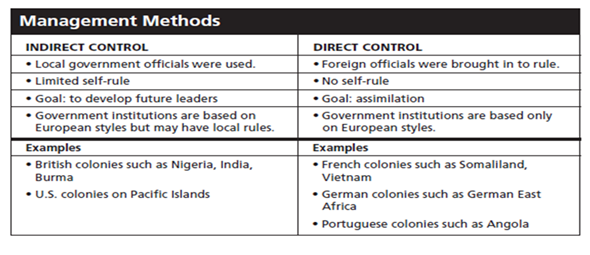
Use the chart for questions 18-20.

Question 18
18.

Question 19
19.

Question 20
20.

Question 21
21.

China and Japan both ended their isolation from European countries in the late 1800s. Why did the Japanese empire grow, while China's empire collapsed going into the early 1900s? Support your answer with at least 3 historical examples.

Question 22
22.

Is nationalism a constructive (positive) or destructive ideology? Explain your answer using at least 3 historical examples.

Which of the following was the primary reason the United States advocated the Open Door Policy?
Protecting and broadening US trade with China
Expanding the concept of the Monroe Doctrine to Asia
Justifying the taking of the Philippines as a US colony
Justifying the extension of American colonies into the Far East
As the European powers grew more industrialized, their colonies became very important as sources of which of the following?
New inventions
Military prestige
Slave labor
Raw materials
Which of these factors was not a major reason for Japan’s expansion of its empire in the late-19th and early-20th centuries?
The need to create a defensive buffer from China and Russia
The need for a stable source of raw materials
Direct competition with the United States for control of the region
A sense of ethnic and national superiority over countries in the region
Which best explains the historical context behind the political cartoon below?
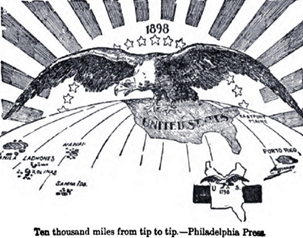
The competition between capitalistic and communistic ideologies led to United States expanding into new markets
New innovations and technology led to the spread of the industrialization to Latin America and Southeast Asia
The need for more markets and raw materials led the United States to become more imperialistic
The American revolution led to the spread of Enlightened ideas and independence movements in new regions of the world
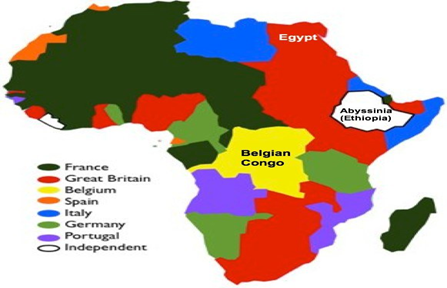
According to the map below, how do Egypt, Belgian Congo, and Ethiopia compare in their experiences with imperialism during the 19th century?

All three countries maintained their independence
The three countries were subject to imperialism by the same country
Two of the countries were subject to imperialism and one maintained its independence
The three countries were subject to imperialism by different countries
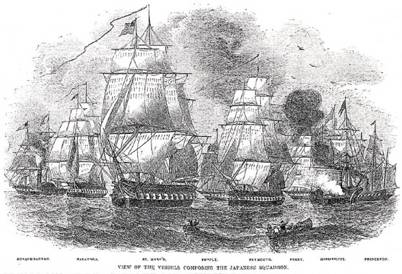
The sketch below represents the fleet of ships brought by Commodore Matthew Perry on his second trip to Japan in 1854. Based on the illustration, what was the most obvious goal of Perry’s visit?

The United States wanted to demonstrate military strength and, thus, hint at the consequences of refusing our requests
The United States wanted to bring samples and demonstrate as many of the products we had for sale as possible
The United States wanted to demonstrate that it was a peaceful, civilized, and nonthreatening nation
The United States wanted to learn from the Japanese industrial and educational systems
____ was Prussian Chancellor who used his influence to create a German confederation that excluded Austria.
Count Cavour
Otto von Bismarck
Wilhelm II
Giuseppe Garibaldi
The purpose of the Berlin Conference was to
Divide Africa amongst European nations.
Divide Eastern Europe between Germany and Russia.
Provide African nations a say in their division.
Address Germany’s aggression toward Poland.
An area in which a foreign nation controlled trade and investment is called_______.
a bureaucracy
a sphere of influence
a trade union
an enterprise zone
Why was India called the "jewel in the crown"?
The sepoys were a perfect model of successful imperialism.
It was the most valuable of all of Britain’s colonies.
It had a vast supply of diamonds, rubies, and sapphires.
The success of India’s self-sufficient economy strengthened Britain.
The term Raj is used to refer to the period of Indian history during which India was
loosely ruled by the British East India Company.
torn apart by civil war.
Ruled by the British government
independent.
The sepoys were
Indian soldiers.
Sikh civil servants.
Bengal Hindus.
Mughal princes.
One result of the Sepoy Mutiny was that
British officials became more sensitive to the needs of Indians.
the British government tightened its control over India.
the British East India Company went bankrupt.
the British stopped trying to convert Indians to Christianity.
China
Indian National Congress and Muslim League
Japan
Boxer Rebellion, Taiping Rebellion
India
Satsuma Rebellion
Which two wars were fought as part of Japanese imperialism in Korea?
Sino-Japanese War
Boer War
Russo Japanese War
Franco-Prussian War
How was the Belgian Congo different from other European colonies?
The people were able to overthrow the Europeans through unification.
It was the private property of King Leopold II.
People were allowed to rule themselves.
It was located in Japan.
Which of these are examples of nationalism? Select all that apply.
Believing that all countries are created equal and should have equal standing in the world.
Attacking other countries in order to prove your nation’s superiority.
The unification of Italy and the unification of Germany.
Making alliances with neighboring countries, even if they are of different ethnic groups.
Groups like the Basques wanting independence from Spain, or the Greeks from the Ottoman Empire
How did the German style of governing colonies compare to the U.S. style?
Both Germany and the United States preferred direct control.
Both Germany and the United States preferred indirect control.
Germany preferred direct control, whereas the United States preferred indirect control.
Germany preferred indirect control, whereas the United States preferred direct control.
How did indirect control compare to direct control?
Indirect control allowed limited self-rule.
Indirect control required more supervision from foreign countries.
Indirect control used the European styles of government exclusively.
Indirect control excluded local government officials.
What conclusion can be drawn from this chart?
Both management methods caused about the same loss of cultural identity.
Management methods would have no effect on cultural identity.
Indirect control probably caused more loss of cultural identity.
Direct control probably caused more loss of cultural identity.