Unit 9 Day 2 Probability Practice #2
star
star
star
star
star
Last updated about 5 years ago
18 Nsɛmmisa
4
4
4
4
4
4
6
4
6
6
6
4
4
4
4
4
4
4
Use the following information for problems #1-
How is the hatching of water python eggs influenced by the temperature of the snake's nest?
Researchers randomly assigned newly laid eggs to one of three water temperatures: hot, neutral, or cold.
Hot duplicates the extra warmth provided by the mother python, and cold duplicates the absence of the mother.
The results are shown in the two-way table below.
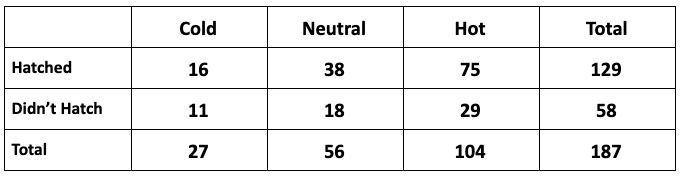
Suppose we select one of the eggs at random.
Define event C as cold water, event H= hot water, event N= neutral water, and events hatched or not hatched.
If we randomly select an egg, find P(hatched):
Hint: (you will use the marginal distribution)
Express your answer as a decimal rounded to three places after the decimal point.
Suppose we select one of the eggs at random.
Define event C as cold water, event H= hot water, event N= neutral water, and events hatched or not hatched.
If we randomly select an egg, find the probability that the egg hatched given that it was in cold temperature: P(hatched|Cold)=
Hint: (double check the total you will use)
Express your answer as a decimal rounded to three places after the decimal point.
Suppose we select one of the eggs at random.
Define event C as cold water, event H= hot water, event N= neutral water, and events hatched or not hatched.
If we randomly select an egg, find the probability that the egg hatched given that it was in neutral temperature: P(hatched|Neutral)=
Hint: (double check the total you will use)
Express your answer as a decimal rounded to three places after the decimal point.
Suppose we select one of the eggs at random.
Define event C as cold water, event H= hot water, event N= neutral water, and events hatched or not hatched.
Compare the probabilities in #1-3, are nest temperature and hatched status independent?
Check all that apply.
Suppose we select one of the eggs at random.
Define event C as cold water, event H= hot water, event N= neutral water, and events hatched or not hatched.
If an egg is randomly selected, find P(Cold or not hatched)=
Hint: (double check the total you will use)
Express your answer as a decimal rounded to three places after the decimal point.
Suppose we select one of the eggs at random.
Define event C as cold water, event H= hot water, event N= neutral water, and events hatched or not hatched.
If an egg is randomly selected, find P(not Hot|hatched)=
Hint: (double check the total you will use)
Express your answer as a decimal rounded to three places after the decimal point.
A recent census at a major university revealed that 60% of its students mainly used Macintosh computers (Macs) and 80% used PCs. In the census, 43% used both types of computers.
Fill in the Venn Diagram, using the % given.
I will grade this question, but you will use the information for the following questions.
Are using a Mac and/or a PC mutally exclusive?
How do you know?
Check all that apply.
A recent census at a major university revealed that 60% of its students mainly used Macintosh computers (Macs) and 80% used PCs. In the census, 43% used both types of computers.
What percent of the students used a Mac or a PC at the campus?
Enter your answer as a percent.
A recent census at a major university revealed that 60% of its students mainly used Macintosh computers (Macs) and 80% used PCs. In the census, 43% used both types of computers.
What percent of the students used a Mac but not a PC at the campus?
Enter your answer as a percent.
A recent census at a major university revealed that 60% of its students mainly used Macintosh computers (Macs) and 80% used PCs. In the census, 43% used both types of computers.
What percent of the students who used a Mac also used a PC at the campus?
(Given that the students used a Mac, what percent also used a PC?)
P(PC|Mac)=
It might be helfpul to sketch a 2-way table to answer the question.
Enter your answer as a percent that is rounded to one place past the decimal point or as a decimal.
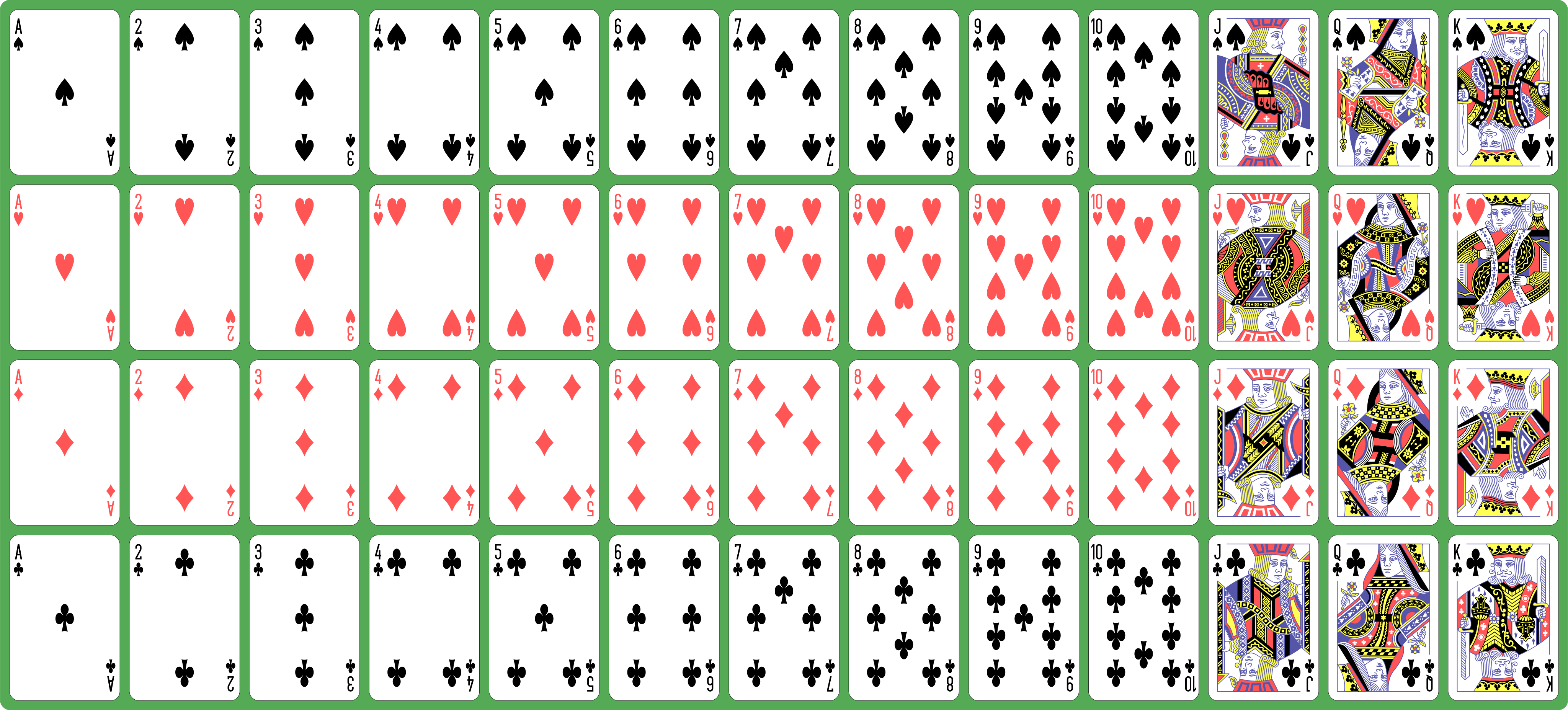
Use the picture of a deck of cards to help you answer the question:
You draw a card at random from a standard deck of 52 cards.
Find the conditional probability the card is a heart given that it is red.
P(heart|red)=
Express your answer as a decimal rounded to three places past the decimal point.
Use the picture of a deck of cards to help you answer the question:
You draw a card at random from a standard deck of 52 cards.
Find the conditional probability the card is an ace, given that it is red.
P(ace|red)=
Express your answer as a decimal rounded to three places past the decimal point.
Use the picture of a deck of cards to help you answer the question:
You draw a card at random from a standard deck of 52 cards.
Find the conditional probability the card is a queen, given that it is a face card.
P(Queen|face card)=
Express your answer as a decimal rounded to three places past the decimal point.
Use the picture of a standard deck of 52 cards to help you answer the question:
If you draw 2 cards from a well shuffled deck of 52 cards, what is the probability that they are both hearts?
Hint: they are drawn without replacement, remember to assume that you got what you wanted in the first card.
P(heart, heart)=P(heart)xP(heart|1st card is a heart)=
Express your answer as a decimal rounded to three places past the decimal point.
Use the picture of a standard deck of 52 cards to help you answer the question:
You are dealt a hand of three cards from a well shuffled deck of 52 cards, one at a time, no replacement.
What is the probability the first heart you get is the third card dealt?
Hint: they are drawn without replacement, remember to assume that you got what you wanted in the first card.
P(not red, not red, red)=P(not red)xP(not red|1st card is not red)xP(red|1st & 2nd cards were not red)=
Express your answer as a decimal rounded to three places past the decimal point.
Use the picture of a standard deck of 52 cards to help you answer the question:
You are dealt a hand of three cards from a well shuffled deck of 52 cards, one at a time, no replacement.
What is the probability the cards are all not spades?
Hint: they are drawn without replacement, remember to assume that you got what you wanted in the first card.
P(not spades, not spades, not spades)=P(not spades)xP(not spades|1st card is not spades)xP(not spades|1st & 2nd cards were not spades)=
Express your answer as a decimal rounded to three places past the decimal point.
Use the picture of a standard deck of 52 cards to help you answer the question:
You are dealt a hand of three cards from a well shuffled deck of 52 cards, one at a time, no replacement.
What is the probability you get at least one spade?
Hint: they are drawn without replacement, remember to assume that you got what you wanted in the first card.
P(at least one of three is a spades)= 1-P(not spades, not spades, not spades)
Express your answer as a decimal rounded to three places past the decimal point.