Carbon Cycle Gizmos Part A
star
star
star
star
star
Last updated over 5 years ago
15 Nsɛmmisa

1
1
1
1
1
1

1
1
1
1
1
1
1
1
1
How do plants on Earth affect the amount of carbon in Earth’s atmosphere?
Animals eat plants and produce carbon dioxide and water. How do animals affect the amount of carbon in Earth’s atmosphere?
The Carbon Cycle Gizmo allows you to follow the many paths an atom of carbon can take through Earth’s systems. To begin, notice the black carbon atom in the Atmospheric CO2 area, highlighted in yellow. The glowing blue areas represent possible locations the carbon atom could go next.
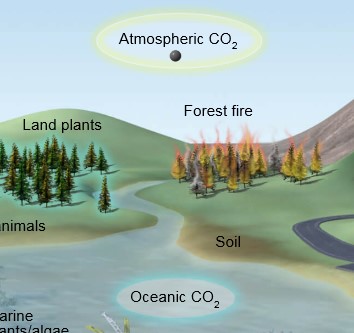
From Earth’s atmosphere, where can the carbon atom go next?
Click on Land plants and read the description. How did the carbon atom get from the atmosphere to a plant?
Select Land animals. How did the carbon atom get from land plants into the animal?
Select Atmospheric CO2. How did the carbon atom get from land animals back to the atmosphere?
Introduction: Earth can be divided into four systems. The atmosphereis the air above Earth’s surface. The hydrosphere is composed of all of Earth’s water. The geosphere is the rocky, non-living part of Earth. The biosphere consists of all living things, including people. Some scientists use the term “anthroposphere” to describe everything made or modified by humans.
Explore: Use the Gizmo to create a path for carbon that begins and ends in the atmosphere. Fill in the steps in the path below. Then, label each location with the system it represents. Finally, summarize very briefly how the carbon atom got to that location.
Create: Click Reset. Use the Gizmo to create a path in which the carbon atom goes from the atmosphere to the hydrosphere, biosphere and geosphere. Describe each transition briefly.
Explore: Use the Gizmo to create three more carbon paths, each starting and ending in the atmosphere. Label each location with A for atmosphere, B for biosphere, G for geosphere, or H for hydrosphere. (You can also use P for anthroposphere if you like, or just include it in the biosphere.)
Describe your path in questions 9-11
Path #1:
Path #2:
Path #3:
Describe at least two ways that carbon can get from a land plant to the atmosphere.
Describe at least two ways that carbon can get from the atmosphere to the hydrosphere.
Can you find two ways that carbon can get from the ocean to the lithosphere? (The lithosphere is the rigid layer of the Earth, including the crust and part of the mantle.)
Describe at least two ways that carbon can get from seashells to the atmosphere.