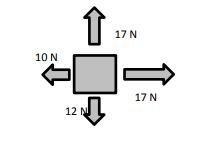
What is the horizontal net force on this object (do not include direction in your answer this time)?
What is the horizontal net force on this object (do not include direction in your answer this time)?
When forces are balanced, they
A combination of all the forces acting on an object is called
When the net force on an object is zero, the object's motion will
To find the net force on an object:
To find the net force on an object:
If you are pushing a box toward your friend with a force of 20 N, and your friend is pushing the box toward you with a force of 30 N, what will happen to the box?
If an object is moving forward with a constant velocity of 12m/s2, what kind of forces are acting on the object?
If an object is stationary, what kind of forces are acting on it?
What are the only kind of forces that can create acceleration?
What is the horizontal net force on this object (do not include direction in your answer this time)?
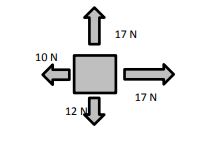
What is the net vertical force on this object (do not include direction in your answer this time)?
Draw the forces acting on the bag (include friction). The person is pulling the bag to the left. Make sure you label all the forces.
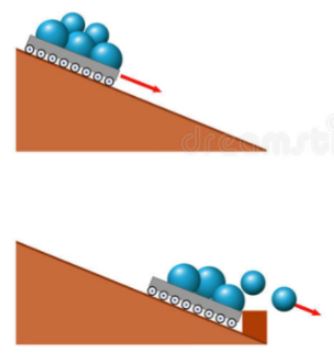
Please explain why the blue spheres fall out of the cart when the cart hits the block at the bottom of the ramp, using inertia and Newton's 1st law of motion (2pts)
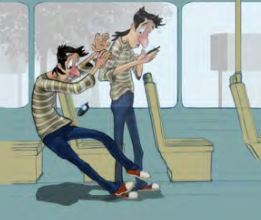
Why does this person fall backwards when the bus accelerates very quickly (use inertia and Newton's 1st law in your answer)?
For a given acceleration, the mass of an object is _________________ the force of that object.
For a given resultant force, the acceleration of an object is _________________ the mass of that object.
Calculate force on an object if acceleration is 10 metres per second squared and the mass of the object is 54 kilograms.
Calculate the mass of an object that experiences an acceleration of 25 metres per second squared from an applied force of 104 newtons, while experiencing a frictional force of 29 newtons.
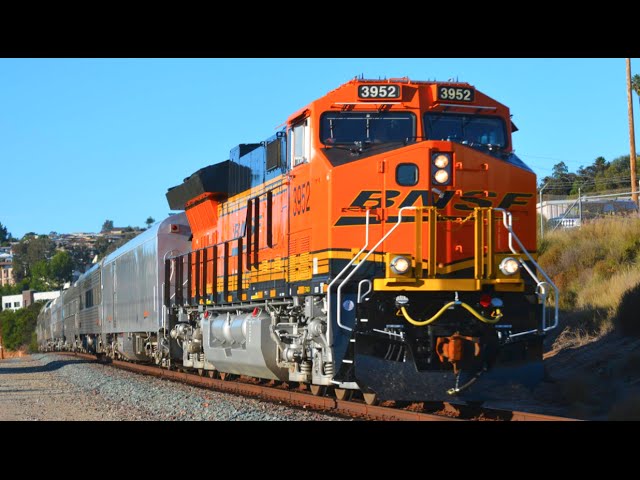
A train of mass 120,000 kg is moving with velocity of 10m/s and is acted upon by a forward force of 7000 N due to engine and frictional force of 750 N. What will be the velocity of the train after 1,000 seconds?
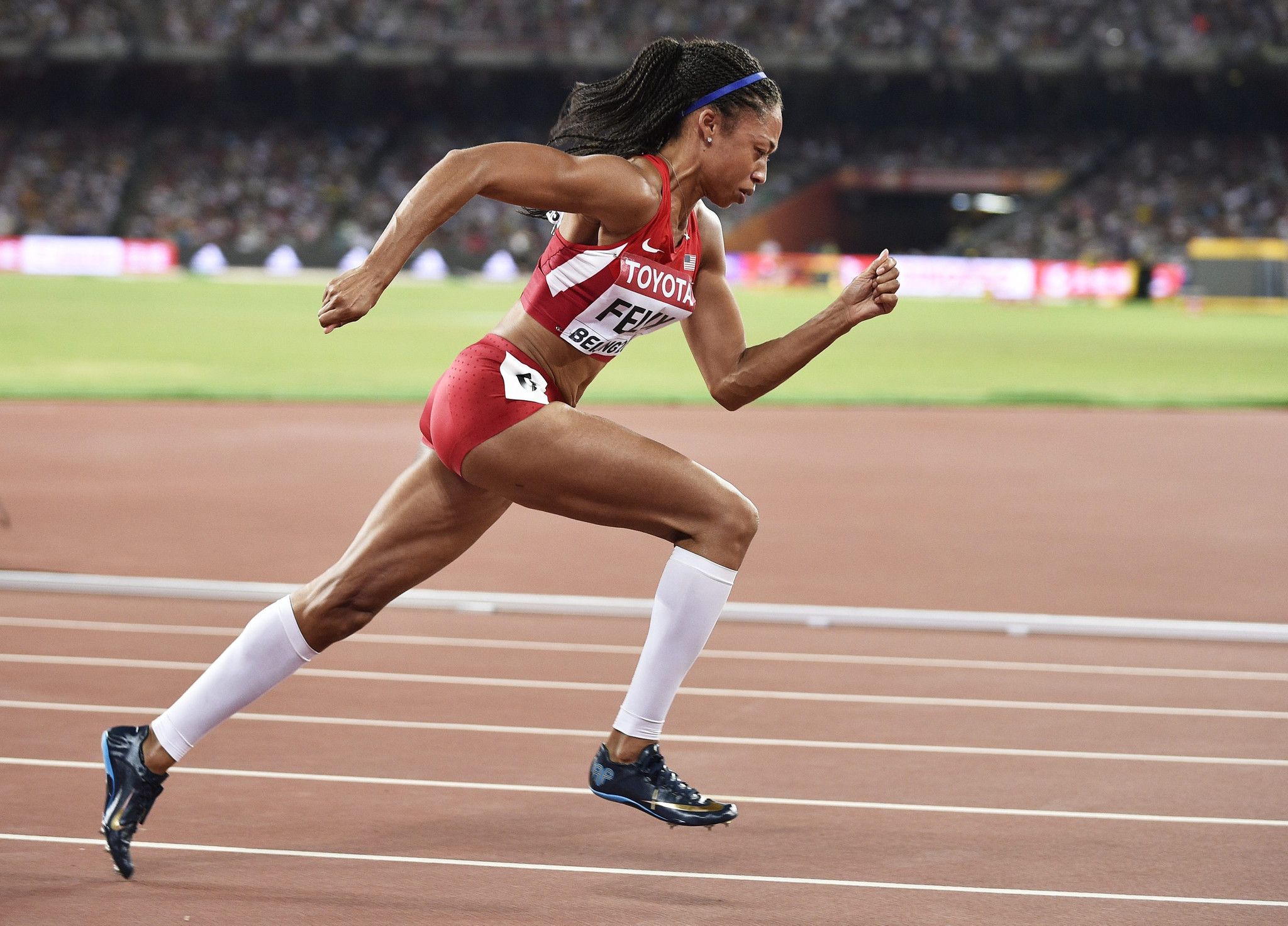
A 75 kg runner decides to take part in a local 5K race. If the runner has a frictional force of 5N between her shoes and the track, how much force must her legs produce to achieve an acceleration to run from 0 m/s to
4 m/s in only 1.6 s?
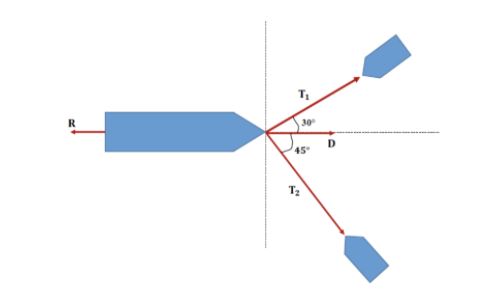
A supertanker, with a mass of 1,500,000 kg, is being towed by two tugboats as shown in the picture. The tentsion in the towing cables apply the forces of T1 = 282,842N at an angle of 30 degrees, and T2=200,000N at an angle of 45 degrees. In addition, the tanker's engine produce a forward force of D of 75,000N. The water also applies an opposing force with a magnitude of 40,000N. What is the supertanker's acceleration?
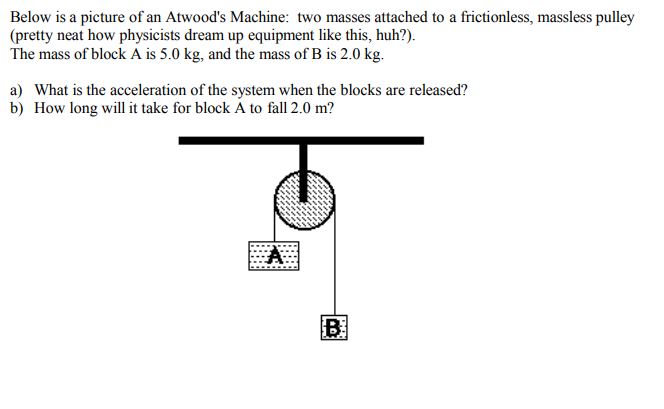
Only answer part A of this question.
When Ronda Rousey got kicked in the face, what was the interaction pair of forces according to Newton's 3rd law?

Newton's 3rd law says that for every action there is a(n) ______________ and ______________ reaction.
If you hit a wall with a stick with 250N of force how much force does the wall put on the stick?
Explain why when two objects collide one object moves faster than the other, and yet Newton's 3rd law says the forces on each object are the same.