Unit 9 Day 4 Probability Review Practice #4

Last updated over 4 years ago
22 questions
Enter all answers as a decimal probability. Where needed, round decimals to the thousandths place (three places past the decimal point).
4

Real Estate Ads suggest that 64% of homes for sale have garages, 21% have swimming pools, and 17% have both.
What is the probability that a home for sale has a pool or a garage?
P(pool or garage)=
Hint: what rule should you use?

4

Real Estate Ads suggest that 64% of homes for sale have garages, 21% have swimming pools, and 17% have both.
Are having a pool and having a garage mutually exclusive?
How do you know?
What does this mean concerning the Addition Rule.

4

Real Estate Ads suggest that 64% of homes for sale have garages, 21% have swimming pools, and 17% have both. On your own paper, create a Venn Diagram or 2-way table displaying the percentages of homes for sale that have pools and/or garages.
What's the probability that a home has neither a pool nor a garage?
P(no pool & no garage)=

4

Real Estate Ads suggest that 64% of homes for sale have garages, 21% have swimming pools, and 17% have both. Use your Venn Diagram or 2-way table that shows the percentages of homes for sale that have pools and/or garages.
What's the probability that a home has a pool but no garage?

4

Real Estate Ads suggest that 64% of homes for sale have garages, 21% have swimming pools, and 17% have both. Use your Venn Diagram or 2-way table that shows the percentages of homes for sale that have pools and/or garages.
If the home has a garage, what's the probability that it has a pool too? (this is a GIVEN situation)
P(pool|garage)=

4

Real Estate Ads suggest that 64% of homes for sale have garages, 21% have swimming pools, and 17% have both. Use your Venn Diagram or 2-way table that shows the percentages of homes for sale that have pools and/or garages.
If the home does not have a garage, what's the probability that it has a pool too? (this is a GIVEN situation)
P(pool|no garage)=

4

Real Estate Ads suggest that 64% of homes for sale have garages, 21% have swimming pools, and 17% have both. Using your answer #5 & 6, are having a pool and having a garage independent events for these homes? Explain using percents, whether the percents are similar or different and what this means about independence.

4

Suppose that 23% of adults smoke cigarettes.
It's known that 57% of smokers and 13% of nonsmokers develop a certain lung condition by age 60.
Create a Tree Diagram to illustrate the situation. Make sure to give ALL probabilities in decimal form, both along the tree branches and on the right side to show the probabilities of the entire sample space.

4

Suppose that 23% of adults smoke cigarettes.
It's known that 57% of smokers and 13% of nonsmokers develop a certain lung condition by age 60.
Use the Tree Diagram to answer the question:
What is the probability a randomly selected 60 year old does not smoke?
P(does not smoke)=

4

Suppose that 23% of adults smoke cigarettes.
It's known that 57% of smokers and 13% of nonsmokers develop a certain lung condition by age 60.
Use the Tree Diagram to answer the question.
What is the probability a randomly selected 60 year old is a smoker and does not have this lung condition?

4

Suppose that 23% of adults smoke cigarettes.
It's known that 57% of smokers and 13% of nonsmokers develop a certain lung condition by age 60.
Use the tree diagram to answer this question:
What is the probability a randomly selected 60 year old is not a smoker and has not developed this lung condition?
P(not smoker & no lung condition):

4

Suppose that 23% of adults smoke cigarettes.
It's known that 57% of smokers and 13% of nonsmokers develop a certain lung condition by age 60.
Use the tree diagram to answer the question:
What is the probability a randomly selected 60 year old has this lung condition?
P(lung condition):
Hint: look at your tree diagrm carefully, there are two ways this can occur.

4

A 2009 poll conducted by Gallup classified respondents by sex and political party, as shown in the table.
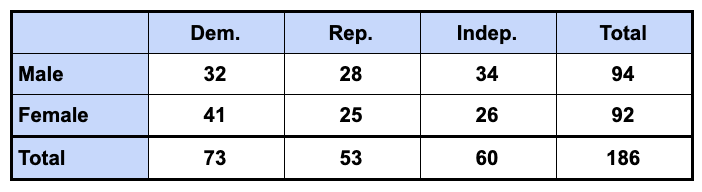

Are party affiliation and the respondent's sex mutually exclusive?
Explain clearly using specific information.

4

A 2009 poll conducted by Gallup classified respondents by sex and political party, as shown in the table.


What is the probability that a randomly chosen voter is a female Republican?
Give your answer set up as a fraction and your answer as a decimal.
Use the format:
It will automatically create the fraction for you using the / key.
No spaces.

4

A 2009 poll conducted by Gallup classified respondents by sex and political party, as shown in the table.


What is the probability that a randomly chosen voter is a Republican given they are a female?
P(Rep|Female)=

Give your answer set up as a fraction and your answer as a decimal.
Use the format:


It will automatically create the fraction for you using the / key.
No spaces.

4

A 2009 poll conducted by Gallup classified respondents by sex and political party, as shown in the table.


What is the probability that a randomly chosen voter is a Republican given they are a male?
P(Rep|Male)=

Give your answer set up as a fraction and your answer as a decimal.
Use the format:


It will automatically create the fraction for you using the / key.
No spaces.

4

A 2009 poll conducted by Gallup classified respondents by sex and political party, as shown in the table.


What is the probability that a randomly chosen voter is a Republican ?
P(Rep)=

Give your answer set up as a fraction and your answer as a decimal.
Use the format:


It will automatically create the fraction for you using the / key.
No spaces.

6

Using the previous answers from #15-17, are gender and political party independent?
Hint: remember to use words like 'appear to be...' or 'seem to be...'

4

In its monthly report, a local animal shelter states that it currently has 48 dogs and 25 cats available for adoption, for a total of 73 pets. Fifteen of the dogs and 18 of the cats are male.
Find the following probabilities if an animal is selected at random:
P(male|cat)=

Give your answer set up as a fraction and your answer as a decimal.
Use the format:


It will automatically create the fraction for you using the / key.
No spaces.

4

In its monthly report, a local animal shelter states that it currently has 48 dogs and 25 cats available for adoption, for a total of 73 pets. Fifteen of the dogs and 18 of the cats are male.
Find the following probabilities if an animal is selected at random from the whole group:
P(dog|male)=
Give your answer set up as a fraction and your answer as a decimal.
Use the format:


It will automatically create the fraction for you using the / key.
No spaces.

4

In its monthly report, a local animal shelter states that it currently has 48 dogs and 25 cats available for adoption, for a total of 73 pets. Fifteen of the dogs and 18 of the cats are male.
If two pets are picked at random to show in a TV ad, what’s the probability they are both male?
P(Male & Male)=

Give your answer set up as fractions multiplied using ( )( ) and your answer as a decimal.
Use the format:


It will automatically create the fraction for you using the / key.
No spaces.

4

In its monthly report, a local animal shelter states that it currently has 48 dogs and 25 cats available for adoption, for a total of 73 pets. Fifteen of the dogs and 18 of the cats are male.
If three pets are picked for the TV ad, what’s the probability they are all dogs?
P(Dog, Dog, Dog)=P(1st Dog)*P(2nd Dog|1st is a Dog)*P(3rd Dog|1st & 2nd are Dogs)=

Give your answer set up as fraction multiplication using ( )( )( ) and your answer as a decimal.
Use the format:


It will automatically create the fraction for you using the / key.
No spaces.