Log in
Sign up for FREE
arrow_back
Library
Day(1) Formal formative review cloned 4/23/2021
By Mariam Fuaad
star
star
star
star
star
Share
share
Last updated almost 5 years ago
13 questions
Add this activity
1
1
1
1
1
1
1
1
1
1
1
1
1
Question 1
1.
Strand (i): Describe Scientific knowledge
Question 1:
Select the correct answer
:
Level 1-2
Plant cell has …………………that gives the plant green color, while animal cell doesn’t.
Cells.
Energy.
Chlorophyll.
Stomata.
Question 2
2.
All Animals are …………………..
Unicellular.
Multicellular.
Chordates.
Vertebrates.
Question 3
3.
Tigers teeth is an example of ………………..
Structural adaptation
Behavioral adaptation.
Functional adaptation.
All of them
Question 4
4.
Spider’s web is sticky, so it traps insects. This help the spider to survive, this is an example of :
Structural adaptation .
Behavioral adaptation.
Functional adaptation.
None of them.
Question 5
5.
A chimpanzee uses wooden stick to catch food. This is an example of ………….
a) Structural adaptation.
Structural adaptation.
Instinctive behavior.
Learned behavior.
Functional adaptation.
Question 6
6.
Snakes secrete their poison in response to threat or danger. This is an example of:
Structural adaptation .
Behavioral adaptation.
Functional adaptation.
None of them.
Question 7
7.
What do all arthropods have?
Spiny skin.
Jointed legs.
Scaly skin.
Mucus
Question 8
8.
1-
What makes mollusks different from cnidarians
All mollusks have shells.
Mollusks are slimy and have mucus to move.
All Mollusks are radial symmetry.
Mollusks have spiny skin.
Question 9
9.
Which characteristics do segmented worms have in common?
They are all radial symmetry.
They have exoskeleton and soft tissue.
They have hydrostatic skeleton and radial symmetry.
They have bilateral symmetry and hydrostatic skeleton.
Question 10
10.
What are similarities between lancelets and mammals?
Both are vertebrate chordates.
Both are invertebrate chordates
Both have notochord, nerve cord and pharyngeal slits.
Both have notochord, mammary glands and live on the beach
Question 11
11.
Reptiles are not able to live in cold habitats because:
They are ectothermic so their skin gain heat from surrounding environment.
They are endothermic so they can generate heat to warm themselves.
They have scaly skin so they live on land.
They give birth so they need a warm place
Question 12
12.
Platypus and echidna are considered as mammals although they lay eggs:
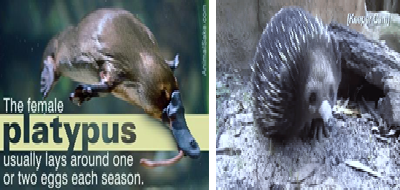
Because they have smooth skin.
Because they have legs.
Because they have mammary glands and feed their babies with milk.
Because they have soft tissue.
Question 13
13.
What do all birds have in common?
They are covered with feathers.
They all can fly.
All of them give birth.
All of them have mammary glands.