Crit C: Friction Lab
star
star
star
star
star
Last updated about 5 years ago
16 Nsɛmmisa
1
1
1
1
1
1
1
1
1
1
1
1
1
3
3
1
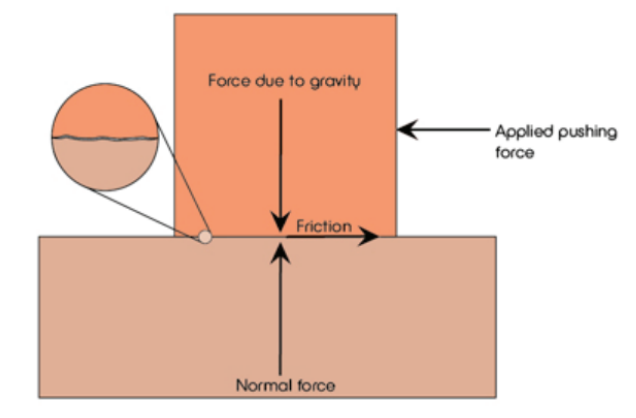
What is friction? Friction is a force which acts to oppose movement, always acting in the opposite direction to motion. This causes objects to slow down, converting their kinetic energy to heat. Friction results from the electromagnetic force between particles as they rub together.
Check out the below force diagram for a visual representation of the above definition:
Without friction, what would happen when you put on the brakes on your bike?
Without friction, would motionless books fall off a flat table? Why or why not? What would happen if the table was slightly tilted?
Without friction, could you use ice skates on pavement? Why or why not?
Question: Which surface type exerts the greatest amount of friction?
Gather the following materials:
A ball of any kind (e.g. tennis ball, soccer ball, toy ball, marble, etc.)
A flat "ramp" - such as a cutting board, cereal box, textbook or box lid
A stack of books, box, or other object to prop up your ramp
A timer (use this link or a phone timer if you don’t have a stopwatch)
Three different floor surfaces (such as carpet, tile, wood, concrete, and/or asphalt)
A 10-foot measuring tape (if you don’t have one, just use your feet and count ten foot-lengths)
Prepare: Locate at least three different floor surface types in your house or outside. This could be different flooring types like wood, carpet, or tile, or it could be outside surfaces such as dirt, asphalt, or concrete. Ideally you will find at least 3 surface types that have about 10 feet of length and are as close to flat as possible.
List the three types of surfaces you will test (e.g. I will test thick carpet, thin carpet, and sidewalk):
Predict: Which surface type do you think will have the greatest amount of friction?
Predict: Which surface type do you think will have the least amount of friction?
Complete this hypothesis: "If I roll a ball on ___, ___ and ____, the ball will travel fastest on the _____ because it has the most/least friction."
Procedure: Read completely and answer questions 8-10 before beginning.
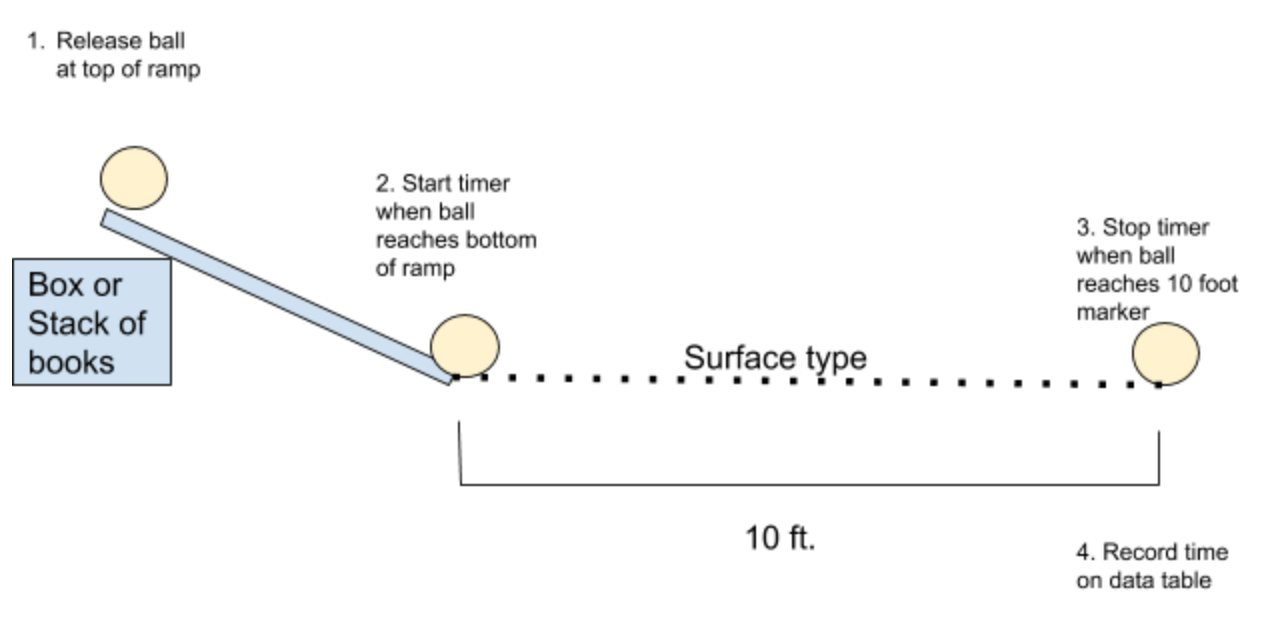
Find a ball of any kind (soccer ball, tennis ball, toy ball, marble, etc.)
Make a ramp: get a flat surface such as a cutting board and prop it up against a stack of books, a box, or other object that will hold up one end. The ramp shouldn’t be too steep, somewhere between 6 and 12 inches in height.
Set the ramp up on one of your surfaces (e.g. carpet) so that if you let the ball go at the top of the ramp, the ball has about 10 feet to travel before it hits anything. Note: if you don’t have 10 feet of clear space, you can do a shorter distance, just make sure it is always the same distance.
Mark a line 10 feet from the bottom of the ramp. You could use a tape measure, but if you don’t have one just count out ten foot-lengths using your feet to measure (touching heel to toe, count out ten steps). Mark that line with a pencil, or whatever you have.
Get your timer ready (use your chromebook or a phone if you don’t have a stopwatch).
For your first trial on this surface type, let the ball go at the top of the ramp then start the timer as soon as it hits the flat floor. Stop the timer when the ball reaches your ten foot marker.
Record the time in the below data table.
Repeat steps 7 and 8 three more times on that same surface type
Move your setup (ramp and 10 foot marker) to a second surface type (e.g. wood floor) and repeat the data collection process for a total of three trials.
Move your setup to a third surface type (e.g. a different carpet or outside on a flat cement sidewalk) and repeat the data collection process.
The Independent Variable (what you are changing) for this lab is:
The Dependent Variable (what you are measuring) for this lab is:
Before you begin testing, think about everything you will need to control (keep constant) to get valid results. Everything should be exactly the same except for the independendent variable (the surface type).
For example, to keep the initial speed of the ball constant, the ramp needs the be at the exact same angle each time. To keep that constant, you should use the same box to prop up the ramp every time.
What else will you keep constant? Name two ways you will set up your tests to make sure your results are valid.
Now, carry out your experiment using the above procedures, being careful to control your constants.
Record your data on this Google Sheet template: https://docs.google.com/spreadsheets/d/1rKDRsoGIGB_10sa5-ycke4BT4sfx8UsdLm3WE9s17xI/template/preview
1. Open the sheet.
2. Rename "surface 1, 2, and 3" cells with the actual names of your surfaces (e.g. carpet)
3. As you go, input your time data under trials 1, 2, and 3. Just put the number, no units ("3.2" for 3.2 seconds)
4. The average time for each surface should automatically calculate and the graph should automatically be made. Look over the graph to make sure it looks correct.
Take a screenshot of your data table from the google sheet and paste it into the whiteboard (insert image using the picture icon)
Take a screenshot of the graph from the google sheet and paste it into the whiteboard (insert image using the picture icon).
Claim: Write a claim that answers the question
Of the surfaces you tested, which surface type exerts the greatest amount of friction?
Evidence: What facts from your experiment back up your claim? Cite specific quantitative data and your qualitative observations. Aim to have at least three clear pieces of evidence.
Reasoning: Explain why you got the results you did in terms of science concepts (see information on friction at the top of this document). What about the surface caused your results?
Extension Question: If your goal is to have your car travel as fast and far as possible, which of the three surfaces should you conduct your tests on? Is there a different surface you wish you could use for the tests?