Peppered Moth Activity
star
star
star
star
star
Last updated over 5 years ago
23 Nsɛmmisa
1
1
1
1
1
1
1
1
1
1
2
1
2
1
3
3

2
1
1
1
1
1
1
Part 1: Click the Peppered Moth Link on the website. A picture can be seen below of the link to click. Use this to answer the questions below.
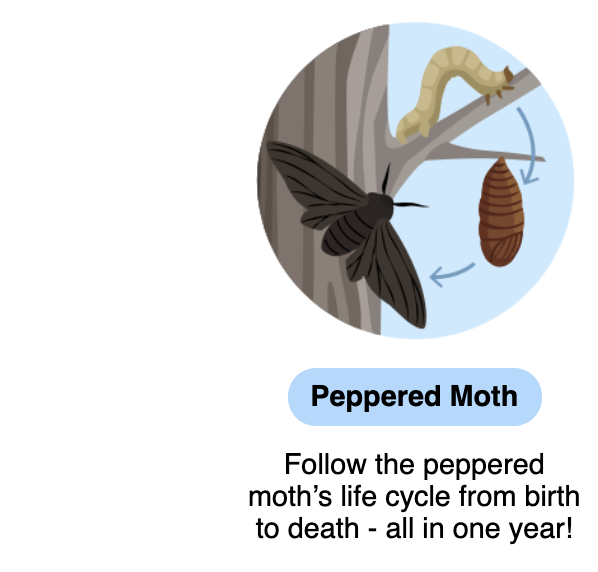
Peppered moths are common insects living in England, Europe, and North America.
How do peppermoth larvae avoid death in the winter?
What is the name of the typical peppered moth that is light?
What is the name of the dark moth that has almost black bodies?
What is the name of the moth that is somwhere in the middle of the two and has more dark spots than the light peppered moth?
Predators of the peppered moth include flycatchers, nuthatches, and the European robin.
How do peppered moths avoid predators?
Part 2: Click the natural selection tab and answer the questions below.
What even was occurring that was causing the moths to change color?
"Finally it was found that the color was genetic. Moths passed their color to the next generation. Eggs from light moths developed into light moths and dark moth eggs turned to dark adults. The dark color was caused by a mutation in the DNA of a single moth, and the mutated gene had been passed to all its offspring."
The passage above explains the genetic change that the moths were going through and passing on to their offspring. Was this new dark color a result of natural selection?
The dark moth population was....
In the last 50 years, the number of dark moths has dropped. Why?
What kind of scientist was Dr. Kettlewell?
Below is Dr. Kettleworth's hypothesis. Do you agree with his hypothesis? Why?
"Heavily polluted forests will have mostly dark peppered moths. Clean forests will have mostly light peppered moths. Dark moths resting on light trees are more likely than light moths to be eaten by birds. The reverse should be true on dark trees. Dark moths in polluted forests would live longer than light moths, but dark moths in clean forests would die sooner."
Read the observation section. According to Dr. Kettleworth where were the dark moths only found?
Describe Dr. Kettleworth's experiment.
Dr. Kettlewell published an article in Scientific American. The article summarized his studies of the peppered moths. What were Dr. Kettleworth's conclusions?
I read the directions! (answer yes for a free points!)
Choose a forest for your experiment: Which forest did you choose?
Screenshot that you completed the simulation and put that in this question!
How many moths did you eat in total?
Screenshot the graphs and put them in this question!
According to your graphs, which moths did you eat more of? Why do you think you ate more of this color?
What did you think of the game?