Log in
Sign up for FREE
arrow_back
Library

Pig Dissection: Digestive

star
star
star
star
star
Last updated almost 5 years ago
28 questions
1
1
1
1
1
1
2
1
1
1
1
1
1
1
1
1
1
1
1

Virtual Pig Dissection

Here is the list of structures you should be able to identify:
  • Tongue
  • Salivary Glands
  • Pharynx
  • Papillae (taste buds)
  • Soft palate / Hard palate
  • Esophagus
  • Liver
  • Small Intestine
  • Duodenum
  • Ileum (Jejunum)
  • Large Intestine (colon)
  • Cecum
  • Gall bladder / Bile duct
  • Pancreas
  • Pyloric Sphincter
  • Cardiac Sphincter
  • Mesentery
  • Rectum
  • Anus
There is at least one question on almost every slide in the virtual pig dissection. Scroll down and click next to move on to the next slide.
Question 1
1.

Sensory papillae are more commonly called ____ and are found on the ____. (choose 2)

1
Question 2
2.

ID the structure

1
1
Question 5
5.

What is the funtion of the flap in question 3?

Skip ahead to "Through the Peritoneal Membrane"
Question 6
6.

Match the serous membrane with its location

Draggable itemarrow_right_altCorresponding Item
pericardium
arrow_right_alt
abdominal cavity
peritoneum
arrow_right_alt
lungs
pleural
arrow_right_alt
heart
Question 7
7.

What is the function of a serous membrane?

1
1
1
1
Question 11
11.

Identify the structure (its the thin membrane attached to the small intestine)

Question 12
12.

Which is longer: small intestine or large intestine?

Question 13
13.

Why is the small intestine this long?

Question 14
14.

Most food stuffs are absorbed in the small intestine, but what IS absorbed in the large intestine?

1
Question 15
15.

ID the structure:

1
Question 17
17.

What is the liver's role in digestion?

Question 18
18.

What is the function of the gall bladder?

Question 19
19.

Bile aids in the breakdown of:

Since fats and water dont mix, bile emulsifies the fat into microscopic droplets to aid in their digestion.
As you can see from this picture, bile can be released from the liver directly into the small intestine via the hepatic duct into the common bile duct. If bile is not needed at the time, it can divert into the gall bladder via the cystic duct (a sphincter prevents it from going into the duodenum).
Question 20
20.
Draggable itemarrow_right_altCorresponding Item
common bile duct
arrow_right_alt
empties into the duodenum
bile
arrow_right_alt
leads out of the liver
pancreas
arrow_right_alt
leads out of the gall bladder
gall bladder
arrow_right_alt
leads out of the pancreas
pancreatic duct
arrow_right_alt
secreted by the liver
sphincter of oddi
arrow_right_alt
stores bile
cystic duct
arrow_right_alt
closes off end portion of common bile duct and pancreatic duct
hepatic duct
arrow_right_alt
produces insulin
Question 21
21.

Place a small circle on the picture where you think the pyloric sphincter is:

Question 22
22.

The folds in the stomach as pictured above, are called:

Question 23
23.

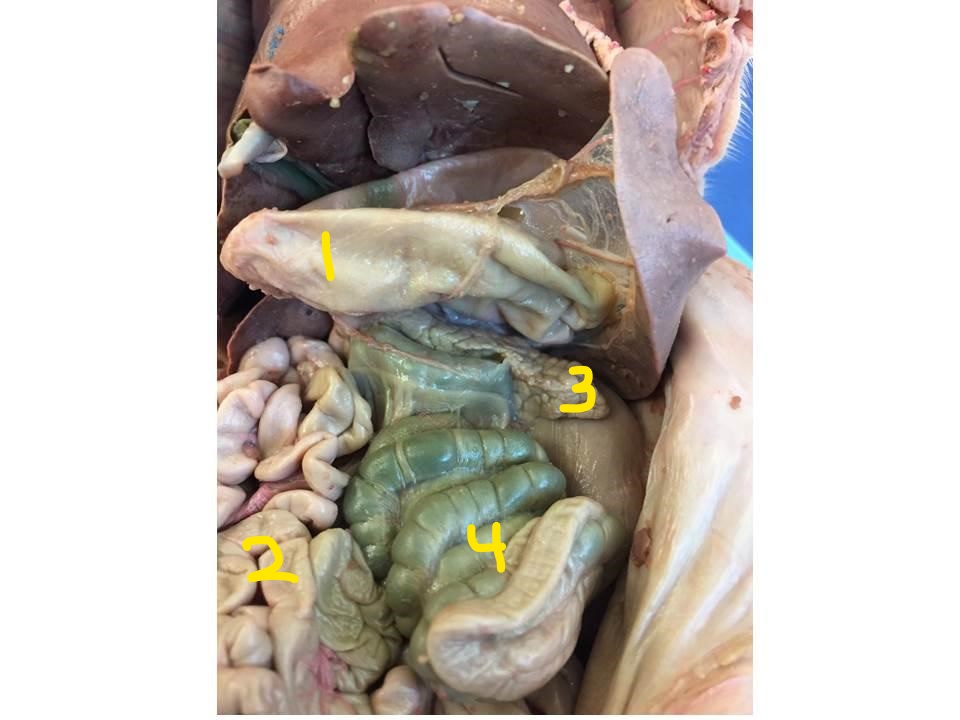
In the image above, which number is the pancreas?

Question 24
24.

Where pepsin is active:

Question 25
25.

Where trypsin is active:

The pancreas produces a number of enzymes that aid in digestion. These enzymes may flow into the small intestine via the common bile duct (exocrine), or they may enter the bloodstream (endocrine)
Question 26
26.

What are two endocrine hormones are produced in the pancreas?

Question 27
27.

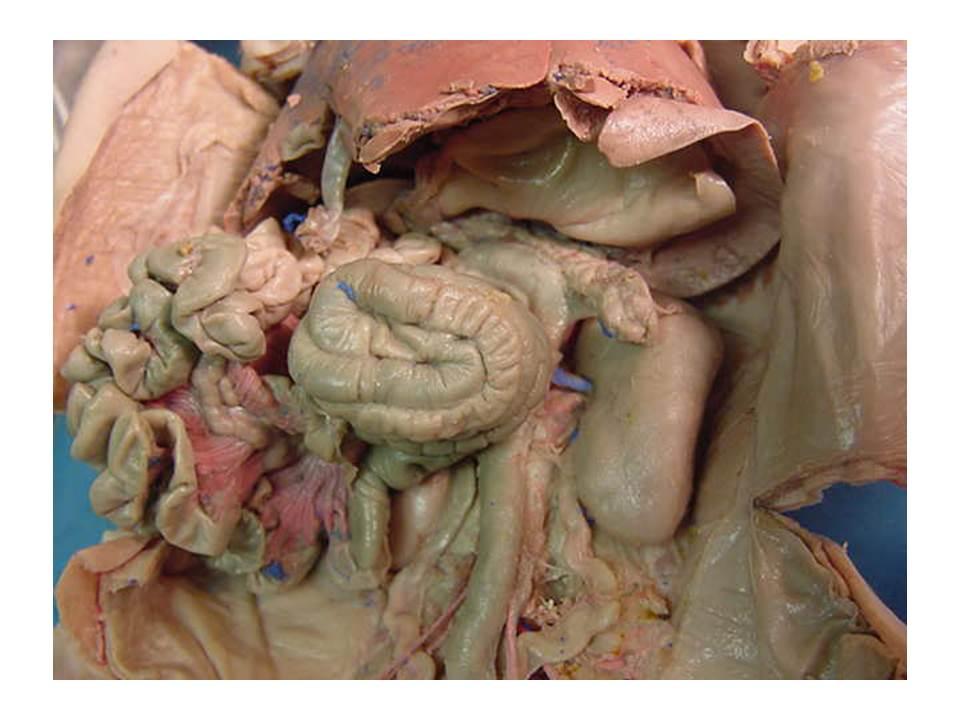
What letter on the image above is the mesentery?

Question 28
28.

What structures are prominent in the mesentery?

Question 3
3.

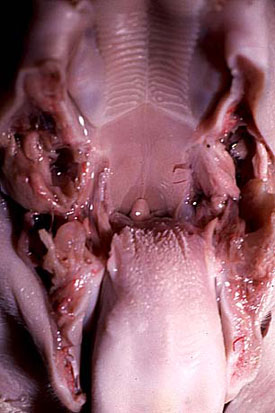
The little flap of tissue to the left of the 3 is the:

Question 4
4.

What enzyme is active in this area...and what does it break down?

Question 8
8.

ID the structure:

Question 9
9.

ID the structure:

Question 10
10.

ID the structure:

Question 16
16.