What does this graph show about how the jelly population change?
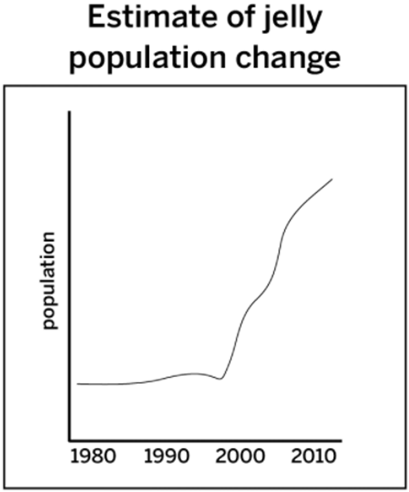
What does this graph show about how the jelly population change?
Anything with parts that interact to make a whole is/an
How do births and deaths in an ecosystem affect population size?
A population size can stay the same over time when
Over a period of time, a population can be considered as stable or changing. A population changing means that
How does the number of births compare to the number of deaths in a population that was stable?
How would you expect the number of births to compare to the number of deaths in a population that was changing?
Within a population organisms are always _______________
If a population is stable, does that mean there are no births and deaths?
What does this graph show about how the jelly population change?
All the living and nonliving things interacting in a particular area is called?
Any living thing such as plants, animals, and bacteria is called
What could have caused the size of the moon jelly population to decrease?
A group of the same type of organism living in the same area is called.
When something stays mostly the same over time it is called
When something becomes different over time is is called
Anything with parts that interact to make a whole is a.
If the number of births and deaths in a given time are equal, then
If there are more births than deaths in a given time, then the size of the population will increase. If there are fewer births than deaths, then the size of the population will ____________.
The structures inside the cells such as the nucleus, cell wall, cytoplasms, and chloroplast are called
Onio cell is a plant cell because it has