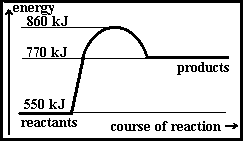
The reaction profile for the course of a chemical reaction. Which of the following statements is TRUE?
The reaction profile for the course of a chemical reaction. Which of the following statements is TRUE?
In an exothermic reaction .....
In an endothermic reaction ......
When an exothemric reaction take place, the raction mixture gives out heat because ...
Which of the following recation is exothermic ?
Energy change in a chemical reaction is represented by the symbol...
ΔH is positive for what type of reactions?
Energy changes in chemical reactions are measured in...
Bond making is an
If a reaction is endothermic overall, what does this tell us about the bonds broken and made during the reaction?
On an energy level diagram (reaction profile), the products of an exothermic reaction will be ...
ΔH is the energy change for the reaction. To calculate this...
Thermal decomposition is...
Pick the correct combination for the correct information regarding bond energies.
The overall energy change in a chemcial reaction is -24kJ/mol. What does this tell us about the reaction?
The reaction profile for the course of a chemical reaction. Which of the following statements is TRUE?
When hydrogen fluoride is heated it breaks down into hydrogen and fluorine.
The equation can be written as: 2HF(g) ==> H2(g) + F2(g)
Use the bond energies shown below to calculate the energy change that takes place when 2 moles of hydrogen fluoride thermally decomposes in this way.
(Bond energies in kJ/mol: H-H = 440; F-F = 155; H-F = 560)
The reaction between hydrogen and chlorine to form hydrogen chloride can be written as:
H2(g) + Cl2(g) ===> 2HCl(g)
Use the bond energies shown to calculate the energy change that takes place when hydrogen chloride is formed according to the above equation.
(Bond energies in kJ/mol: H-H 435, Cl-Cl 245, H-Cl 430)
What is activation energy?
What must we remember to do with the ratio of moles in a reaction?