Describe ONE characteristic of invasive plants that helps them outcompete native plants.

Describe ONE characteristic of invasive plants that helps them outcompete native plants.
Describe ONE characteristic of invasive plants that helps them outcompete native plants.
Describe ONE other characteristic of invasive plants that helps them outcompete native plants.
The research findings are summarized in the graph.
Based on the data in the graph, identify the year in which the abundance of native plants versus invasive plants is nearly equal.
The research findings are summarized in the graph.
Describe the change in overall plant abundance from 2000–2012, using the data in the graph.
The research findings are summarized in the graph.
Explain what the trend in the relative abundance of native hard stem lovegrass and the invasive fountain grass over the 12-year period implies about each species’ ability to withstand drought conditions.
Explain how a loss of species diversity would affect the stability of an ecosystem.
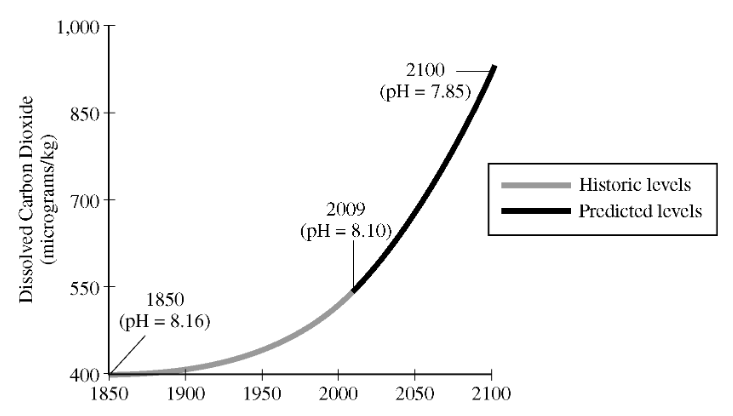
Coral reefs are produced when corals acquire calcium ions (Ca2+) and carbonate ions (CO32−) from seawater and deposit solid CaCO3 to form their exoskeletons. Scientists are concerned that relatively rapid decreases in ocean water pH will hinder the deposition of CaCO3. The graph above shows the amount of CO2 dissolved in ocean water and ocean water pH (shown in parentheses) since 1850 and the predicted changes through 2100.
Explain how an increase in the amount of dissolved CO2 in ocean water results in a decrease in the pH of ocean water.
Coral reefs are produced when corals acquire calcium ions (Ca2+) and carbonate ions (CO32−) from seawater and deposit solid CaCO3 to form their exoskeletons. Scientists are concerned that relatively rapid decreases in ocean water pH will hinder the deposition of CaCO3. The graph above shows the amount of CO2 dissolved in ocean water and ocean water pH (shown in parentheses) since 1850 and the predicted changes through 2100.
Explain why the movement of carbon into the ocean has been increasing since 1850.
Carbon dioxide produced by anthropogenic sources contributes to global climate change.
Identify ONE environmental problem, other than the loss of biodiversity, that is occurring as a result of global climate change.
Carbon dioxide produced by anthropogenic sources contributes to global climate change.
Describe ONE human activity, other than the burning of fossil fuels, that releases CO2 into the atmosphere.