Unit 9 Day 5 Ch. 14 Probability Quiz

Last updated over 4 years ago
18 questions
Enter all probability answers as decimals rounded to the thousandths place (three places past the decimal point).
10

85% of cars brought to Sam’s Garage need an oil change.
Of those cars, 42% also need a safety inspection
Of the cars that don't need an oil change, 76% need a safety inspection.
Use the show your work area to create a tree diagram for this situation so you can calculate the probabilities and answer the following questions.
I have started it for you:

4

Use the Tree Diagram in #1:
What is the probability that a car brought to Sam’s Garage needs both an oil change and a safety inspection?
P(Oil & safety):

4

Use the Tree Diagram in #1:
What is the probability that a car brought to Sam’s Garage needs an oil change and not a safety inspection?
P(Oil & No Safety)=

4

Use the Tree Diagram in #1:
What is the probability that a car brought to Sam’s Garage does not need an oil change and does need a safety inspection?
P(No Oil & Safety)=

4

Use the Tree Diagram in #1:
What is the probability that a car brought to Sam’s Garage does not need an oil change and not a safety inspection?
P(No Oil & No Safety)=

4

Use the answers from above.
What is the probability that a car brought to Sam’s Garage needs a safety inspection?
P(Safety Inspection)=
Hint: use answers from #2, 3, 4, 5 as a resource, which two outcomes are part of your answer for #6?

4

The Venn diagram shows the percentages of cars at Sam’s Garage that need an oil change or air in the tires.
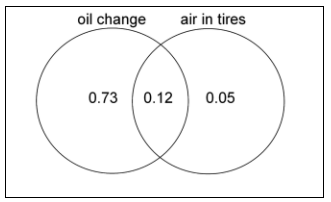
What’s the probability that any car needs air in its tires?
4

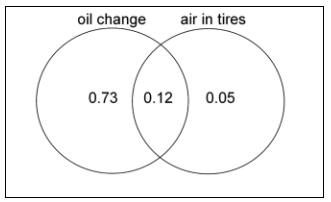
The Venn diagram shows the percentages of cars at Sam’s Garage that need an oil change or air in the tires.

What is the probability that a car needs an oil change or air in its tires?

4

What does mutually exclusive mean?

4

1. Are needing an oil change and needing air put into the tires mutually exclusive?
2. How do you know?
For full credit you need to answer BOTH questions.

4

The Venn diagram shows the percentages of cars at Sam’s Garage that need an oil change or air in the tires.

What is the probability that a car needs an oil change and air?

4

The Venn diagram shows the percentages of cars at Sam’s Garage that need an oil change or air in the tires.

What is the probability that a car needs neither an oil change nor air in the tires?

6

Use the information from the Venn Diagram and answers you have calculated to fill in a 2-way table that compares cars at Sam's Garage: Oil change vs air in the tires.

4

You just bought a small bag of Skittles. Inside are 24 candies: 7 green, 5 orange, 6 red, 4 yellow and only 2 are purple. You tear open one corner of the package and begin eating them, shaking out one at a time. The scenarios are all separate events.

What is the probability that your first Skittle is yellow?
P(Yellow)=

Give your answer as a decimal rounded to the 1000ths place.
Set up the fraction and give the answer.
Ex.

4

You just bought a small bag of Skittles. Inside are 24 candies: 7 green, 5 orange, 6 red, 4 yellow and only 2 are purple. You tear open one corner of the package and begin eating them, shaking out one at a time. The scenarios are all separate events.

What is the probability that your first 2 candies are orange?
P(Orange & Orange)=

Give your answer as a decimal rounded to the 1000ths place.
Show your work set up as fractions and give the answer.
Ex.

4

You just bought a small bag of Skittles. Inside are 24 candies: 7 green, 5 orange, 6 red, 4 yellow and only 2 are purple. You tear open one corner of the package and begin eating them, shaking out one at a time. The scenarios are all separate events.

What is the probability that the 3rd candy out of the bag is purple?
P(not purple, not purple, purple)=

Show your work as multiplication of fractions and give the answer in decimal form.

4

You just bought a small bag of Skittles. Inside are 24 candies: 7 green, 5 orange, 6 red, 4 yellow and only 2 are purple. You tear open one corner of the package and begin eating them, shaking out one at a time. The scenarios are all separate events.

What is the probability that none of the first 3 are green?
P(not green & not green & not green)=

Give your answer as a decimal rounded to the 1000ths place.
Show your work as fractions that are multiplied and give your answer as a decimal.

0

BONUS:
You just bought a small bag of Skittles. Inside are 24 candies: 7 green, 5 orange, 6 red, 4 yellow and only 2 are purple. You tear open one corner of the package and begin eating them, shaking out one at a time. The scenarios are all separate events.

What is the probability that at least one of the first 3 are green?
P(at least one of three skittles are green)=
Remember, 'at least one' makes us think about the complement of none.

Give your answer as a decimal rounded to the 1000ths place.
Show your work and give the answer.