Log in
Sign up for FREE
arrow_back
Library
611 U6 Oceans assessment
By Leanna Bumgarner
star
star
star
star
star
Share
share
Last updated about 4 years ago
15 questions
Add this activity
1
EEn.2.3.1
1
EEn.2.3.1
1
EEn.2.3.1
1
EEn.2.3.1
0
EEn.2.3.1
1
EEn.2.3.1
1
EEn.2.3.1
1
EEn.2.3.1
1
EEn.2.3.1
1
EEn.2.3.1
1
EEn.2.3.1
1
1
1
1
Question 1
1.
1. What is the salinity of seawater?
1.5%
3.5%
5.5%
10%
Question 2
2.
2. What is the most abundant salt in the sea? A. B. C. D.
calcium chloride
potassium chloride
magnesium chloride
sodium chloride
Question 3
3.
The rapid change in temperature that occurs as the depth of the ocean increases is called
trophic level
aphotic zone
transitional phase
thermocline
Question 4
4.
what is density?
mass per unit volume
weight per mass
mass per unit area
weight per volume
Question 5
5.
most ocean water is located in which zone?
mixed water
surface zone
transition zone
deep zone
Question 6
6.
Which of the following is NOT a zone in the three-layered structure of the ocean relating to
density?
surface zone
transition zone
deep zone
intertidal zone
Question 7
7.
Which of the following best describes the ocean bottom?
cold, dark
quiet
increasingly high pressure
all of these
Question 8
8.
the smallest tidal range occurs during which type of tide?
spring tide
neap tide
flood tide
ebb tide
Question 9
9.
when is the daily tidal range greatest?
spring tide
neap tide
flood tide
ebb tide
Question 10
10.
Which of the following is visible evidence of energy passing through water?
wave
Coriolis effect
sea arch
density tide
Question 11
11.
The energy that drives surface ocean currents comes from ____.
wind
wave action
temperature declines
salinity variations
Question 12
12.
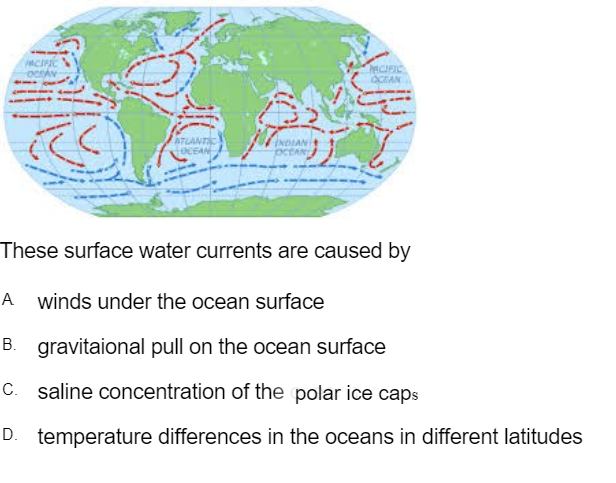
A
B
C
D
Question 13
13.
A
B
C
D
Question 14
14.
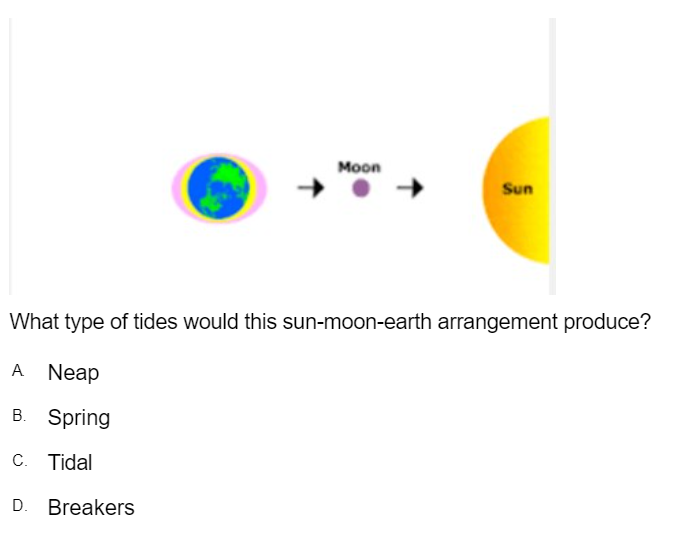
A
B
C
D
Question 15
15.
A
B
C
D