Unit 9 Day 5 Ch 14. Probability Quiz

Last updated over 4 years ago
18 questions
Enter all probability answers as decimals rounded to the thousandths place (three places past the decimal point).
10

75% of cars brought to Sam’s Garage need an oil change.
Of those cars, 46% also need a safety inspection
Of the cars that don't need an oil change, 62% need a safety inspection.
Use the show your work area to create a tree diagram for this situation so you can calculate the probabilities and answer the following questions.
I have started it for you:

4

Use the Tree Diagram in #1:
What is the probability that a car brought to Sam’s Garage needs both an oil change and a safety inspection?
P(Oil & safety):

4

Use the Tree Diagram in #1:
What is the probability that a car brought to Sam’s Garage needs an oil change and not a safety inspection?
P(Oil & No Safety)=

4

Use the Tree Diagram in #1:
What is the probability that a car brought to Sam’s Garage does not need an oil change and does need a safety inspection?
P(No Oil & Safety)=

4

Use the Tree Diagram in #1:
What is the probability that a car brought to Sam’s Garage does not need an oil change and not a safety inspection?
P(No Oil & No Safety)=

4

Use the answers from above.
What is the probability that a car brought to Sam’s Garage needs a safety inspection?
P(Safety Inspection)=
Hint: use answers from #2, 3, 4, 5 as a resource, which two outcomes are part of your answer for #6?

4

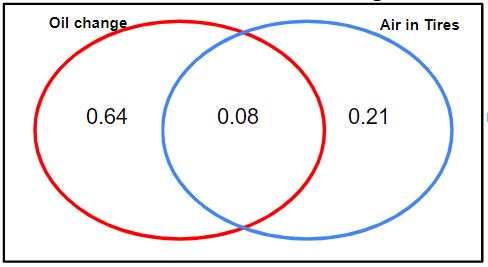
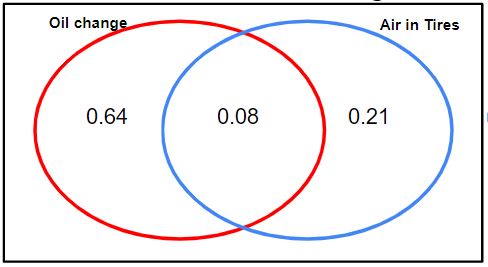
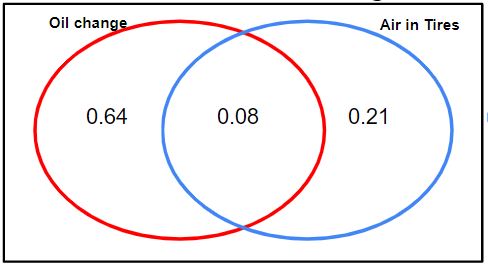
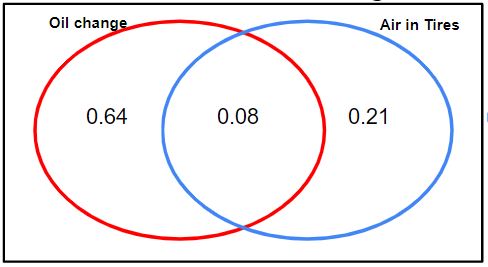
The Venn diagram shows the percentages of cars at Sam’s Garage that need an oil change or air in the tires.
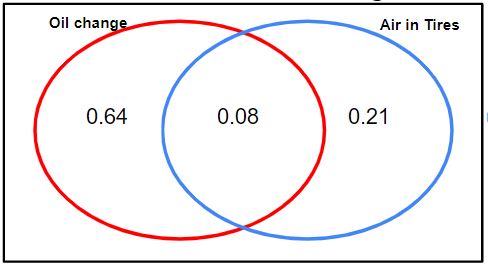

What’s the probability that a car needs air in its tires?
4

The Venn diagram shows the percentages of cars at Sam’s Garage that need an oil change or air in the tires.


What is the probability that a car needs an oil change or air in its tires?

4

What does mutually exclusive mean?

4

1. Are needing an oil change and needing air put into the tires mutually exclusive?
2. How do you know?
For full credit you need to answer BOTH questions.

4

The Venn diagram shows the percentages of cars at Sam’s Garage that need an oil change or air in the tires.


What is the probability that a car needs an oil change and air?

4

The Venn diagram shows the percentages of cars at Sam’s Garage that need an oil change or air in the tires.


What is the probability that a car needs neither an oil change nor air in the tires?

6

Use the information from the Venn Diagram and answers you have calculated to fill in a 2-way table that compares cars at Sam's Garage: Oil change vs air in the tires.


Hint: think about what each of the areas represent that have a number in them. And what the area represents outside the circles.

4

You just bought a small bag of Skittles. Inside are 24 candies: 7 green, 5 orange, 6 red, 4 yellow and only 2 are purple. You tear open one corner of the package and begin eating them, shaking out one at a time. The scenarios are all separate events.

What is the probability that your first Skittle is orange?
P(Orange)=

Give your answer as a decimal rounded to the 1000ths place.
Set up the fraction and give the answer.
Ex.

4

You just bought a small bag of Skittles. Inside are 24 candies: 7 green, 5 orange, 6 red, 4 yellow and only 2 are purple. You tear open one corner of the package and begin eating them, shaking out one at a time. The scenarios are all separate events.

What is the probability that your first 2 candies are green?
P(2 Green)=P(Green & Green)=

Give your answer as a decimal rounded to the 1000ths place.
Show your work set up as fractions and give the answer.
Ex.

4

You just bought a small bag of Skittles. Inside are 24 candies: 7 green, 5 orange, 6 red, 4 yellow and only 2 are purple. You tear open one corner of the package and begin eating them, shaking out one at a time. The scenarios are all separate events.

What is the probability that the 3rd candy out of the bag is red?
P(not red, not red, red)=

Show your work as multiplication of fractions and give the answer in decimal form.

4

You just bought a small bag of Skittles. Inside are 24 candies: 7 green, 5 orange, 6 red, 4 yellow and only 2 are purple. You tear open one corner of the package and begin eating them, shaking out one at a time. The scenarios are all separate events.

What is the probability that none of the first 3 are yellow?
P(not yellow & not yellow & not yellow)=

Give your answer as a decimal rounded to the 1000ths place.
Show your work as fractions that are multiplied and give your answer as a decimal.

0

BONUS:
You just bought a small bag of Skittles. Inside are 24 candies: 7 green, 5 orange, 6 red, 4 yellow and only 2 are purple. You tear open one corner of the package and begin eating them, shaking out one at a time. The scenarios are all separate events.

What is the probability that at least one of the first 3 are green?
P(at least one of three skittles are green)=
Remember, 'at least one' makes us think about the complement of none.

Give your answer as a decimal rounded to the 1000ths place.
Show your work and give the answer.