If it makes it through the nasal cavity, it will next pass through number 7 which is the .......
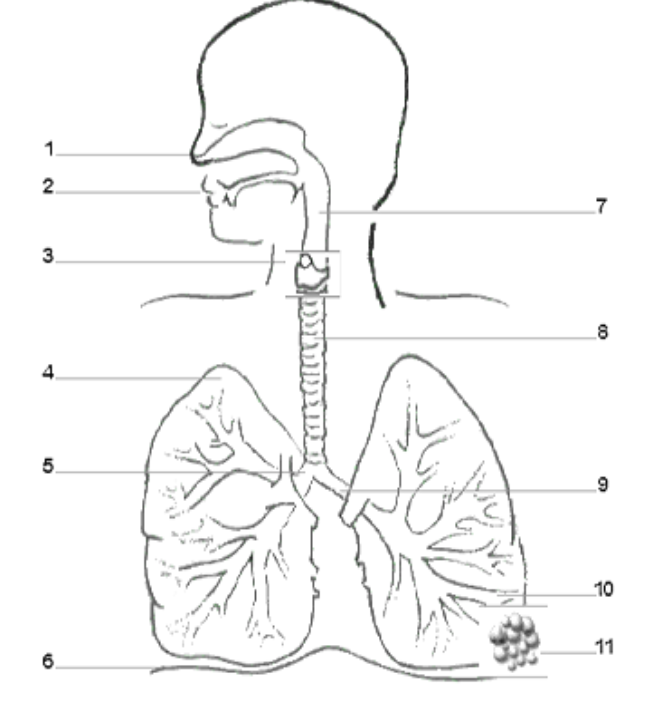
If it makes it through the nasal cavity, it will next pass through number 7 which is the .......
Pathogens enter your body from droplets in the air, or an opening such as a cut. The first line defenses are always activated and providing protection. Which of the following are first line defenses?
If the pathogen makes it past your first line defenses, 2nd line defenses kick in. Let's say Sars-CoV-2 enters your body through droplets in the air. First it passes through your nasal cavity where some virus' may be trapped in ____________produced by ______________.
If it makes it through the nasal cavity, it will next pass through number 7 which is the .......
From there it will pass through number 3, the ____________ and then into the trachea.
The trachea has cartilaginous rings that help to keep the airway open as food in the esophagus presses against it. In the trachea, some cells here produce mucus, other cells lining the walls have projections called ____________ that _________________.
If the cells of the trachea are successful, the pathogen will be pushed into our esophagus and down to our stomach where there are ___________, such as stomach acid and enzymes, to break it apart.
If the cells of the trachea are not successful, the pathogen will continue down the respiratory system and through the......
From the grape like structures at the end of the respiratory system, the pathogen will infect cells or enter the blood at the _________________ as gases are being exchanged.
Which of the following respiratory structures have large surface areas to increase the efficiency of their function?
Now that Sars-CoV-2 has entered cells and the blood, you starts to feel sick. You call in sick from school and say "I will be out for 10 days, I am home sick with...."? Name the illness.
Now that you have called into school and are home sick. Your body continues to fight the virus and you feel real bad. Your temperature is 101. You remember from anatomy that a fever, as long as it does not get too much higher, is actually good. Which of the following describes a fever? (select all that apply)
The virus is able to get into our cell and replicate thanks to three structures. Match each structure to its' function.
| Draggable item | arrow_right_alt | Corresponding Item |
|---|---|---|
Protein Coat | arrow_right_alt | Allows the virus to enter our cells |
Spike Protein | arrow_right_alt | Provides the code for the viral proteins |
RNA | arrow_right_alt | Provides a disguise for the for the viral Nucleic Acids as they move through the body |
Once some body cells are affected they will perform ____________ to attract leukocytes.
First _________will arrive. They will exit the blood and enter the body tissue through ______________ and then, start to ______________ pathogens.
Some of the next few cells to arrive are___________which will not attack the virus, but instead create an environment which facilitates the arrival of other white blood cells.
Basophils, Neutrophils and Eosinophils are all....
So far, only first and second line defenses, which are part of the __________immune response, have been activated.
Before body cells are attacked and pathogens in them are killed, the virus is able to replicate rapidly using our cells machinary. Put the following steps of viral infection in order.
New viruses are packaged together and sent out into the body.
The virus releases its RNA into the cytoplasm
RNA polymerase copies viral RNA
The viral RNA is translated and proteins are made
The virus attaches to a cell and enters
All of the following are made by translation EXCEPT:
The option you selected in question 28 is instead made by......
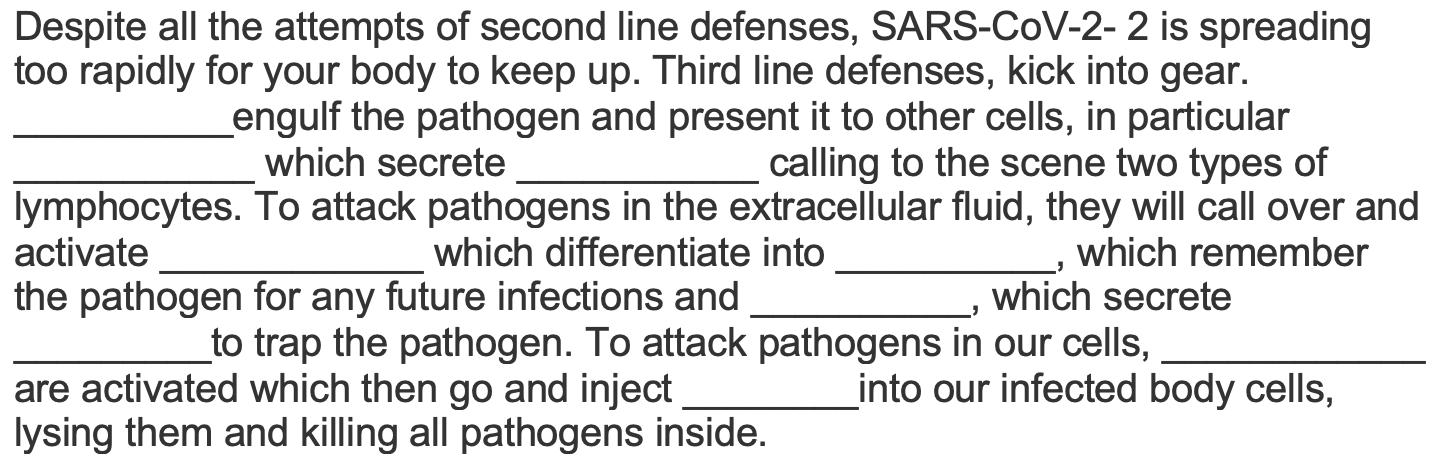
A _______1_____ enters your body, macrophages engulf it and present the ____2_________ for other cells to see. Eventually, in response, your body may produce _____3____ to trap it.
While you are sick with SARS- CoV-2 wreaking havoc on your body. Your sister just came back from a trip to a foreign country where she tried all sorts of new exotic foods. She is not feeling too good either. She goes to the doctors and they run some blood tests based on her symptoms.
They following is her blood cell count results:
Neutrophil 58%
Lymphocyte 27%
Monocyte 5%
Eosinophil 15%
Basophil 0.5%.
A. First, identify the leukocyte that is abnormally high by comparing these results to the normal values below.
B. Then, based off these results, what might be also causing your sister to feel ill?

The respiratory system and immune system work closely together to protect the body from pathogens. Our body systems are made of organs, which are made of tissues which are made of cells that even at such a small scale, contribute to fighting off pathogens.
1. Name one cell of the respiratory system that helps to protect against pathogens and explain HOW it does so.
2. Name one cell of the immune system that helps to protect against pathogens and explain HOW it does so.
Match each of the following cells/ molecules to the appropriate analogy. Then use the "show your work" option to explain your reasoning----(this is optional, but this way if you match them differently than I would, but have a good reason for it, you can get credit still)
| Draggable item | arrow_right_alt | Corresponding Item |
|---|---|---|
Plasma B Cells | arrow_right_alt | Fire Alarm |
Cytokines | arrow_right_alt | Spider Web |
Antibodies | arrow_right_alt | Pac Man |
Macrophage | arrow_right_alt | Spider |