After you have watched the Ch. 15 Video #1 on Probability Models, practice what you learned with the following ten questions.
4 points
4
Question 1
1.
Use the probability model to find the expected value of the random variable.
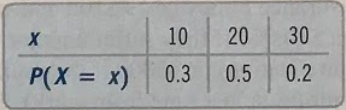
Use the method you learned in the video to calculate the expected value. (expected value is the mean or average)
The expected value is the sum of each of the possible values multiplied by its probability of occurring.
Use the format:
E(X)=#
4 points
4
Question 2
2.
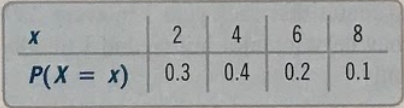
Use the probability model to find the expected value of the random variable.
Use the method you learned in the video to calculate the expected value.
The expected value is the sum of each of the possible values multiplied by its probability of occurring.
Use the format:
E(X)=#
round to two places past the decimal.
4 points
4
Question 3
3.
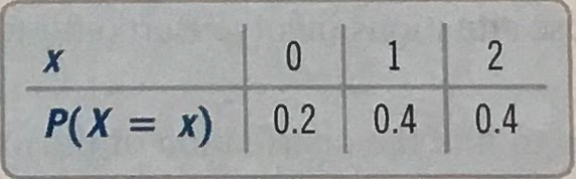
Use the probability model to find the expected value of the random variable.
Use the method you learned in the video to calculate the expected value.
The expected value is the sum of each of the possible values multiplied by its probability of occurring.
Use the format:
E(X)=#
4 points
4
Question 4
4.
An electronics retailer is developing a model for insurance policies on new cell phone purchases. It estimates that 60% of customers never make a claim (cost=$0), 25% of customers require a small repair costing an average of $50, and 15% of customers request a full refund costing $200.
What is the long term average cost the retailer should expect to pay to its customers per claim?
First:
Define the random variable, what does X=?
10 points
10
Question 5
5.
An electronics retailer is developing a model for insurance policies on new cell phone purchases. It estimates that 60% of customers never make a claim (cost=$0), 25% of customers require a small repair costing an average of $50, and 15% of customers request a full refund costing $200.
What is the long term average cost the retailer should expect to pay to its customers per claim?
Second:
Use the 'show your work' area to create the probability model.
10 points
10
Question 6
6.
An electronics retailer is developing a model for insurance policies on new cell phone purchases. It estimates that 60% of customers never make a claim (cost=$0), 25% of customers require a small repair costing an average of $50, and 15% of customers request a full refund costing $200.
Now that you've created the probability model you are ready to answer:
What is the long term average cost the retailer should expect to pay to its customers per claim?
Remember, the average cost is the Expected Value or E(X)
Make sure to use $ symbol since this is money.
4 points
4
Question 7
7.
Sarah Nosal took her Toyota Camry in for repair recently because the air conditioner was cutting out intermittently. The mechanic identified the problem as dirt in a control unit. He said that in about 75% of such cases, drawing down and then recharging the coolant a couple of times cleans up the problem- and costs only $60.
If that fails,then the control unit must be replaced at an additional cost of $100 for parts and $40 for labor.
Define the random variable:
Hint: what are we estimating? What does the 'X' represent?
4 points
4
Question 8
8.
Sarah Nosal took her Toyota Camry in for repair recently because the air conditioner was cutting out intermittently. The mechanic identified the problem as dirt in a control unit. He said that in about 75% of such cases, drawing down and then recharging the coolant a couple of times cleans up the problem- and costs only $60. If that fails, then the control unit must be replaced at an additional cost of $100 for parts and $40 for labor.
Create the Probability Model for this situation in the 'show your work' area.
4 points
4
Question 9
9.
Sarah Nosal took her Toyota Camry in for repair recently because the air conditioner was cutting out intermittently. The mechanic identified the problem as dirt in a control unit. He said that in about 75% of such cases, drawing down and then recharging the coolant a couple of times cleans up the problem- and costs only $60. If that fails, then the control unit must be replaced at an additional cost of $100 for parts and $40 for labor.
What is the Expected Value of the cost of this repair?
This is money so use $ symbol.
4 points
4
Question 10
10.
What does the Expected Value mean in this context?