Unit 9 Day 7 Probability Models Practice with Standard Deviation

Last updated over 4 years ago
14 questions
4

Use the following probability model and your TI-84 calculator:
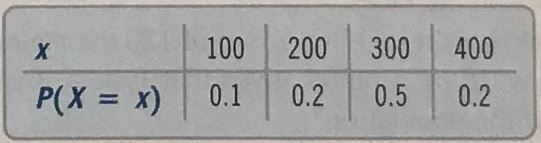
Enter the possible values for x into L1 and the P(X=x) into L2.
Use Stat, Calc, 1-VarStats to find the expected value.
Make sure List: L1 and FreqList: L2

What is the expected value for the random variable E(X)? Remember, the E(X) is the mean or x-bar.

Use the format:
E(X)=#
Enter your answer as a decimal rounded to three places.
4

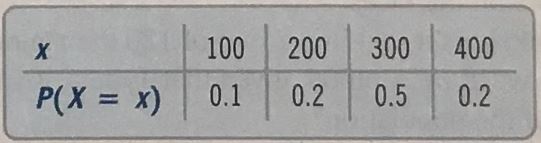
Use the same probability model as #1, and your TI-84 calculator:


What is the standard deviation for the expected value? (sigma x)
Use the format:
s=#
Enter your answer as a decimal rounded to three places.
4

A local non-profit organization is again hosting their annual casino night fundraiser to raise money for charity.
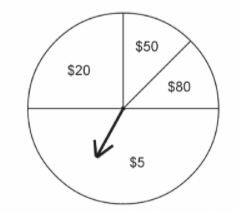
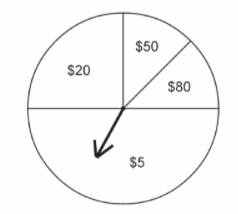
One of last year’s most popular games involved the spinner shown here.


Players paid $20 to spin the spinner once and collected the prize where the arrow landed.
Unfortunately, the non-profit later discovered that this game paid out more money than it took in. They want to use the spinner again this year but need it be profitable for the charity and still attractive to players.

4

Find the expected value for this game (average profit) by multiplying each profit value by its probability and adding.
Use the TI-84 to enter the different values for x into L1 and the probabilities for each value of x into L2
Then use: Stat, Calc, 1-Var Stats.
Be sure to use units ($) and - if the answer is negative.

4

Now find the standard deviation for the probability model.
Use the TI-84 to enter the information into L1 (the different values for 'x') and L2 P(X=x),
Stat, Calc, 1-Var Stats.
Use format:
s=
Be sure to use units ($) and - if the answer is negative.
Round to the cents place, use units since this is money ($).

4

This year they will use the same spinner, just raise the price to $25 per spin.


Use the 'show your work' section to create the new probability model (this part can't be done with the TI-84, we are creating the numbers to enter into L1 & L2).

4

Use the completed probability model to calculate the expected value for the profit of this game for the organization, with the price of $25 per spin.
Use the TI-84 to enter the information into L1 (the different values for 'x') and L2 (the probabilities for each value of 'x'), then Stat, Calc, 1-Var Stats.
Use the format:
E(X)=
Use units.

4

Use the completed probability model to calculate the standard deviation for the profit of this game for the organization, with the price of $25 per spin.
Use the TI-84 to enter the information into L1 (the different values for 'x') and L2 (the probabilities for each value of 'x'), then Stat, Calc, 1-Var Stats.
Use the format:
s=
Use units, this is money so only round to the cents place.

4

Below is a partially filled in table for a game with a different spinner that costs $50 to spin.
Notice the different amounts for x (the amount that can be won).
Use the show your work section to complete the probability model.

4

Use the completed probability model to find the expected value for this spinner.
Use the TI-84:
Enter the profit values (x) for each $ reward into L1.
Enter the probabilities, P(X=x) for each x value into L2.
Use Stat, Calc, 1-VarStats to find the Expected Value and the Standard Deviation.
Enter the Expected Value:
'E(X)='
Make sure to include units since it is money.

4

Use the completed probability model to find the standard deviation for the expected value for this spinner.
Enter the profit values (x) for each $ reward into L1.
Enter the probabilities for each x value into L2.
Use Stat, Calc, 1-VarStats to find the Expected Value and the Standard Deviation.
Enter the Standard Deviation:
s=
Round to the cents place, include units.

4

A consumer organization inspecting new cars found that many had appearance defects (dents, scratches, paint chips, etc). While none had more than three of these defects, 7% had three, 11% had two and 21% had one defect.
Fill in the following probability model for this situation.

4

Use the probability model you created.
Using the TI-84 calculator, enter the information from the probability model.
Enter the possible values for x into L1 (the number of defects) and the P(X=x) into L2.
Stats, Calc, 1-VarStats.
What is the Expected number of appearance defects the dealer can expect to find on a car?
Use the format: E(X)=
Your answer will be a decimal.

4

What is the standard deviation for the number of defects?
Use the format:
s=
Enter your answer as a decimal rounded to three places past the decimal point.