05.05.21 HW - Double Replacement Reactions and Solubility Rules
star
star
star
star
star
Last updated over 4 years ago
23 questions
1
Recall the types of chemical reactions discussed earlier in the unit. Which of the following best describes a double replacement reaction?
1
In your own words, describe what happens to the reactants in a double replacement reaction.
1
Which of the following reactions is a double replacement reaction? Note that the equations are not balanced and that there may be more than one more answer.
1
The reaction below is an example of a double replacement reaction:
2NaOH + CuCO3 → Na2CO3 + Cu(OH2)
Which type of compounds react in double replacement reactions?
The reaction below is an example of a double replacement reaction:
2NaOH + CuCO3 → Na2CO3 + Cu(OH2)
Which type of compounds react in double replacement reactions?
1
Match the states of matter with their symbol.
| Draggable item | arrow_right_alt | Corresponding Item |
|---|---|---|
solid | arrow_right_alt | (g) |
solution / aqueous | arrow_right_alt | (s) |
gas | arrow_right_alt | (aq) |
liquid | arrow_right_alt | (l) |
1
Consider the two reactants below:
NaCl + AgNO3 → ________ + ________
Which of the following are the products of this reaction? If you would like a space to write things out, click on the 'show your work' box below. Do not worry about balancing yet.
Consider the two reactants below:
NaCl + AgNO3 → ________ + ________
Which of the following are the products of this reaction? If you would like a space to write things out, click on the 'show your work' box below. Do not worry about balancing yet.
1
Consider the two reactants below:
NaOH + Cu(SO4)2 → ________ + ________
Which of the following are the products of this reaction? If you would like a space to write things out, click on the 'show your work' box below. Do not worry about balancing yet.
Consider the two reactants below:
NaOH + Cu(SO4)2 → ________ + ________
Which of the following are the products of this reaction? If you would like a space to write things out, click on the 'show your work' box below. Do not worry about balancing yet.
1
Consider the two reactants below:
iron (III) nitrate + magnesium sulfate →
Which of the following are the products of this reaction? If you would like a space to write things out, click on the 'show your work' box below. Do not worry about balancing yet.
Consider the two reactants below:
iron (III) nitrate + magnesium sulfate →
Which of the following are the products of this reaction? If you would like a space to write things out, click on the 'show your work' box below. Do not worry about balancing yet.
1
Consider the two reactants below:
nickel (II) chloride + potassium carbonate →
Which of the following are the products of this reaction? If you would like a space to write things out, click on the 'show your work' box below. Do not worry about balancing yet.
Consider the two reactants below:
nickel (II) chloride + potassium carbonate →
Which of the following are the products of this reaction? If you would like a space to write things out, click on the 'show your work' box below. Do not worry about balancing yet.
1
Write a balanched chemical equation for the reaction that takes place between the following reactants:
copper (II) chloride + beryllium oxide
I strongly encourage you to click on the 'show your work' box below and write things out.
Remember that you will not be able to write subscripts and that you can type your formulas like this in your answer: FeCl3
Write a balanched chemical equation for the reaction that takes place between the following reactants:
copper (II) chloride + beryllium oxide
I strongly encourage you to click on the 'show your work' box below and write things out.
Remember that you will not be able to write subscripts and that you can type your formulas like this in your answer: FeCl3
1
Write a balanched chemical equation for the reaction that takes place between the following reactants:
sodium phosphate + lead (II) nitrate
I strongly encourage you to click on the 'show your work' box below and write things out.
Remember that you will not be able to write subscripts and that you can type your formulas like this in your answer: FeCl3
Write a balanched chemical equation for the reaction that takes place between the following reactants:
sodium phosphate + lead (II) nitrate
I strongly encourage you to click on the 'show your work' box below and write things out.
Remember that you will not be able to write subscripts and that you can type your formulas like this in your answer: FeCl3
1
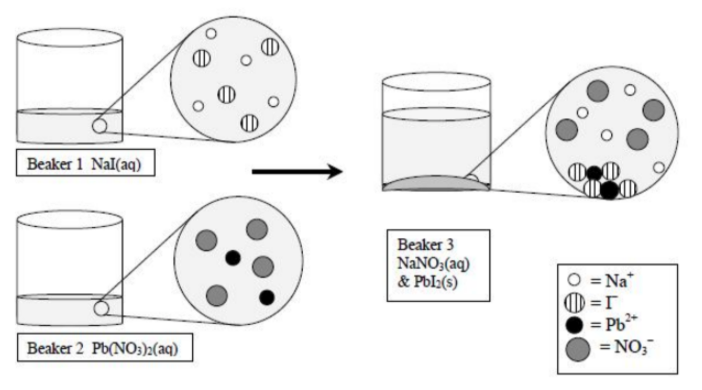
Most of the chemicals in this reaction are _____.
1
Match the particles present in Beaker 1, 2, and 3 with their formula.
| Draggable item | arrow_right_alt | Corresponding Item |
|---|---|---|
| arrow_right_alt | I- | |
| arrow_right_alt | Na+ | |
| arrow_right_alt | NO3- | |
| arrow_right_alt | Pb2+ | |
| arrow_right_alt | PbI2 |
1
Categorize the following substances as either reactants or products for the reaction above.
- NaI (aq)
- PbI2 (s)
- NaNO3 (aq)
- Pb(NO3)2 (aq)
- Reactants
- Products
1
Why do you think some of the spheres in Beaker 3 depicted as touching and shown on the bottom of the beaker?
1
What evidence is found in Beaker 3 that indicates that a chemical change has occured?
1
Some ions were aqueous as reactants and remained aqueous after the reaction occured. Identify these ions.
1
The ions identified in the question above are called spectator ions. Create a definition of spectator ions based on the model.
1
Write the complete balanced equation to represent the chemical reaction in Beaker 3 and indicate the states of matter.
1
Categorize the following substances as soluble or insoluble in water.
- Ba(NO3)2
- CrPO4
- CaCO3
- K3PO4
- CaSO4
- Pb(NO3)2
- Ca(ClO4)2
- Soluble
- Insoluble
1
Determine whether the following substances form a solid or dissolve in water to form a solution.
- lithium chlorate
- strontium sulfate
- silver (I) bromide
- mercury (II) chloride
- ammonium phosphate
- calcium nitrate
- copper (II) acetate
- Forms solid
- Dissolves in water
1
What do you understand best about predicting products of double replacement reactions and solubility rules?
1
What are you struggling with the most around predicting products of double replacement reactions and solubility rules?