Log in
Sign up for FREE
arrow_back
Library
Respiratory System Labeling
By Katelyn Owens
star
star
star
star
star
Share
share
Last updated over 1 year ago
23 questions
Add this activity
1
1
1
3
1
1
1
1
1
1
1
1
6
1
1
2
2
1
title
1
2
3
4
5
zoom_in
Label the Respiratory System:
1
1
1
1
1
Question 6
6.
State how air travels into the respiratory system. Starting with the nose.
Use must use the following organs: Bronchi, Alveoli, Trachea, Bronchioles, Nose
Question 7
7.
What is the function of the respiratory system?
exchange carbon dioxide and oxygen with the body and atmosphere
movement
transport oxygen to body tissues
to break down nutrients
Question 8
8.
Air enters the respiratory sytem through
the mouth
the nose
the trachea
the esophagus
Question 9
9.
Match the function/description to the organ.
Voicebox
Back of the throat
Air enters the respiratory system through this organ. The organ also filters and warms the air
Nose
Pharynx
Larynx
Question 10
10.
The main branches that branch off of the trachea
Trachea
Alveoli
Bronchi
Bronchioles
Question 11
11.
The small branches off of the bronchi that lead to the alveoli
Trachea
Diaphragm
Pharynx
Bronchioles
Question 12
12.
The windpipe. Transports air from the nose/mouth to the lungs.
Trachea
Diaphragm
Pharynx
Bronchioles
Question 13
13.
The tiny sacs where gas exchange occurs
Trachea
Diaphragm
Alveoli
Bronchioles
Question 14
14.
The thin membrane that contracts and relaxes. This membrane changes the volume of the chest cavity forcing air in and out.
Trachea
Diaphragm
Alveoli
Bronchioles
Question 15
15.
The act of breathing in is called
Inhalation
Exhalation
Photosynthesis
Cellular Respiration
Question 16
16.
During inhalation (breathing in), what gas enters the body?
carbon dioxide
oxygen
helium
nitrogen
Question 17
17.
During exhalation (breathing out), what gas exits the body?
carbon dioxide
oxygen
helium
nitrogen
Question 18
18.
Match the description with the process of inhalation or exhalation
The chest cavity gets smaller
The diaphragm relaxes
Air is forced out of the lungs
The chest cavity expands
The diaphragm contracts
Air is forced into the lungs
Inhalation
Exhalation
Question 19
19.
As a person exercises, carbon dioxide levels in the bloodstream increase. This causes the brain to signal which of these systems to respond?
digestive and immune
immune and respiratory
respiratory and circulatory
circulatory and endocrine
Question 20
20.
Where is the trachea located?
In the throat in front of the esophagus, the trachea connects the nasal cavity to the lungs
In the nose
In the chest, the trachea connects the heart to the lungs
In the throat, the trachea connects the mouth to the stomach
Question 21
21.
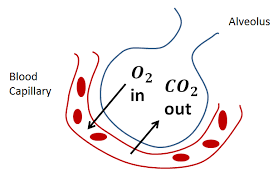
Look at the image. What gas moves into the alveoli? Explain why.
Question 22
22.
Look at the image. What gas moves out of the alveoli and into the blood? Explain why.
Question 23
23.
Look at the image. What process causes the gases to move across the membrane?
Question 1
1.
Identify structure 1.
A. Bronchi
B. Alveoli
C. Trachea
D. Nose
E. Bronchioles
Question 2
2.
Identify structure 2.
A. Bronchi
B. Alveoli
C. Trachea
D. Nose
E. Bronchioles
Question 3
3.
Identify structure 3.
A. Bronchi
B. Alveoli
C. Trachea
D. Nose
E. Bronchioles
Question 4
4.
Identify structure 4.
A. Bronchi
B. Alveoli
C. Trachea
D. Nose
E. Bronchioles
Question 5
5.
Identify structure 5.
A. Bronchi
B. Alveoli
C. Trachea
D. Nose
E. Bronchioles