
1
1
1
1
1
2
2
2
12% of Delcastle graduates return to DTHS to visit their former teachers within 5 years after graduation. Use this information to determine the following probability:
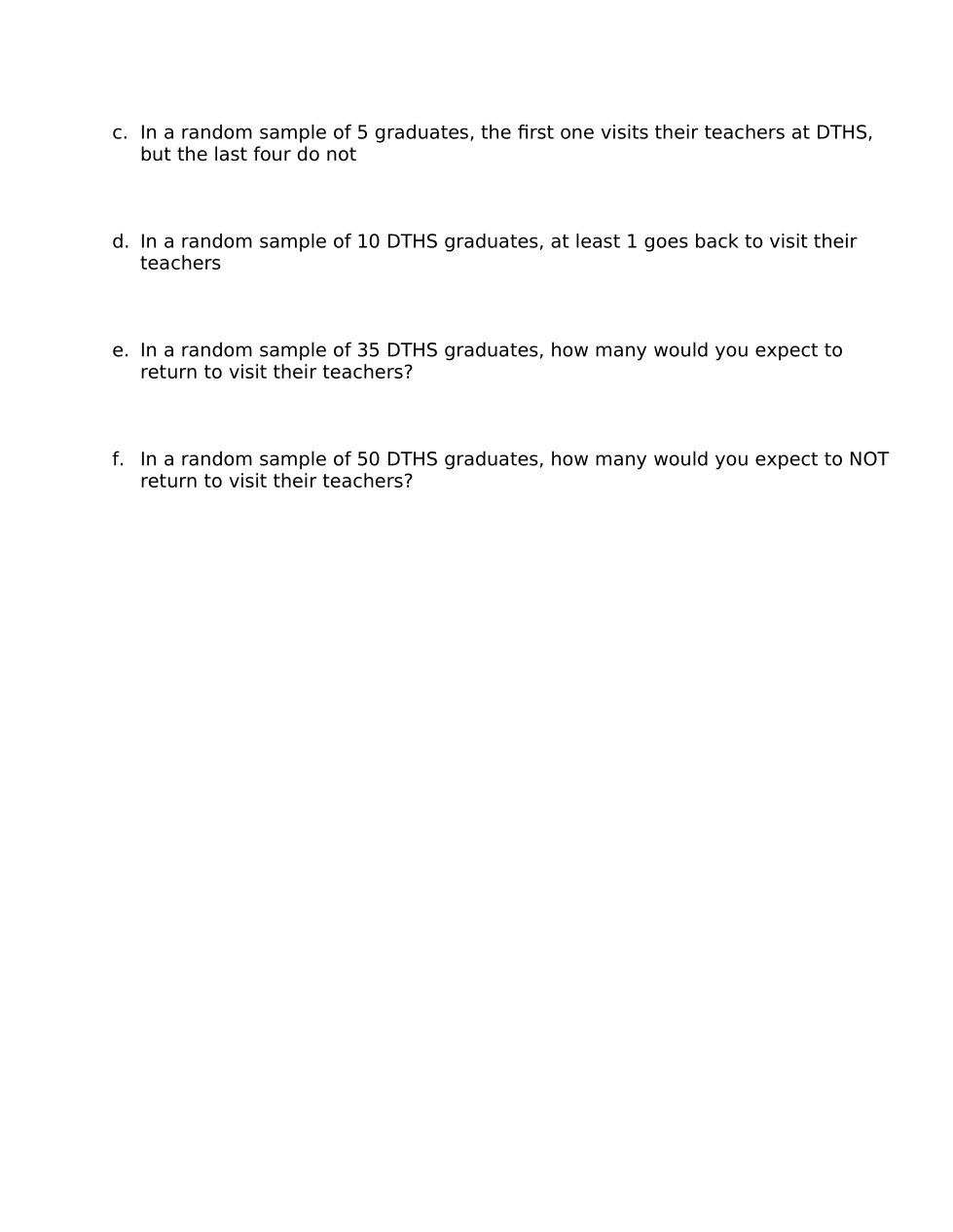
In a random sample of 5 graduates, the first one visits their teachers at DTHS, but the last four do not. Include your calculations leading up to your final answer.
12% of Delcastle graduates return to DTHS to visit their former teachers within 5 years after graduation. Use this information to determine the following probability:
In a random sample of 10 DTHS graduates, at least 1 goes back to visit their teachers. Include your calculations leading up to your final answer.
Does the following situation fit the definition of a binomial situation? If it does not, include an explanation for why not.
Surveying students at lunch for their thoughts on the school menu.
Does the following situation fit the definition of a binomial situation? If it does not, include an explanation for why not.
Rolling a die 20 times and recording the number of times that a 1 occurs.
Does the following situation fit the definition of a binomial situation? If it does not, include an explanation for why not.
Recording the number of questions you answered correctly on a 10-question multiple-choice quiz.
Does the following situation fit the definition of a binomial situation? If it does not, include an explanation for why not.
Recording your answer choices to a 10-question multiple-choice quiz, with answer choices of a-d for each question.
Does the following situation fit the definition of a binomial situation? If it does not, include an explanation for why not.
Surveying 100 people and asking them how many hours of TV they watch each week.
On a multiple-choice pop quiz with three questions (with answer choices of a-d for each) and only one correct answer choice for each, determine the following probability:
You incorrectly guess the first two questions and then correctly guess the third question. Include your calculations leading up to your final answer.
On a multiple-choice pop quiz with three questions (with answer choices of a-d for each) and only one correct answer choice for each, determine the following probability:
You are able to correctly guess one of the three questions. Include your calculations leading up to your final answer.
On a multiple-choice pop quiz with three questions (with answer choices of a-d for each) and only one correct answer choice for each, determine the following probability:
You are able to correctly guess two of the three questions. Include your calculations leading up to your final answer.
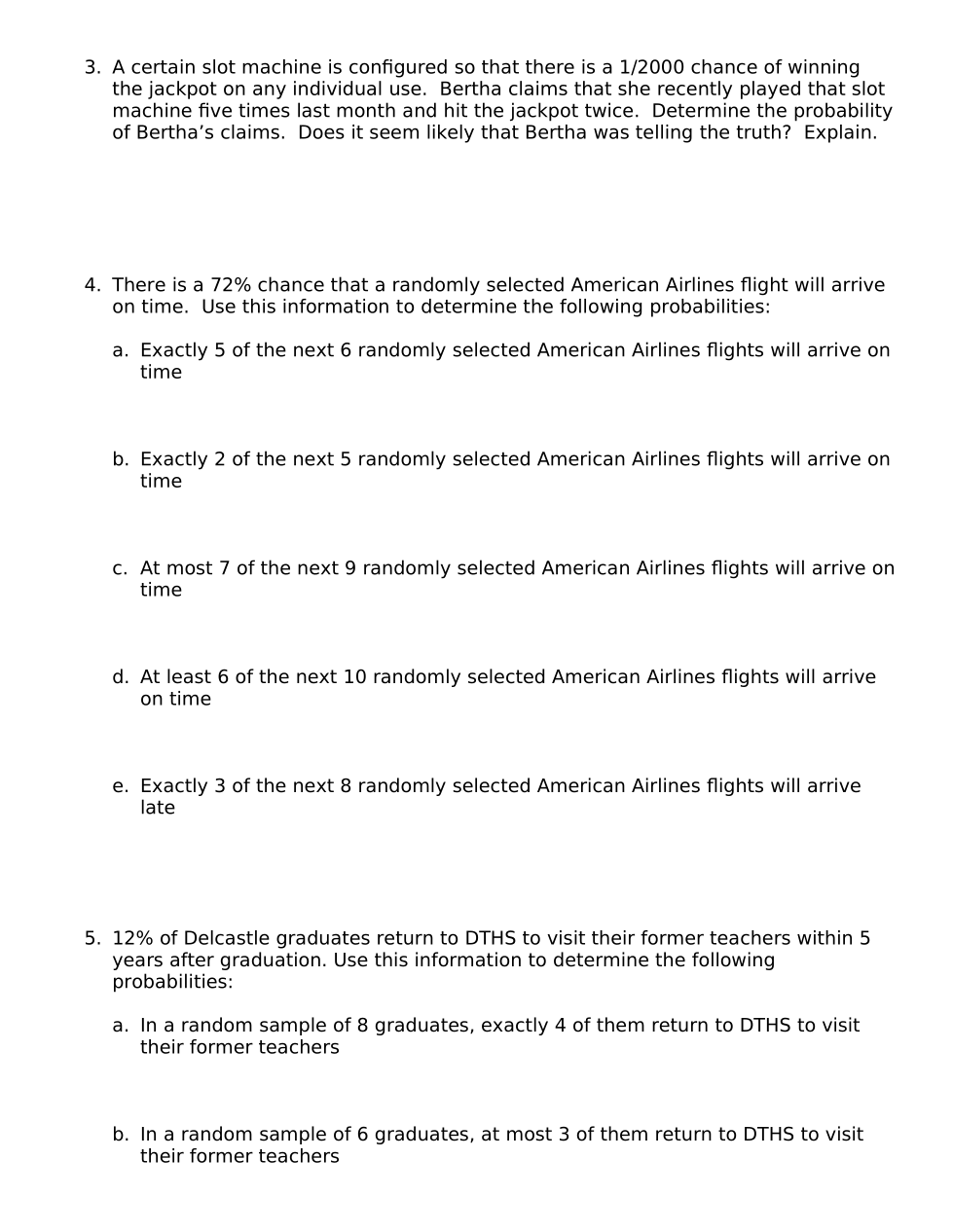
A certain slot machine is configured so that there is a 1/2000 chance of winning the jackpot on any individual use. Bertha claims that she recently played that slot machine five times last month and hit the jackpot twice.
Determine the probability of Bertha's claim (include your calculations). Does it seem likely that Bertha was telling the truth? Use your results to support your answer.
There is a 72% chance that a randomly selected American Airlines flight will arrive on time. Use this information to determine the following probability:
Exactly 5 of the next 6 randomly selected American Airlines flights will arrive on time. Include your calculations leading up to your final answer.
There is a 72% chance that a randomly selected American Airlines flight will arrive on time. Use this information to determine the following probability:
Exactly 2 of the next 5 randomly selected American Airlines flights will arrive on time. Include your calculations leading up to your final answer.
There is a 72% chance that a randomly selected American Airlines flight will arrive on time. Use this information to determine the following probability:
At most 7 of the next 9 randomly selected American Airlines flights will arrive on time. Include your calculations leading up to your final answer.
There is a 72% chance that a randomly selected American Airlines flight will arrive on time. Use this information to determine the following probability:
At least 6 of the next 10 randomly selected American Airlines flights will arrive on time. Include your calculations leading up to your final answer.
There is a 72% chance that a randomly selected American Airlines flight will arrive on time. Use this information to determine the following probability:
Exactly 3 of the next 8 randomly selected American Airlines flights will arrive late. Include your calculations leading up to your final answer.
12% of Delcastle graduates return to DTHS to visit their former teachers within 5 years after graduation. Use this information to determine the following probability:
In a random sample of 8 graduates, exactly 4 of them return to DTHS to visit their former teachers. Include your calculations leading up to your final answer.
12% of Delcastle graduates return to DTHS to visit their former teachers within 5 years after graduation. Use this information to determine the following probability:
In a random sample of 6 graduates, at most 3 of them return to DTHS to visit their former teachers. Include your calculations leading up to your final answer.
12% of Delcastle graduates return to DTHS to visit their former teachers within 5 years after graduation. Use this information to determine the following probability:
In a random sample of 35 DTHS graduates, how many would you expect to return to visit their teachers? Include your calculations leading up to your final answer.
12% of Delcastle graduates return to DTHS to visit their former teachers within 5 years after graduation. Use this information to determine the following probability:
In a random sample of 50 DTHS graduates, how many would you expect to NOT return to visit their teachers? Include your calculations leading up to your final answer.