More Practice with Binomial Probabilities
star
star
star
star
star
Last updated over 5 years ago
24 Nsɛmmisa
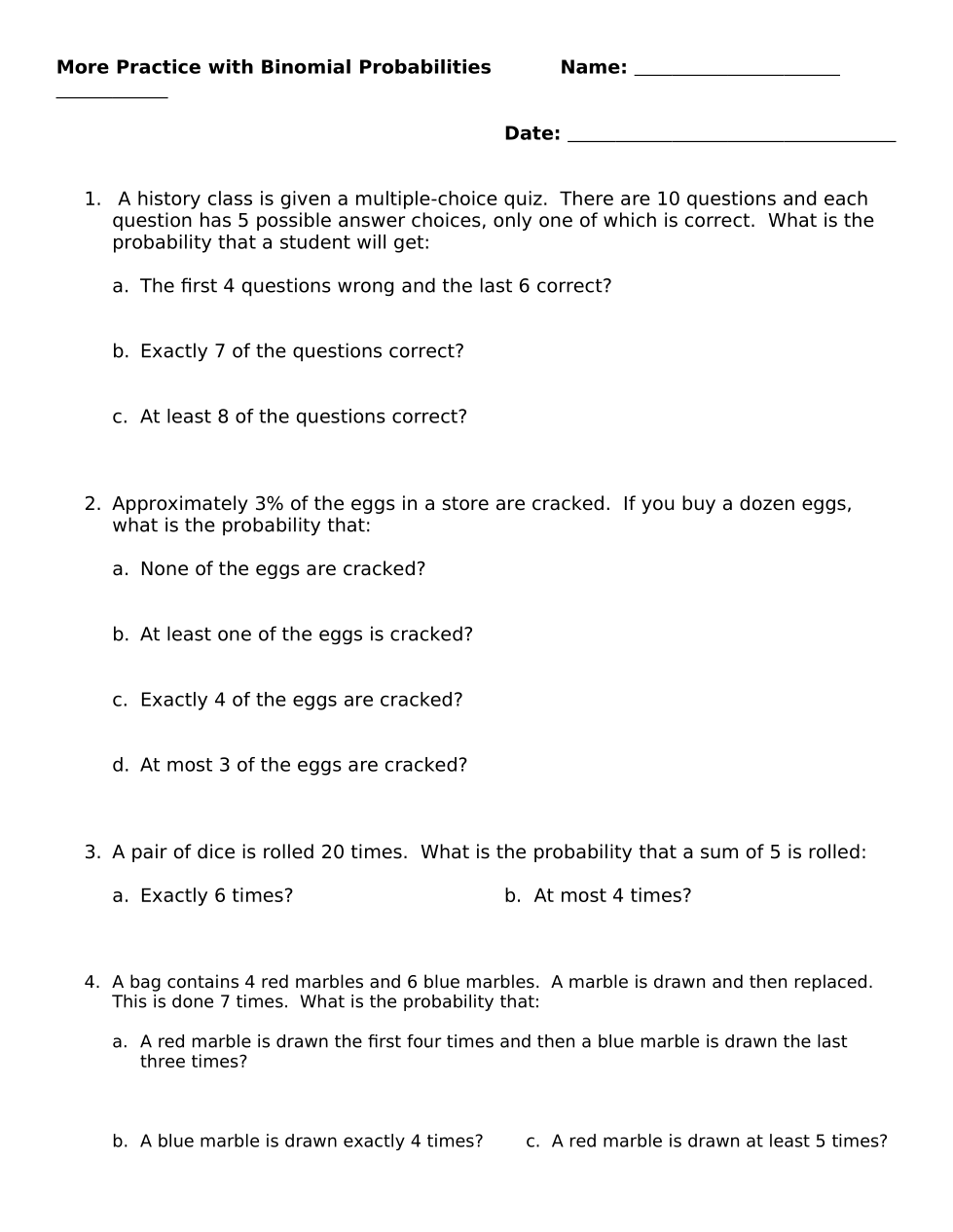
A history class is given a multiple-choice quiz. There are 10 questions and each question has 5 possible answer choices, only one of which is correct. Determine the probability that a student will get:
The first 4 questions wrong and the last 6 correct. Include your calculations leading up to your final answer.
A history class is given a multiple-choice quiz. There are 10 questions and each question has 5 possible answer choices, only one of which is correct. Determine the probability that a student will get:
Exactly 7 of the questions correct. Include your calculations leading up to your final answer.
A history class is given a multiple-choice quiz. There are 10 questions and each question has 5 possible answer choices, only one of which is correct. Determine the probability that a student will get:
At least 3 of the questions correct. Include your calculations leading up to your final answer.
Approximately 3% of the eggs in a store are cracked. If you buy a dozen eggs, determine the probability that:
None of the eggs are cracked. Include your calculations leading up to your final answer.
Approximately 3% of the eggs in a store are cracked. If you buy a dozen eggs, determine the probability that:
At least 1 of the eggs is cracked. Include your calculations leading up to your final answer.
Approximately 3% of the eggs in a store are cracked. If you buy a dozen eggs, determine the probability that:
Exactly 4 of the eggs are cracked. Include your calculations leading up to your final answer.
Approximately 3% of the eggs in a store are cracked. If you buy a dozen eggs, determine the probability that:
At most 3 of the eggs are cracked. Include your calculations leading up to your final answer.
A pair of dice is rolled 20 times. Determine the probability that a sum of 5 is rolled exactly 6 times.
Include your calculations leading up to your final answer.
A pair of dice is rolled 20 times. Determine the probability that a sum of 5 is rolled at most 4 times.
Include your calculations leading up to your final answer.
A bag contains 4 red marbles and 6 blue marbles. A marble is drawn and then replaced. This is done 7 times. Determine the probability that:
A red marble is drawn the first four times and then a blue marble is drawn the last three times. Include your calculations leading up to your final answer.
A bag contains 4 red marbles and 6 blue marbles. A marble is drawn and then replaced. This is done 7 times. Determine the probability that:
A blue marble is drawn exactly 4 times. Include your calculations leading up to your final answer.
A bag contains 4 red marbles and 6 blue marbles. A marble is drawn and then replaced. This is done 7 times. Determine the probability that:
A red marble is drawn at least 5 times. Include your calculations leading up to your final answer.
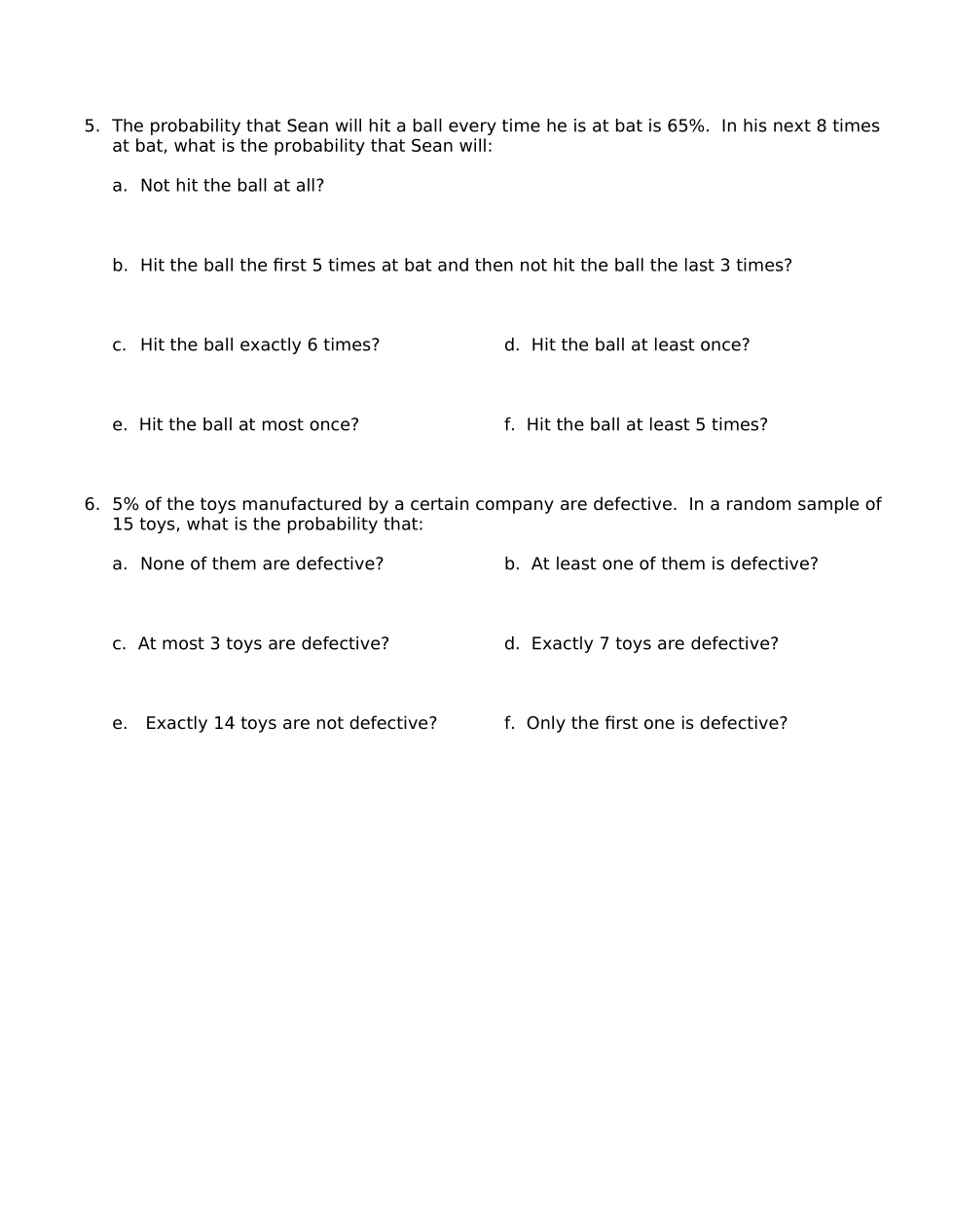
The probability that Sean will hit a ball every time he is at bat is 65%. In his next 8 times at bat, what is the probability that Sean will:
Not his the ball at all?
The probability that Sean will hit a ball every time he is at bat is 65%. In his next 8 times at bat, what is the probability that Sean will:
Hit the ball the first 5 times at bat and then not hit the ball the last 3 times?
The probability that Sean will hit a ball every time he is at bat is 65%. In his next 8 times at bat, what is the probability that Sean will:
Hit the ball exactly 6 times?
The probability that Sean will hit a ball every time he is at bat is 65%. In his next 8 times at bat, what is the probability that Sean will:
Hit the ball at least once?
The probability that Sean will hit a ball every time he is at bat is 65%. In his next 8 times at bat, what is the probability that Sean will:
Hit the ball at most once?
The probability that Sean will hit a ball every time he is at bat is 65%. In his next 8 times at bat, what is the probability that Sean will:
Hit the ball at least 5 times?
5% of the toys manufactured by a certain company are defective. In a random sample of 15 toys, what is the probability that:
None of them are defective?
5% of the toys manufactured by a certain company are defective. In a random sample of 15 toys, what is the probability that:
At least one of them is defective?
5% of the toys manufactured by a certain company are defective. In a random sample of 15 toys, what is the probability that:
At most 3 toys are defective?
5% of the toys manufactured by a certain company are defective. In a random sample of 15 toys, what is the probability that:
Exactly 7 toys are defective?
5% of the toys manufactured by a certain company are defective. In a random sample of 15 toys, what is the probability that:
Exactly 14 toys are NOT defective?
5% of the toys manufactured by a certain company are defective. In a random sample of 15 toys, what is the probability that:
Only the first one is defective?