Unit 5 Lesson 1 Review
star
star
star
star
star
Last updated over 5 years ago
20 Nsɛmmisa
Hyɛ no nsow a efi ɔkyerɛwfo no hɔ:
binomial probabilities
statistically significant
expected earnings
binomial probabilities
statistically significant
expected earnings
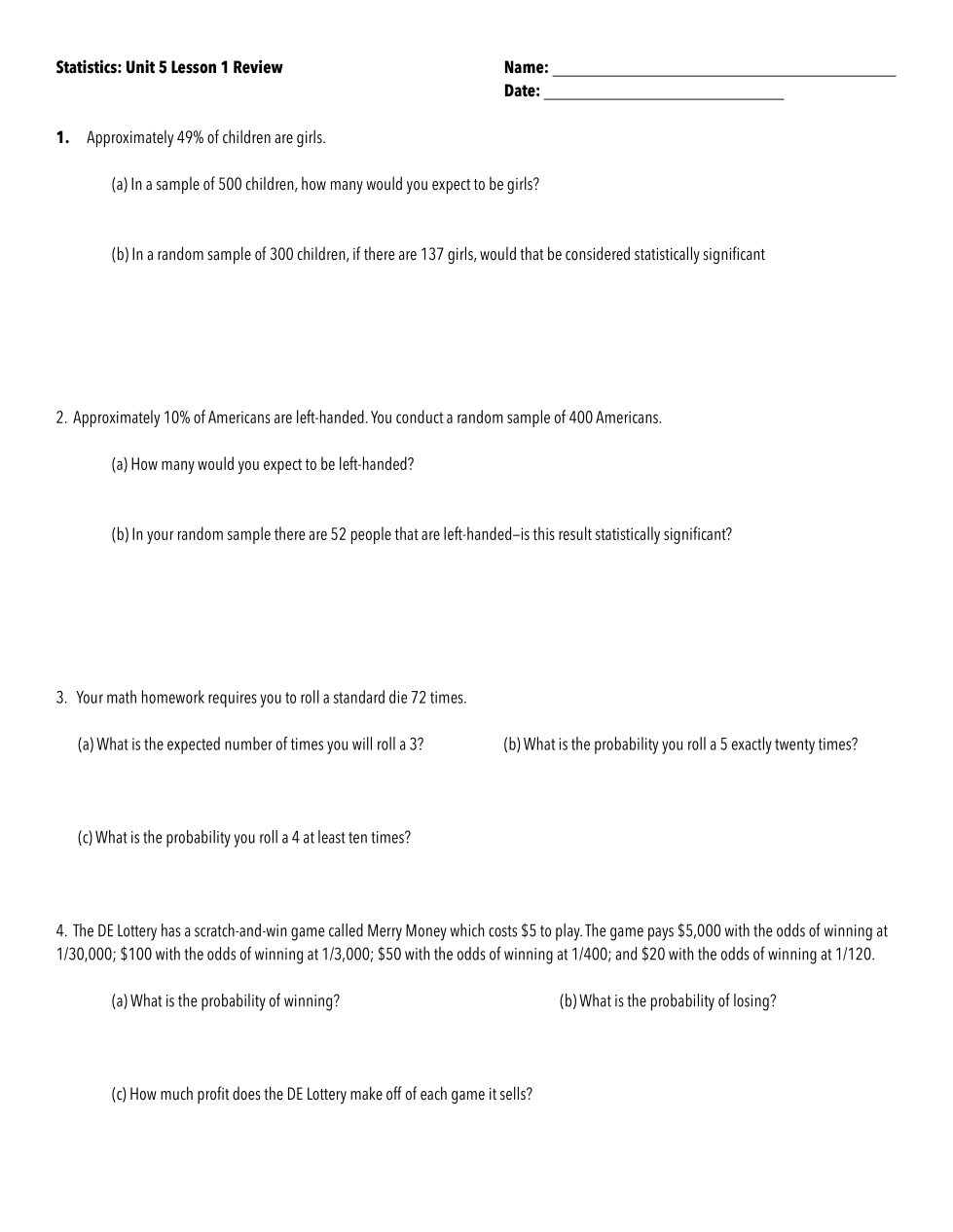
Approximately 49% of children are girls. In a sample of 500 children, how many would you expect to be girls? Include your calculations with your final answer.
Approximately 49% of children are girls. In a random sample of 300 children, if there are 137 girls, would that be considered statistically significant? Include your calculations with your final answer.
Approximately 10% of Americans are left-handed. You conduct a random sample of 400 Americans. How many would you expect to be left-handed? Include your calculations with your final answer.
Approximately 10% of Americans are left-handed. You conduct a random sample of 400 Americans. In your random sample there are 52 people that are left-handed--is this result statistically significant? Include your calculations with your final answer.
Your math homework requires you to roll a standard die 72 times. What is the expected number of times you will roll a 3? Include your calculations with your final answer.
Your math homework requires you to roll a standard die 72 times. What is the probability you roll a 5 exactly twenty times? Include your calculations with your final answer.
Your math homework requires you to roll a standard die 72 times. What is the probability you roll a 4 at least ten times? Include your calculations with your final answer.
The DE Lottery has a scratch-and-win game called Merry Money which costs $5 to play. The game pays the following: $5,000 with the odds of winning that amount at 1/30,000; $100 with the odds of winning that amount at 1/3,000; $50 with the odds of winning at 1/400; and $20 with the odds of winning at 1/120.
What is the probability of winning? Include your calculations with your final answer.
The DE Lottery has a scratch-and-win game called Merry Money which costs $5 to play. The game pays the following: $5,000 with the odds of winning that amount at 1/30,000; $100 with the odds of winning that amount at 1/3,000; $50 with the odds of winning at 1/400; and $20 with the odds of winning at 1/120.
What is the probability of losing? Include your calculations with your final answer.
The DE Lottery has a scratch-and-win game called Merry Money which costs $5 to play. The game pays the following: $5,000 with the odds of winning that amount at 1/30,000; $100 with the odds of winning that amount at 1/3,000; $50 with the odds of winning at 1/400; and $20 with the odds of winning at 1/120.
How much profit does the DE Lottery make off of each game it sells? Include your calculations with your final answer.
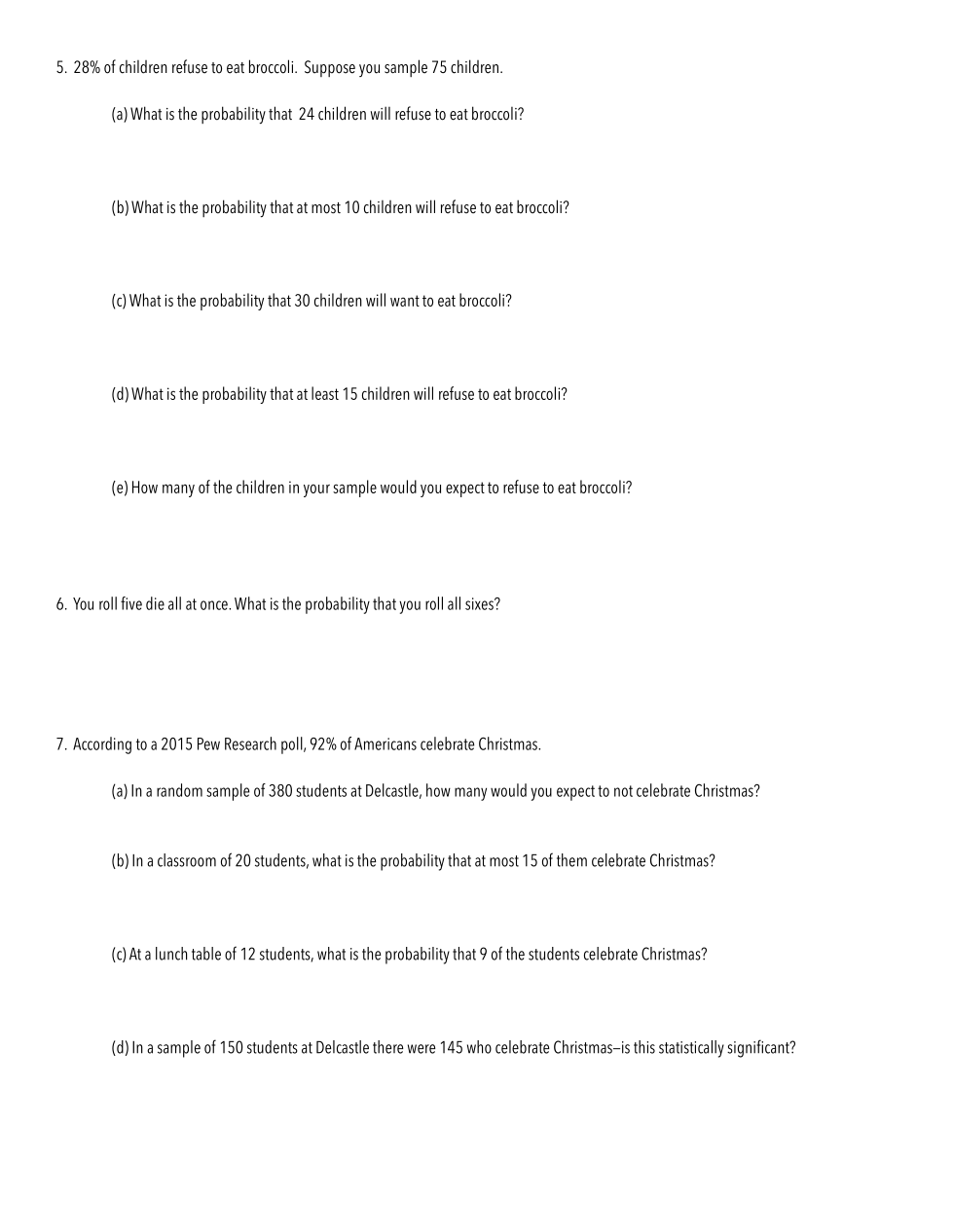
28% of children refuse to eat broccoli. Suppose you take a random sample of 75 children:
What is the probability that 24 children will refuse to eat broccoli? Include your calculations with your final answer.
28% of children refuse to eat broccoli. Suppose you take a random sample of 75 children:
What is the probability that at most 10 children will refuse to eat broccoli? Include your calculations with your final answer.
28% of children refuse to eat broccoli. Suppose you take a random sample of 75 children:
What is the probability that 30 children will want to eat broccoli? Include your calculations with your final answer.
28% of children refuse to eat broccoli. Suppose you take a random sample of 75 children:
What is the probability that at least 15 children will refuse to eat broccoli? Include your calculations with your final answer.
28% of children refuse to eat broccoli. Suppose you take a random sample of 75 children:
How many of the children in your sample would you expect to refuse to eat broccoli? Include your calculations with your final answer.
You roll five die all at once. What is the probability that you roll all sixes? Include your calculations with your final answer.
According to a 2015 Pew Research poll, 92% of Americans celebrate Christmas.
In a random sample of 380 students at Delcastle, how many would you expect to NOT celebrate Christmas? Include your calculations with your final answer.
According to a 2015 Pew Research poll, 92% of Americans celebrate Christmas.
In a classroom of 20 students, what is the probability that at most 15 of them celebrate Christmas? Include your calculations with your final answer.
According to a 2015 Pew Research poll, 92% of Americans celebrate Christmas.
At a lunch table of 12 students, what is the probability that 9 of the students celebrate Christmas? Include your calculations with your final answer.
According to a 2015 Pew Research poll, 92% of Americans celebrate Christmas.
In a sample of 150 students at Delcastle there were 145 who celebrate Christmas--is this statistically significant? Include your calculations with your final answer.