3.4. The Story of Single-Use Plastics

Last updated over 4 years ago
16 questions
1

Quick review: are these resources renewable or non-renewable?

  • Metal
  • Solar energy (the sun)
  • Trees
  • Chicken nuggets
  • Coal
  • Plastic
  • Renewable
  • Non-renewable
1

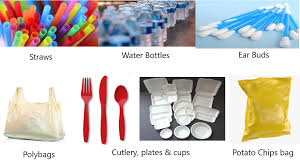
Now that we've explored trees and forests, let's focused on a non-renewable resource: plastic. Specifically, you're going to learn about single-use plastics: that's things like plastic water bags, bottles, spoons and food wrappers that are used once, then thrown away.


Guess: what is one environmental problem with single-use plastics?

Read a short science article, and predict what is going on.

Microplastics found deep in sand where turtles nest

Date: September 26, 2018
Source: University of Exeter


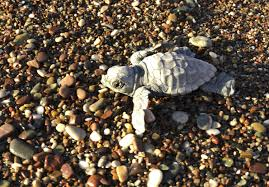
Every summer, Loggerhead and Green Sea Turtles visit the beaches of Cyprus to lay their eggs. Around 50 days later, the 2'' long baby turtles emerge and make their way to the sea.

Over time, their populations have declined, due to fishing, fox predation and habitat loss. But, University of Exeter scientists have discovered a new threat.

On a recent study, researchers found an average of 130,000 fragments of plastic per cubic metre on beaches in Cyprus -- this the second-worst level ever recorded on a beach (the worst was in South China).

Researchers say that this plastic pollution could eventually begin to affect hatching success. It could even alter the ratio of male and female turtle hatchlings.

"We sampled 17 nesting sites for loggerhead and green turtles and found microplastics at all beaches and all depths," said Dr Emily Duncan, of Exeter's Centre for Ecology. "Microplastics have different physical properties than natural sand, so high levels could effect turtle breeding.

"Unlike the beaches in China where the highest levels of microplastics have been recorded, these beaches in Cyprus are located far from industrial factories and aren't visited by large numbers of people," said Professor Brendan Godley, leader of the University of Exeter's marine strategy.

"Therefore it seems that microplastic contamination is arriving on ocean currents."

Source:
https://www.sciencedaily.com/releases/2018/09/180926082740.htm
1

Write a prediction: What's going on? Where did the plastic come from, and why is it so harmful?
I think...

1

Complete this connection circle to illustrate what might be happening. (Remember, that's where you add pieces of the system in the circles, then draw arrows to show how they are connected. I started for you).

Watch to learn more about the life cycle of plastic, then answer questions 5-7.
1

Place in order: what is the lifecycle of plastic?

  1. Natural gas or crude oil is pumped from the ground
  2. Used, then tossed or recycled.
  3. Wrapped, shipped and sent to a store to be purchased
  4. Pellets are melted & molded into products
  5. The processed oil is broken into pellets or "nurdles."
  6. Oil is refined using chemical processes
1

Landfills (garbage dumps) have all of these problems. Which one is plastic responsible for?

1

How long does it take plastic to decompose?

Okay, but recycling is a great solution, right? Learn more, then answer questions 8-10.
If the video isn't working below, here's the link: https://www.youtube.com/watch?v=zVBkjMbF4Z4&feature=emb_logo
1

According to the EPA (Environmental Protection Agency), what percentage of plastics are actually recyled in the US?

1

Until China stopped accepting it, one third of our reycling was shipped there on a boat every year. Now it probably ends up in the landfill.

1

You can recycle something as long as it has the ♲ symbol on it.

Okay, recyling isn't a magical solution. So, can we just ban single-use plastics completely?

Yes, but there might be unintended consequences. If you are using systems thinking, you make sure to consider the "unintended consequences" of any action - like the the accidental side-effects! Read this article and answer 11-12.


Are Plastic Bag Bans Garbage?

April 9, 2019, Planet Money

It was only about 40 years ago that plastic bags became standard at U.S. grocery stores. This also made them standard in sewers, landfills, rivers and the Great Pacific Garbage Patch. They clog drains and cause floods, litter landscapes and kill wildlife. The national movement to get rid of them is gaining steam — with more than 240 cities and counties passing laws that ban or tax them since 2007. But are these bans actually helping the environment?

University of Sydney economist Rebecca Taylor started studying bag regulations and recently published a study of bag regulations in California. It's a classic tale of unintended consequences.

Paper or plastic?
Before California banned plastic shopping bags statewide in late 2016, 139 California cities and counties implemented the policy themselves. Taylor and colleagues compared bag use in cities with bans with those without them. For six months, they spent weekends in grocery stores tallying the types of bags people carried out (she admits these weren't her wildest weekends).

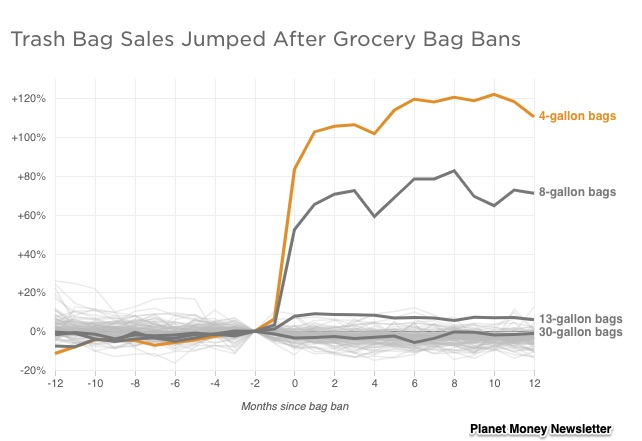
Taylor found these bag bans did what they were supposed to: People in the cities with the bans used fewer plastic bags, which led to about 40 million fewer pounds of plastic trash per year. But people who used to reuse their shopping bags for other purposes, like picking up dog poop or lining trash bins, still needed bags. "What I found was that sales of garbage bags actually skyrocketed after plastic grocery bags were banned," she says. For example, small, 4-gallon bags saw a 120 percent increase in sales after bans went into effect. Plus, these trash are thicker, and use more plastic than typical shopping bags.

On top of that, cities that banned plastic bags saw a surge in the use of paper bags, which she estimates resulted in about 80 million pounds of extra paper trash per year.

Plastic haters, it's time to brace yourselves. A bunch of studies find that paper bags are actually worse for the environment. They require cutting down and processing trees, which involves lots of water, toxic chemicals, fuel and heavy machinery. While paper is biodegradable and avoids the problem of plastic litter, Taylor says, the huge increase in paper use actually raises greenhouse gas emissions overall.

Are tote bags killing us?
What about reusable cloth bags? No waste at all! They've got to be great, right?

Not quite.

A 2011 study by the U.K. government found a person would have to reuse a cotton tote bag 131 times before it was better for climate change than using a plastic grocery bag once. A Danish study that took into account environmental impacts such as water used to grow and make cloth, damage to ecosystems and air pollution, made cloth bags even worse. They estimate you would have to use an organic cotton bag 20,000 times more than a plastic grocery bag to make using it better for the environment.

Stop depressing me. What should we do?
The most environment-friendly way to carry groceries is to probably to use the same plastic bag over and over again. As for bag policies, Taylor says skip the ban. Instead, impose a fee on both paper and plastic bags and encourages reuse.

Source: https://www.npr.org/sections/money/2019/04/09/711181385/are-plastic-bag-bans-garbage
1

When people stopped being able to use plastic bags for groceries, what was an unintended consequence? Choose all that are correct.

1

Next time your family goes shopping, what type of bag would you recommend and why?

But wait, when recycling does happen that's good news, right? Mostly, but there's this....
1

What are micro-fibers?

1

Check out a label on a few of your clothing items. Are any synthetic (look for "poly...")? Write what material(s) you find.

So is there any solution? Here are some awesome examples of how business have tackled a piece of the problem. Choose 2 to explore, then share about your favorite below.

Bioplastic made of shrimp shells
https://www.designnews.com/materials-assembly/shrimp-shells-used-develop-eco-friendly-bioplastic

Adidas Shoes:
https://www.youtube.com/watch?v=pJBRqespiOA

Edible Spoons
https://www.youtube.com/watch?time_continue=2&v=r4Cc5zmy0eY&feature=emb_logo

"Ocean Clean-up" Sunglasses
https://www.youtube.com/watch?v=Lm4JrI69Hoo&feature=emb_logo

Plastic-eating mealworms
https://www.cnn.com/2020/09/10/world/mealworms-bacteria-plastic-waste-c2e-spc-intl/index.html

Patagonia Clothing Design
https://www.patagonia.com/stories/what-you-can-do-about-microfiber-pollution/story-32012.html
1

Explain: what does this business do to reduce the environmental harm caused by single-use plastics?

1

OPINION. Based on what you've learned, who do you think is most responsible for fixing the problem of single-use plastics?