Unit 9 Day 12 CH 14 & 15 Partner Test

Last updated over 4 years ago
34 questions
1. This is a partner test. I am assessing your understanding level of the material we have covered.
2. The test should be done with only the assistance of your notes, class slide decks or the posted Ch. 9 & 10 slide decks and your partner. You should not request or accept the assistance of a friend, family member or neighbor. Submitting answers and/or work done by or with the assistance of someone else is grounds for an Academic Integrity write-up.
0

After reading the text above, select your response.

To be clear, selecting "No" does not free you of the consequences of your actions. Rather, it means I will disable your test until we can talk one-on-one so that you better understand before proceeding.

2

A wildlife biologist examines frogs for a genetic trait he suspects may be linked to sensitivity to industrial toxins in the environment. Previous research had established that this trait is usually found in 1 of every 7 frogs. (this is the probability)
He collects and examines a dozen frogs from a large industrial area.
Assume the frequency(probability) of the trait has not changed.
Is this scenario a Bernoulli Trial?
How do you know?
Select 5 answers.

2

A wildlife biologist examines frogs for a genetic trait he suspects may be linked to sensitivity to industrial toxins in the environment. Previous research had established that this trait is usually found in 1 of every 7 frogs. (this is the probability)
He collects and examines a dozen frogs from a large industrial area.
Assume the frequency(probability) of the trait has not changed.
Using the information above, give the Binomial Model that we will be using:

Keep the probability as a decimal.

4

A wildlife biologist examines frogs for a genetic trait he suspects may be linked to sensitivity to industrial toxins in the environment. Previous research had established that this trait is usually found in 1 of every 7 frogs. (this is the probability)
He collects and examines a dozen frogs. Assume the frequency(probability) of the trait has not changed.
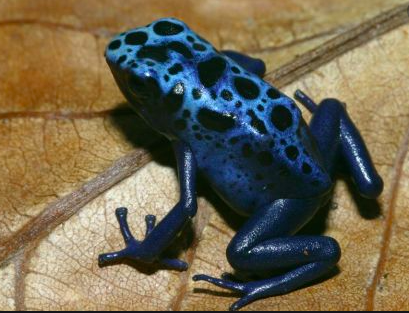

Using this scenario, what is p?
Keep as a decimal.
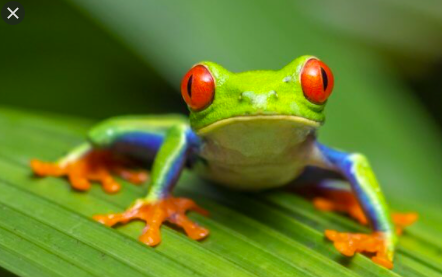
4

Using the same scenario as #4, what is the value for q?
Keep as a decimal.

4

Using the same scenario as #4, what is the value for n?

2

To determine the exact probability that the wildlife biologist finds the trait in none of the 12 frogs, what function will you use?

4

Use the TI-84 calculator to determine the probability that the wildlife biologist finds the trait in none of the 12 frogs.
Use 2nd, Vars...
Enter your answer as a decimal, rounded to three places.

4

Explain what the answer to #8 means using the context of the frogs.

4

What’s the probability he finds the trait in 3 or 4 frogs?
Hint: what operation does 'or' tell you to do?

Enter your answer as a decimal rounded to three places.

4

What’s the probability he finds the trait in no more than 4 frogs?
Hint: Choose carefully- binompdf or binomcdf
Enter your answer as a decimal rounded to three places.

4

What’s the probability he finds the trait in at least 2 of the frogs?
Choose carefully- binompdf or binomcdf
Remember: 'at least' makes us think of the complement. P(at least 2 of the frogs)=1- P(no more than...

Enter your answer as a decimal rounded to three places.

6

Probability models are used when there are more than two possible outcomes and they each have different probabilities of occuring.

In a litter of seven kittens, four are female. You pick two kittens at random and record the number of male kittens. Use the amount of kittens to figure out the probability of each outcome.
Be careful, the probability of choosing each of the kittens (1st vs 2nd) is different since they are not replaced.

*** order matters when choosing kittens, so for one male kitten it could be: M,F OR F,M*** take this into consideration when finding the probability of getting one male kitten.

Fill in the table to create a Probability Model.

4

Is your probability model valid? (it needs to be!)
How do you know? Use statistical reasons to explain.

4

If a family comes to visit and wants to pick out two kittens, use your probability model to find the expected number of male kittens that they will take home.

Use the TI-84 Calculator, Stat, Edit, enter the values into L1 and L2, then use Stat, Calc, 1-VarStats.
Enter the answer as a decimal rounded to three places.

2

Explain what the answer to #15 means in the context of the number of male kittens.

4

If a family comes to visit and wants to pick out two kittens, use your probability model to find the standard deviation for the number of male kittens chosen to take home.

Use the TI-84 Calculator, enter the values into L1 and L2, then use 1-VarStats.
Enter the standard deviation as a decimal rounded to three places.

2

Explain the meaning for the standard deviation in this scenario.

3

In one city, police estimate that 82% of drivers wear their seat belts. They set up a safety roadblock and they stop drivers to check for seat belt use. If 160 drivers are stopped, what's the probability they find no more than 140 wearing their seat belts?

Can you estimate the probability using the Normal Model?
Select 3 answers.

4

In one city, police estimate that 82% of drivers wear their seat belts. They set up a safety roadblock and they stop drivers to check for seat belt use. If 160 drivers are stopped, would it be unusual for the police to find 140 drivers wearing their seatbelts?

1st calculate the expected value(this is the mean) and the standard deviation, write them down.


2nd calculate the z-score. Enter it below rounded to three places past the decimal point.

4

In one city, police estimate that 82% of drivers wear their seat belts. They set up a safety roadblock and they stop drivers to check for seat belt use. If 160 drivers are stopped and the police to found 140 drivers wearing their seatbelts, would this be statistically significant?

Explain why or why not using statistical information we have discussed in class.

4

In one city, police estimate that 82% of drivers wear their seat belts. They set up a safety roadblock and they stop drivers to check for seat belt use. The police stopped 160 drivers.

Now that you've calculated the z-score. Use the Normal Model to estimate the probability that no more than 140 drivers will have on their seatbelts.

Use 2nd, Vars, Normalcdf, you will need to decide the lower and upper limits.
IF you need Upper Infinity use: 99
IF you need lower infinity use: -99
USE the Z-score from #21.
Enter your answer as a decimal rounded to three places.

4

In one city, police estimate that 82% of drivers wear their seat belts. They set up a safety roadblock and they stop drivers to check for seat belt use. The police stopped 160 drivers.

Use the Binomial Model to find the EXACT probability that no more than 140 of them suffer from manic-depressive illness.
Use 2nd, Vars, Binom... (you need to decide if you should use binompdf or binomcdf)
Enter your answer as a decimal rounded to three places.

4

Compare the results from the two models. Did the Normal Model over or underpredict the probability?
How do you know?

4

In one city, police estimate that 78% of drivers wear their seat belts. They set up a safety roadblock and they stop drivers to check for seat belt use. The police stopped 160 drivers.

Use the Binomial Model to find the EXACT probability that exactly 134 of them have their seatbelts on.

Use 2nd, Vars, Binom... (you need to decide if you should use binompdf or binomcdf)
Enter your answer as a decimal rounded to three places.

4

Venn Diagram:
A survey of local high schools revealed that total of 16% of students play football, a total of 9% played baseball, and 6% play both baseball and football.
Use the 'show your work' section to fill in the information into the Venn Diagram.

4

A survey of local high schools revealed that 16% of students play football, 9% played baseball, and 6% play both baseball and football.
Use the 'show your work' section to fill in the information into the 2-way table.

4

Use the 2-way table for football and baseball players to answer the question:
What is the probability that a high school student plays football or baseball?
P(football or baseball) =
Enter your answer as a decimal.

4

Use the 2-way table for football and baseball players to answer the question:
Given that an athlete plays football, what is the probability that he plays baseball?
P(Baseball | Football) =

4

Use the 2-way table for football and baseball players to answer the question:
Given that an athlete does NOT play football, what is the probability that he plays baseball?\
P(Baseball | No Football) =

4

Use the 2-way table for football and baseball players and your calculations in the previous three questions:
Are playing football and baseball mutually exclusive?
Why or why not? (make sure to use statistical reasons to explain your answer, it needs to be clear)

4

Compound probability without replacement:

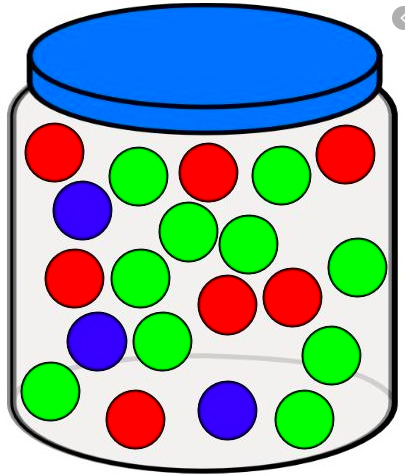
Using the jar of 20 gumballs pictured above, what is the probability of picking two green gumballs?
(the first you give to a friend and the second you eat yourself)

P(Green, Green):

Enter your answer as a decimal rounded to three places.

4

Compound probability without replacement:

Using the jar of 20 gumballs pictured above, what is the probability of picking a red and then a green gumball? (the first you give to a friend and the second you eat yourself)

P(Red, Green):

Enter your answer as a decimal rounded to three places.

0

BONUS:
Compound probability without replacement:

Using the jar of 20 gumballs pictured above, you are going to randomly pick out 3 gumballs. What is the probability of picking at least one blue gumball?
(remember, 'at least one' means the complement of none of the gumballs are blue)

Enter your answer as a decimal rounded to three places.