AP Physics Task 4

Last updated over 4 years ago
25 questions
1

How much work would a child do while pulling a 12-kg wagon a distance of 4.3 m with a 22 N force?

1

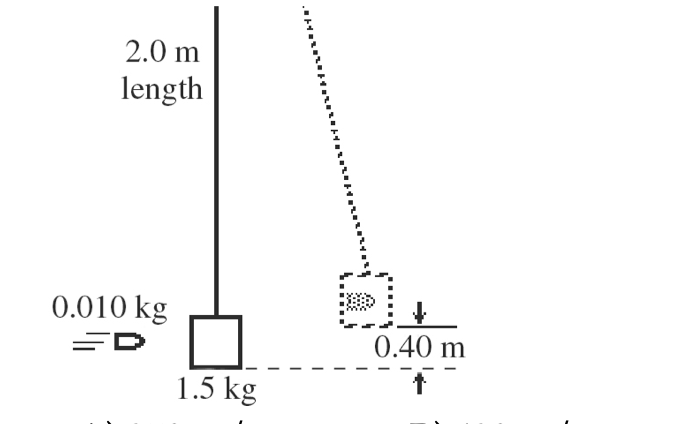
As shown in the figure, a bullet of mass 0.010 kg moving horizontally suddenly strikes a block of wood of mass 1.5 kg that is suspended as a pendulum. The bullet lodges in the wood, and together they swing upward a vertical distance of 0.40 m. The length of the string is 2.0 m. What was the speed of the bullet just before it struck the wooden block?
1

A crane lifts a 425 kg steel beam vertically upward a distance of 95 m. How much work does the crane do on the beam if the beam accelerates upward at 1.8 m/s 2 ? Neglect frictional forces.

A) 4.0 × 10 5 J

B) 4.7 × 10 5 J

C) 2.7 × 10 5 J

D) 3.2 × 10 5 J

1

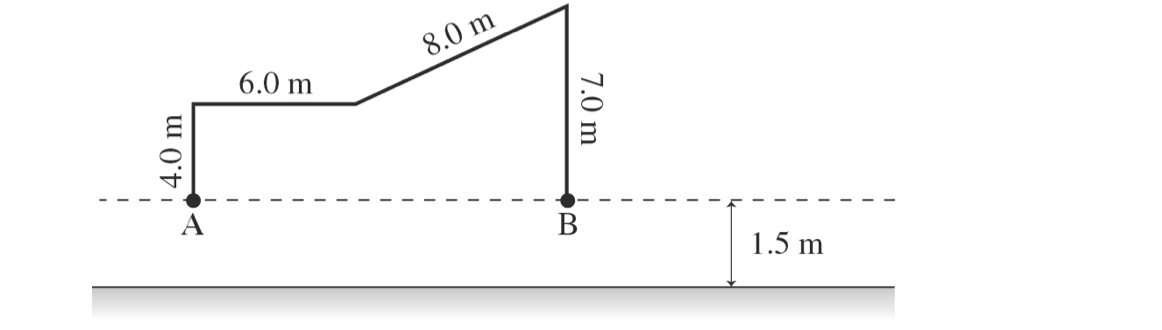
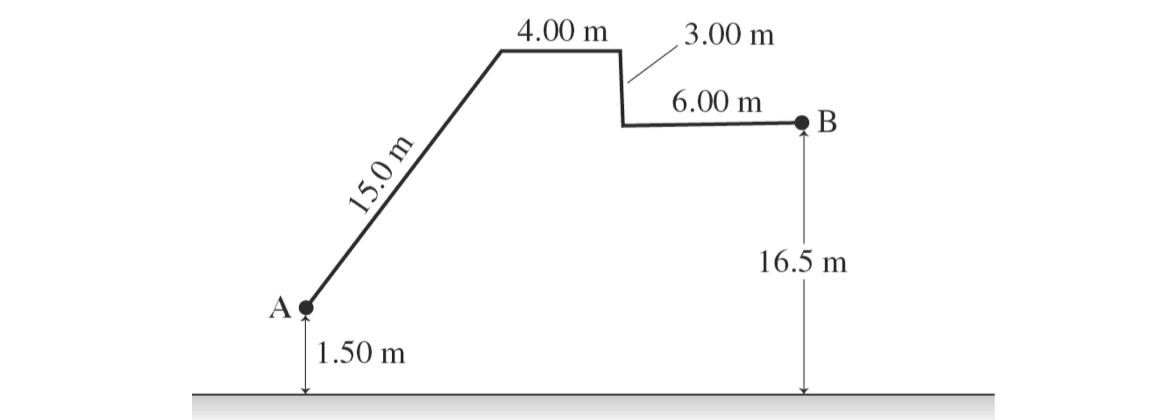
A person carries a 25.0-N rock through the path shown in the figure, starting at point A and ending at point B. The total time from A to B is 1.50 min. How much work did gravity do on the rock between A and B?

1

A person carries a 2.00-N pebble through the path shown in the figure, starting at point A and ending at point B. The total time from A to B is 6.75 min. How much work did gravity do on the rock between A and B?

1

6) How much kinetic energy does a 0.30-kg stone have if it is thrown at 44 m/s?

1

A 1.0-kg object moving in a certain direction has a kinetic energy of 2.0 J. It hits a wall and comes back with half its original speed. What is the kinetic energy of this object at this point?

1

A 10-kg dog is runnng with a speed of 5.0 m/s. What is the minimum work required to stop the dog in 2.40 s?

1

A 1000-kg car experiences a net force of 9500 N while slowing down from 30 m/s to 15.9 m/s.

How far does it travel while slowing down?

1

A sled having a certain initial speed on a horizontal surface comes to rest after traveling 10 m. If the coefficient of kinetic friction between the object and the surface is 0.20, what was the initial speed of the object?

1

A stone is moving on a rough level surface. It has 24 J of kinetic energy, and the friction force on it is a constant 0.50 N. What is the maximum distance it can slide?

1

You do 116 J of work while pulling your sister back on a fritctionless swing, whose chain is

5.10 m long, until the swing makes an angle of 32.0° with the vertical. What is your sister's mass?

1

A 10-kg mass, hung by an ideal spring, causes the spring to stretch 2.0 cm. What is the spring constant (force constant) for this spring?

1

An ideal spring has a spring constant (force constant) of 2500 N/m. is stretched 4.0 cm. How much work is required to stretch the spring by 4.0 cm?

1

If the work done to stretch an ideal spring by 4.0 cm is 6.0 J, what is the spring constant (force constant) of this spring?

1

How much work is required to stretch an ideal spring of spring constant (force constant) 40 N/m from x = 0.20 m to x = 0.25 m if the unstretched position is at x = 0.00 m?

1

A rock falls from a vertical cliff that is 4.0 m tall and experiences no significant air resistance as it falls. At what speed will its gravitational potential energy (relative to the base of the cliff) be equal to its kinetic energy?

1

A block slides down a frictionless inclined ramp and experiences no significant air resistance. If the ramp angle is 17.0° above the horizontal and the length of the surface of the ramp is 20.0 m, find the speed of the block as it reaches the bottom of the ramp, assuming it started sliding from rest at the top.

1

A prankster drops a water balloon from the top of a building. If the balloon is traveling at 29.1 m/s when it strikes a window ledge that is 1.5 m above the ground, how tall is the building? Neglect air resistance.

1

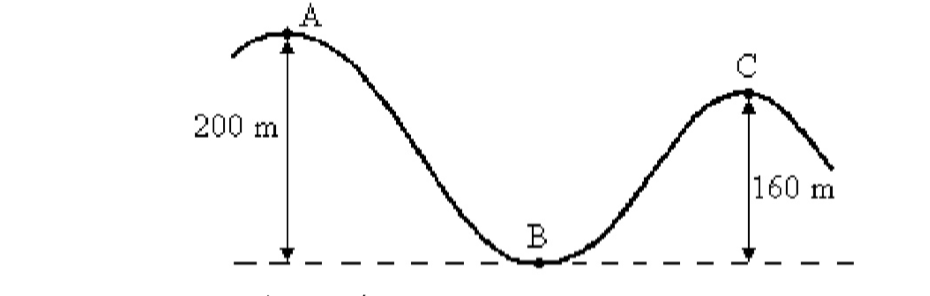
A bead is moving with a speed of 20 m/s at position A on the track shown in the figure. This track is friction-free, and there is no appreciable air resistance. What is the speed of the bead at point C?

1

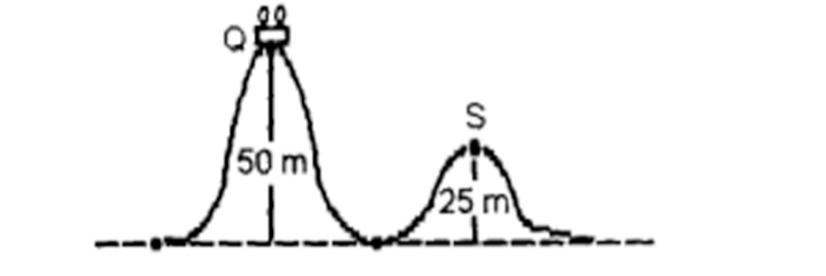
The figure shows a famous roller coaster ride. You can ignore friction. If the roller coaster leaves point Q from rest, what is its speed at the top of the 25-m peak (point S)?

1

A 60-kg skier pushes off the top of a frictionless hill with an initial speed of 4.0 m/s. How fast will she be moving after dropping 10 m in elevation? Air resistance is negligible.

1

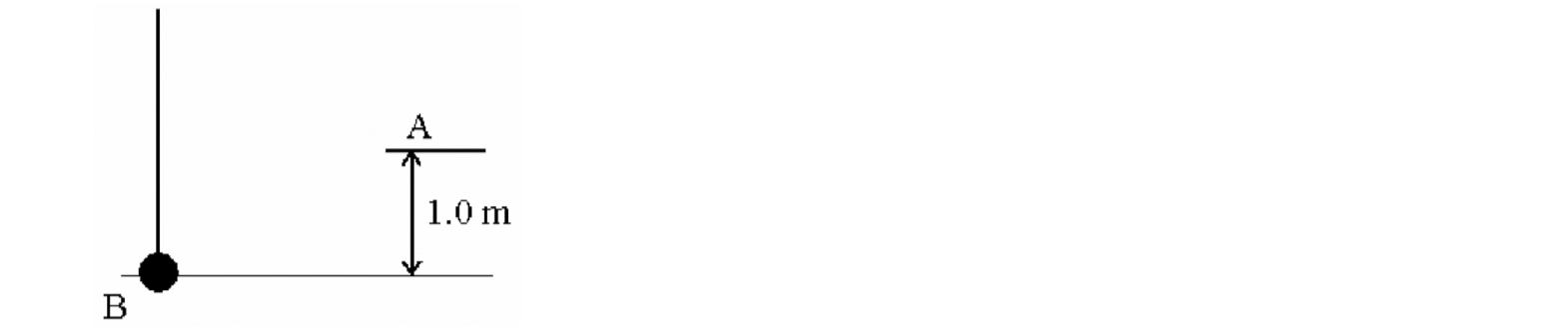
In the figure, a ball hangs by a very light string. What is the minimum speed of the ball at the bottom of its swing (point B) in order for it to reach point A, which is 1.0 m above the bottom of the swing?


1

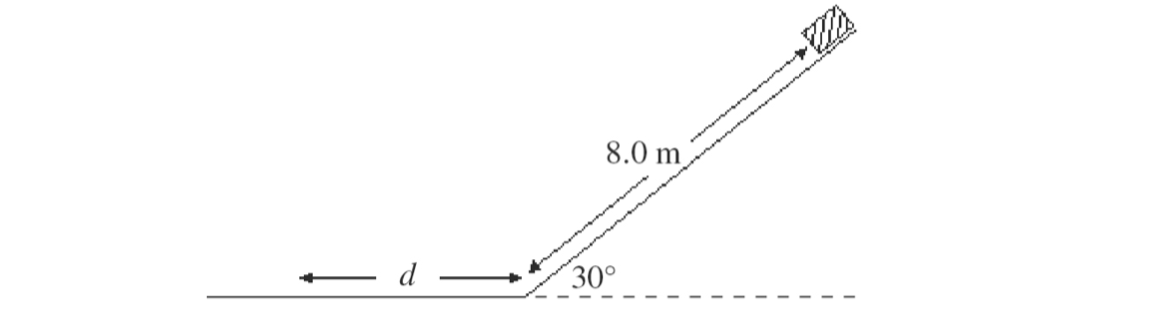
An object with a mass of 10 kg is initially at rest at the top of a frictionless inclined plane that rises at 30° above the horizontal. At the top, the object is initially 8.0 m from the bottom of the incline, as shown in the figure. When the object is released from this position, it eventually stops at a distance d from the bottom of the inclined plane along a horizontal surface, as shown. The coefficient of kinetic friction between the horizontal surface and the object is 0.20, and air resistance is negligible. Find the distance d.

1

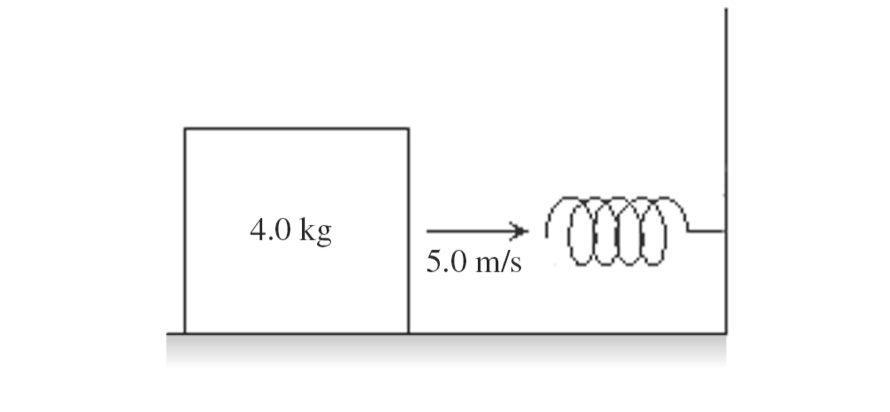
As shown in the figure, a 4.0-kg block is moving at 5.0 m/s along a horizontal frictionless surface toward an ideal spring that is attached to a wall. After the block collides with the spring, the spring is compressed a maximum distance of 0.68 m. What is the speed of the block when the spring is compressed to only one-half of the maximum distance?