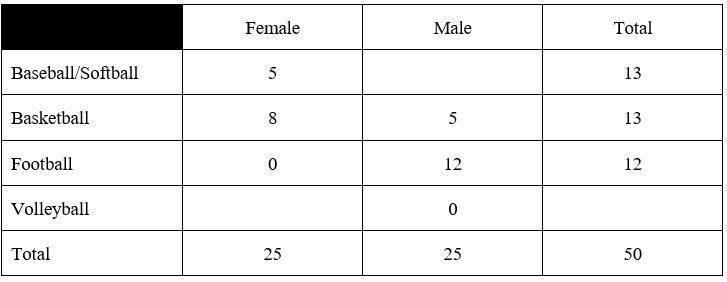
Give the value that correctly completes the table.
1
1
1
1
Question 6
6.
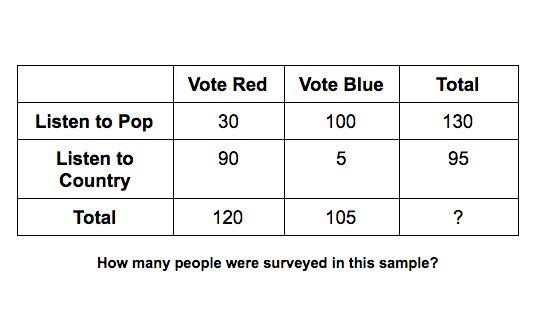
How many total people were surveyed?
Use the video above to answer questions 7-11.
Question 7
7.
Question 8
8.
Question 9
9.
Question 10
10.
Question 11
11.
Calculate the probability that the contestant wins the car BEFORE the correct numbers are revealed.
HINT: She already knows the 1st and 3rd numbers. She needs higher than a 5 AND lower than a 4 AND lower than a 5.
Question 12
12.
Match the probability term to its definition.
trial
the likelihood that something will happen or will not happen
dependent event
something that happens (or does not happen)
event
an event that has an equal likelihood regardless of past events
probability
an event where the likelihood changes based on what happened previously
independent event
every other event that could possibly occur
complement
actually performing the event
Question 3
3.
Give the value that correctly completes the table.
Question 4
4.
Give the value that correctly completes the table.
Question 5
5.
Given that the person is a female, what is the probability that she chose baseball/softball as her favorite sport?
The first number in the price of the car is a 1 because it is given.
Based strictly on probability (not factoring in what Drew Carey says about "not selling a 14, 13, 12, or 11 thousand dollar car"), what are the chances that the contestant is correct on the 2nd number in the price being higher than a 5?
None of the above
The contestant gets the third number in the price of the car correct on her second roll. Prior to the roll, what was the probability that she rolled the correct number?
None of the above
The contestant rolls a four on her third roll and guesses the 4th number in the price of the car is LOWER than a 4. What is the probability that she is correct?
None of the above
The contestant rolls a five on her fourth roll and guesses the 5th number in the price of the car is LOWER than a 5. What is the probability that she is correct?
None of the above
Categorize each of the following scenarios into independent events or dependent events.
flipping a coin and getting heads, then flipping a coin and getting tails
spinning a spinner and getting "1", then spinning the same spinner and getting "2"
pulling a blue marble out of a bag, then pulling a green marble out of a bag
pulling a blue marble out of a bag, putting it back in, then pulling a green marble out of a bag
flipping a king from a deck of cards, then flipping a jack