Log in
Sign up for FREE
arrow_back
Library
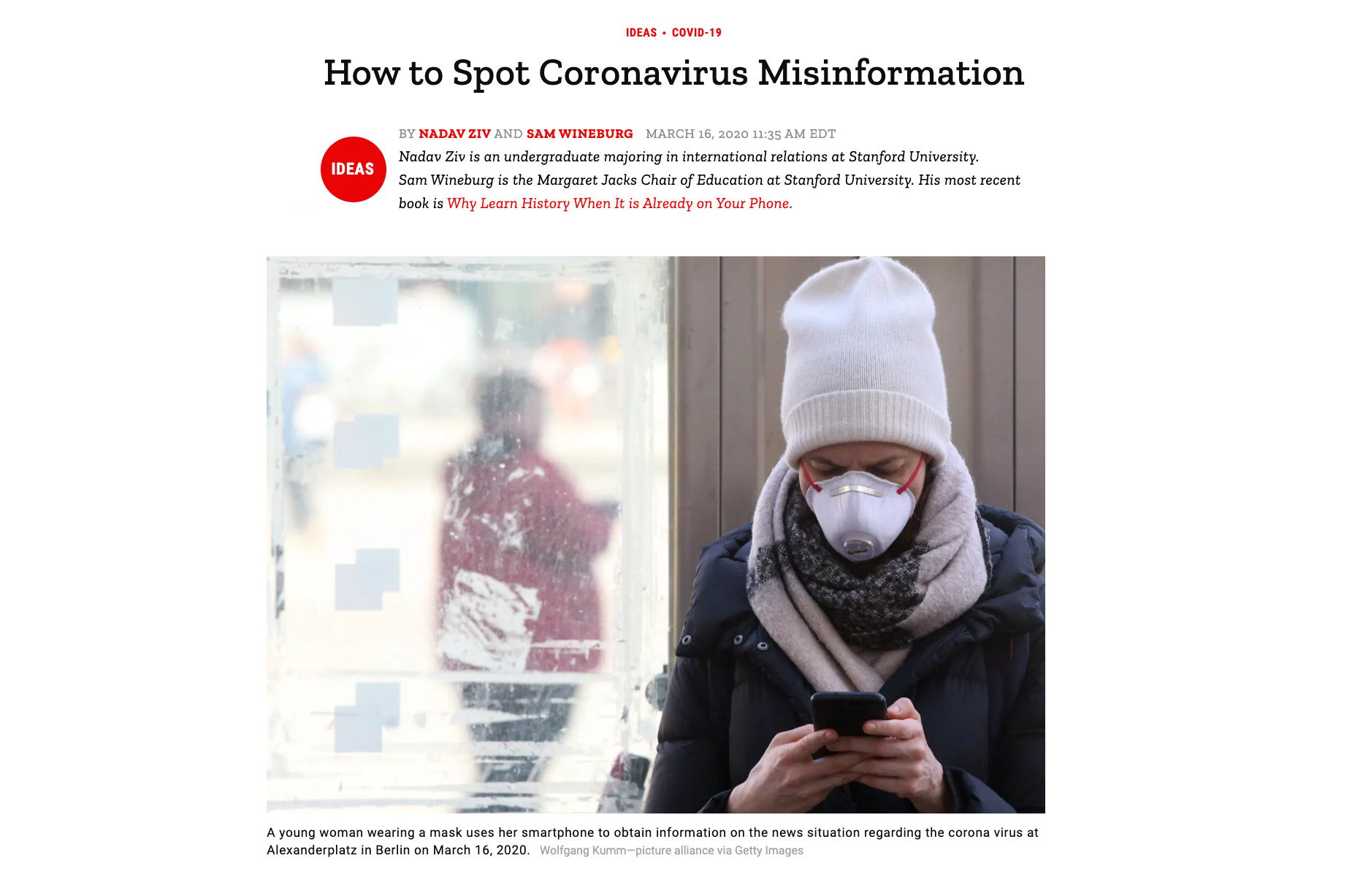
How to Spot Coronavirus Misinformation by Nadav Ziv and Sam Wineburg
By Haiyen Truong
star
star
star
star
star
Share
share
Last updated over 1 year ago
12 questions
Add this activity
1
IIWD.01
1
IIRC.02
1
IIWD.01
1
IIRC.02
1
IITE.01
1
RPU.01
1
zoom_in
1
Question 1
1.
What is the craziest piece of misinformation that you have heard about Covid-19?
You are encouraged but not required to use the "Show Your Work" function to upload the example to share with our class!
visibility
View drawing
2
zoom_in
1
Question 2
2.
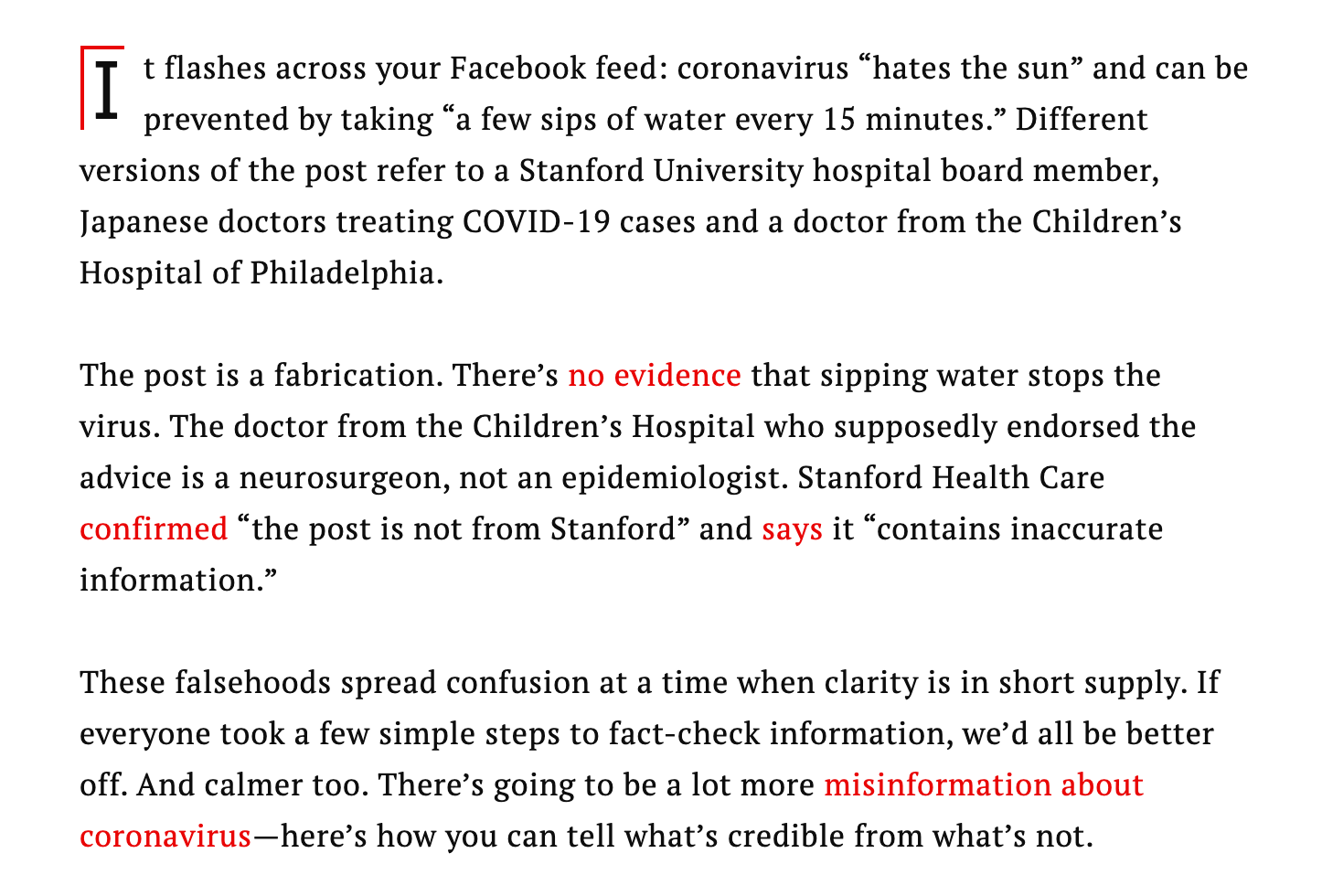
The authors refer to the "different versions of the post" in lines 2-3 in order to
explain how people who produce Coronavirus misinformation come from a variety of backgrounds.
suggest that social media should be better regulated to stop the spread of misinformation.
provide an example of how Coronavirus misinformation is a widespread problem.
assert that it is nearly impossible to know what Coronavirus information is true and false.
RTS.02
Question 3
3.
As used in line 1 of paragraph 2, "fabrication" most nearly means
product.
fiction.
exaggeration.
model.
visibility
View drawing
Question 4
4.
It can be reasonably inferred that the doctor described in the second paragraph
promoted an unproven Coronavirus treatment to gain attention and fame.
was educated at Stanford's prestigious medical school.
did not know their name was being used in the misleading pos
has had notable success treating COVID-19 patients.
title
zoom_in
Here is the original misinformation post from the article:
5
zoom_in
1
Question 5
5.
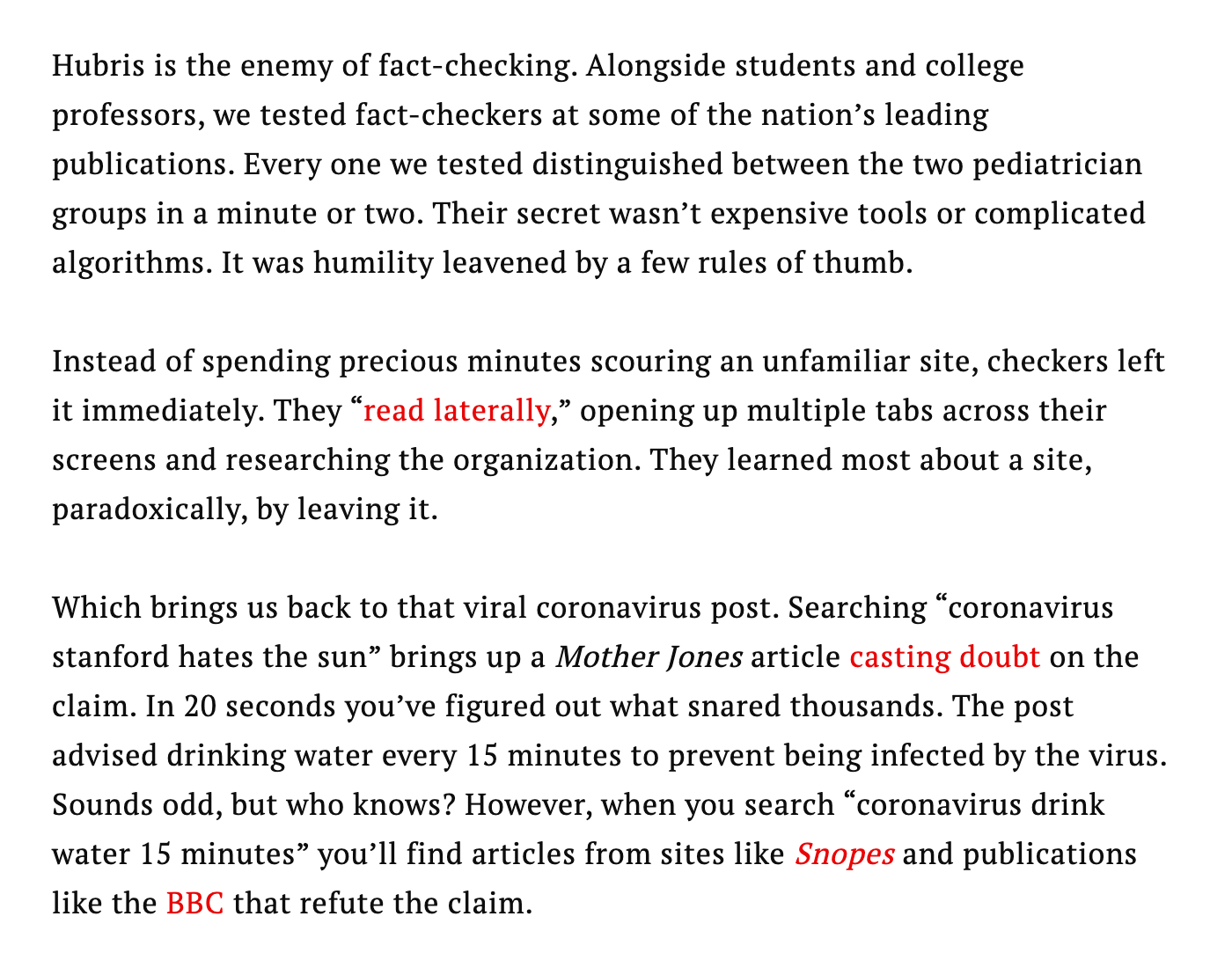
The passage indicated that fact checkers are able to determine whether a source is trustworthy by
regularly testing their effectiveness by comparing serious and less-serious organizations.
spending hours to scour unfamiliar websites for inconsistencies and discrepancies.
leaving the unfamiliar site and using outside sources to confirm or contradict suspect claims.
investing in their natural intelligence and utilizing expensive tools.
IIRC.01
Question 6
6.
As used in line 1 of paragraph 2, "scouring" most nearly means...
polishing brilliantly.
skimming quickly.
reviewing thoroughly.
cleaning obsessively.
visibility
View drawing
Question 7
7.
It can be reasonably inferred that the authors consider Mother Jones, Snopes, and the BBC to be
disseminators of competing information about the Coronavirus.
the original publishers of the fake news stories about Coronavirus treatments.
reliable sources that provide valid information and truthful facts.
niche websites that should only be used by professional fact-checkers.
8
zoom_in
1
Question 8
8.
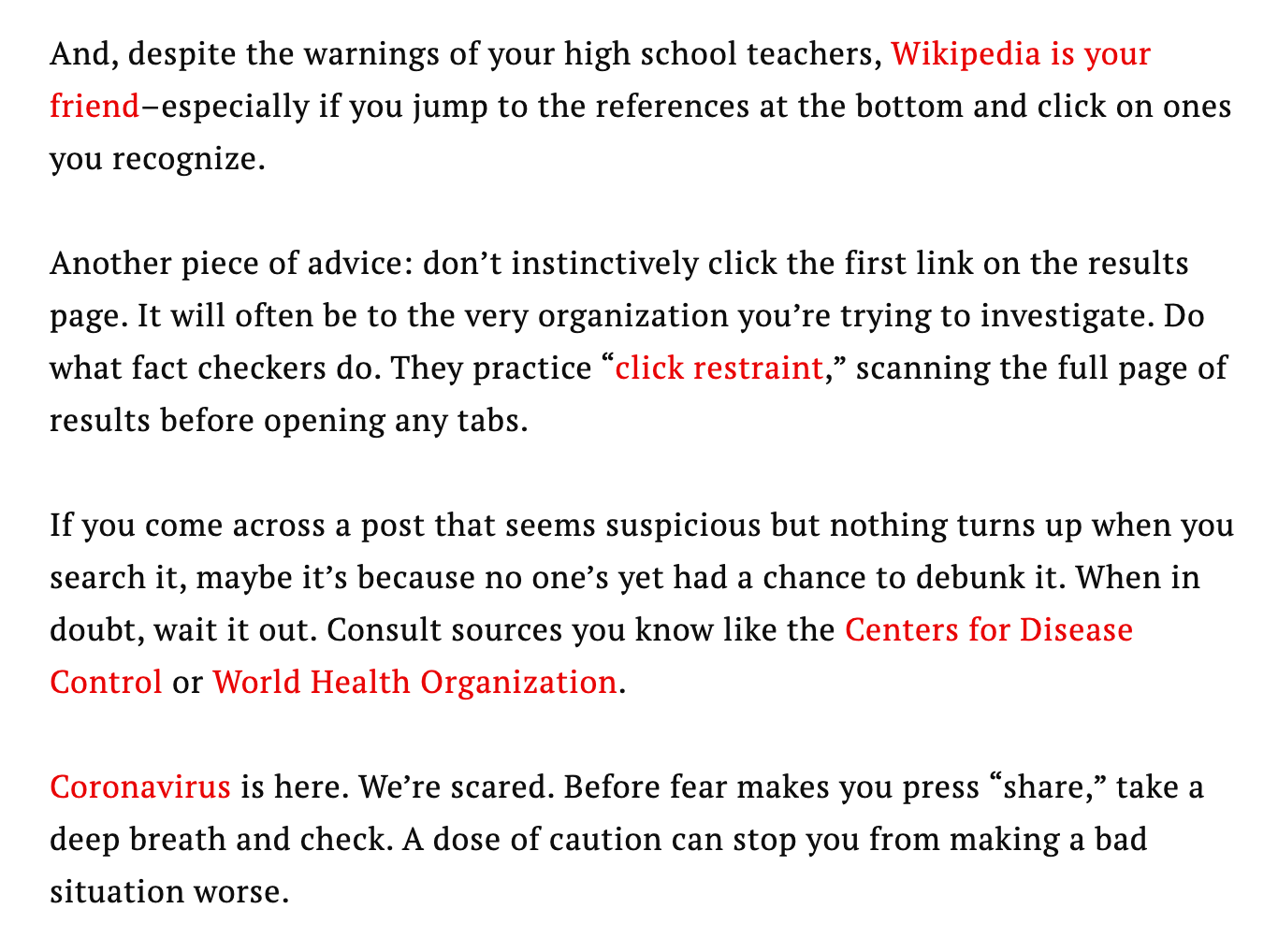
The excerpt suggests that a high school teacher would most likely
be completely unfamiliar with Wikipedia and its potential benefits.
promote the use of Wikipedia to learn background information on research topics.
teach students about the pros and cons of using Wikipedia for research.
discourages students from using Wikipedia under any circumstances.
IIRC.02
Question 9
9.
Which choice best supports the conclusion that the author's recommended methods will not always work immediately?
Lines 8-9 ("If you...debunk it")
Lines 4-5 ("Another piece...to investigate")
Lines 1-3 ("Wikipedia is...you recognize")
Lines 12-13 ("Before fear...and check")
visibility
View drawing
Question 10
10.
The main purpose of the article is to
provide information about the Coronavirus that people can actually trust.
contradict some specific Coronavirus treatment information that has gone viral.
teach readers how to evaluate new information to determine what's trustworthy.
explain why some people try to mislead and confuse the public during chaotic times.
title
zoom_in
Do
NOT
proceed beyond this point. We are going to test your understanding of the article next time in class.
11
zoom_in
0
0
Question 11
11.
Example A:
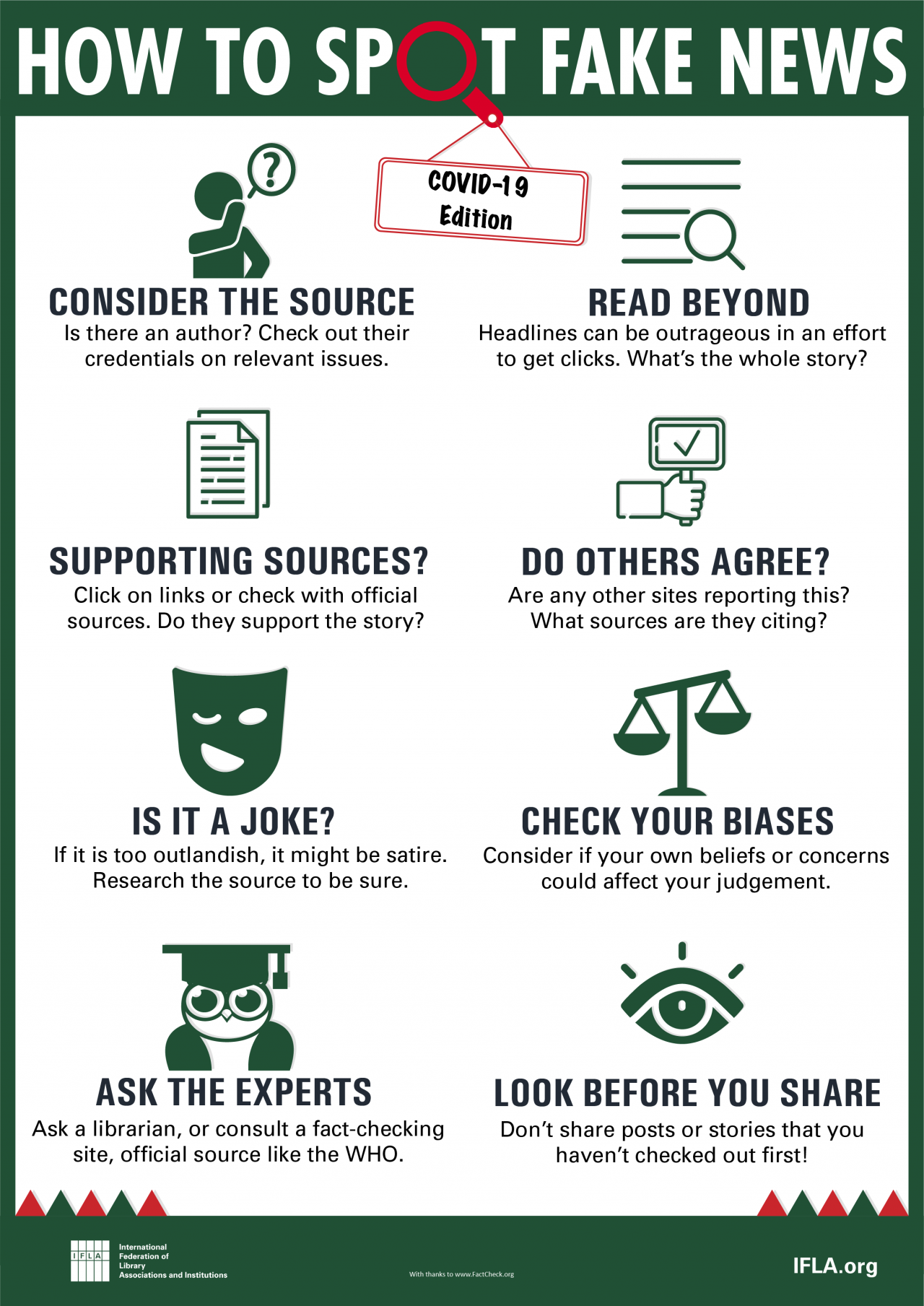
Why is this an example of "fake news"? [Check
all
that apply]
Unsubstantiated Source
Lack of Supporting Sources
Satire -- Too ridiculous to be true.
visibility
View drawing
Question 12
12.
Example B:
Why is this an example of "fake news"? [Check
all
that apply]
Unsubstantiated Source
Lack of Supporting Sources
Satire -- Too ridiculous to be true.
visibility
View drawing