A 0.14-kg baseball is dropped from rest from a height of 2.0 m above the ground. What is the magnitude of its momentum just before it hits the ground if we neglect air resistance?
1 point
1
Question 2
2.
A 0.10-kg ball, traveling horizontally at 25 m/s, strikes a wall and rebounds at 19 m/s. What is the magnitude of the change in the momentum of the ball during the rebound?
1 point
1
Question 3
3.
A 328-kg car moving at 19.1 m/s in the +x direction hits from behind a second car moving at 13.0 m/s in the same direction. If the second car has a mass of 790 kg and a speed of 15.1 m/s right after the collision, what is the velocity of the first car after this sudden collision?
1 point
1
Question 4
4.
A 549-kg car moving at 19.1 m/s in the +x direction hits from behind a second car moving at 10.9 m/s in the same direction. If the second car has a mass of 641 kg and a speed of 17.2 m/s right after the collision, what is the velocity of the first car after this sudden collision?
1 point
1
Question 5
5.
Two ice skaters suddenly push off against one another starting from a stationary position. The 45-kg skater acquires a speed of 0.375 m/s relative to the ice. What speed does the 60-kg skater acquire relative to the ice?
1 point
1
Question 6
6.
Two ice skaters suddenly push off against one another starting from a stationary position. The 45-kg skater acquires a speed of 0.375 m/s relative to the ice. What speed does the 60-kg skater acquire relative to the ice?
1 point
1
Question 7
7.
In a police ballistics test, a 10.0-g bullet moving at 300 m/s is fired into a 1.00-kg block at rest. The bullet goes through the block almost instantaneously and emerges with 50.0% of its original speed. What is the speed of the block just after the bullet emerges?
1 point
1
Question 8
8.
A dinner plate falls vertically to the floor and breaks up into three pieces, which slide horizontally along the floor. Immediately after the impact, a 200-g piece moves along the +x-axis with a speed of 2.00 m/s, a 235-g piece moves along the +y-axis with a speed of 1.50 m/s. The third piece has a mass of 100 g. What is the speed of the third piece?
1 point
1
Question 9
9.
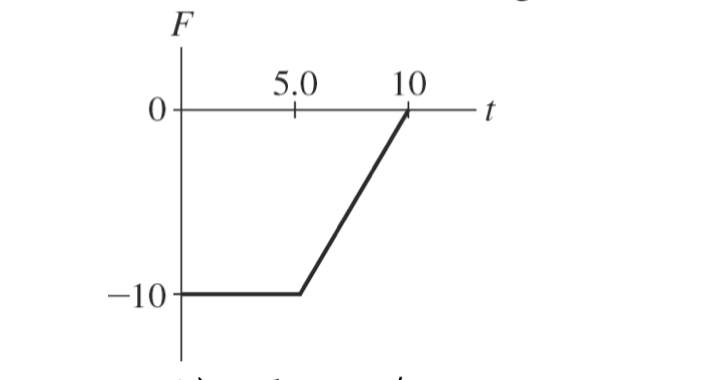
The graph in the figure shows the x component F of the net force that acts for 10 s on a 100-kg crate. What is the change in the momentum of the crate during the 10 s that this force acts?
1 point
1
Question 10
10.
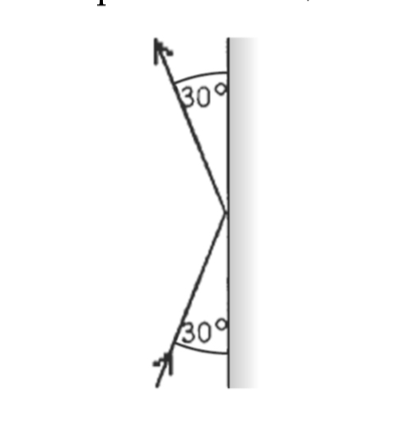
A super dart of mass 20 g, traveling at 350 m/s, strikes a steel plate at an angle of 30° with the plane of the plate, as shown in the figure. It bounces off the plate at the same angle but at a speed of 320 m/s. What is the magnitude of the impulse that the plate gives to the bullet?
1 point
1
Question 11
11.
A block of mass m = 34 kg and speed V is behind a block of mass M = 81 kg and speed of 0.50 m/s, as shown in the figure. The surface is frictionless and the blocks collide and couple. After the collision, the blocks have a common speed of 0.90 m/s. What is the magnitude of the impulse on the 34-kg block due to the collision?
1 point
1
Question 12
12.
A block of mass m = 5.6 kg, moving on a frictionless surface with a velocity of v i = 6.5 m/s to the right, collides with a block of mass M at rest, as shown in the figure. After the collision, the 5.6-kg block recoils with a velocity of v f = 0.70 m/s to the left. If the blocks are in contact for 0.20 s, what is the magnitude of the average force on the 5.6-kg block, while the two blocks are in contact?
1 point
1
Question 13
13.
A 2.0-kg mass moving at 5.0 m/s suddenly collides head-on with a 3.0-kg mass at rest. If the collision is perfectly inelastic, what is the speed of the masses just after the collision?
1 point
1
Question 14
14.
A 1500-kg car traveling at 90 km/h toward the east suddenly collides with a 3000-kg car traveling at 60 km/h toward the south. The two cars stick together after the collision. What is the speed of the cars after collision?
1 point
1
Question 15
15.
A 1500-kg car traveling at 90 km/h toward the east suddenly collides with a 3000-kg car traveling at 60 km/h toward the south. The two cars stick together after the collision. What is the direction of motion of the cars after collision?
1 point
1
Question 16
16.
A 900-kg car traveling east at 15.0 m/s suddenly collides with a 750-kg car traveling north at 20.0 m/s. The cars stick together after the collision. In what direction does the wreckage move just after the collision?
1 point
1
Question 17
17.
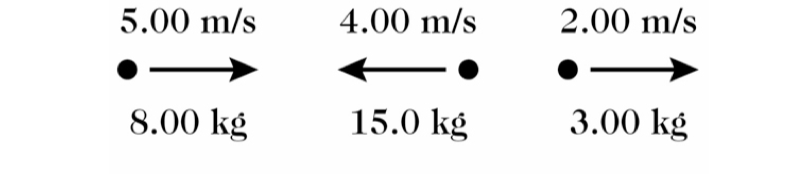
Three objects are moving along a straight line as shown in the figure. Taking the positive direction to be to the right, what is the total momentum of this system?
1 point
1
Question 18
18.
A 0.330-kg volleyball is thrown vertically downward with a speed of 0.150 m/s in a place where g = 9.81 m/s2. It takes 0.0655 s to reach the ground. What is the magnitude of its momentum just before it hits the ground?
1 point
1
Question 19
19.
Two air track carts move along an air track towards each other. Cart A has a mass of 450 g and moves toward the right with a speed of 0.850 m/s. Cart B has a mass of 300 g and moves toward the left with a speed of 1.12 m/s. What is the total momentum of the two-cart system?
1 point
1
Question 20
20.
A 100-g ball falls from a window that is 12 m above ground level and experiences no significant air resistance as it falls. What is its momentum when it strikes the ground?
1 point
1
Question 21
21.
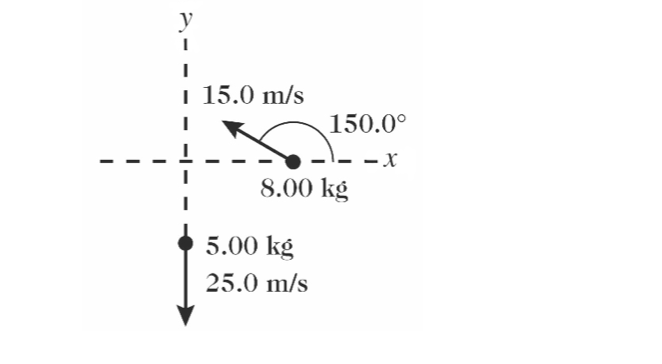
Find the magnitude and direction of the net momentum of the system shown in the figure. Express the direction by giving the angle the net momentum makes with the +x-axis.