Complete the single replacement reaction. Write the formula of the missing product #1.
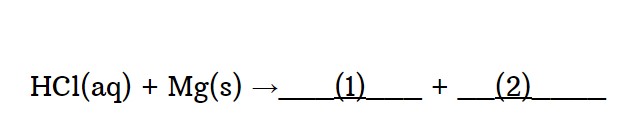
Complete the single replacement reaction. Write the formula of the missing product #1.
What is an electrolyte? (Look up the definition if you do not remember!)
Water is NOT an electrolyte. Explain this fact.
What happens when soluble salts dissolve in water? Describe this phenomenon. Sketch a model to show the phenomenon in the "show your work" spot. (Remember to include all characteristics of a good model!)
Write the dissociation (ionization) equation for each:
b), e) and f) of #4 are acids.
Write a statement that would tell someone what to look for in the chemical formula to identify an acid.
a) NaCl(s)
b) HCl
c) LiOH
d) Ba(OH)2
e) HC2H3O2
f) H3PO4
c) and d) of #4 are bases.
Write a statement that would tell someone what to look for in the chemical formula to identify a base.
List three additional acids:
List three additional bases:
What do you know about the pH scale? What does the pH scale measure?
What is the pH of pure water?
Define a salt. (Look up the chemistry definition if you need to).
Complete the single replacement reaction. Write the formula of the missing product #1.
Complete the single replacement reaction. Write the formula of the missing product #2.
Complete the double replacement reaction. Write the formula of the missing product #1.
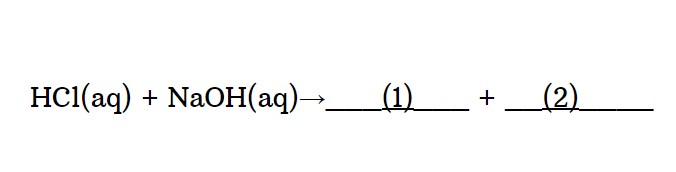
Complete the double replacement reaction. Write the formula of the missing product #2.
Which substance, when dissolved in water, forms a solution that conducts an electric current?
Select two indicators from Refernce Table M that are yellow in solutions with a pH of 5.5.
HNO3
Ca(OH)2
CH3OH
NH3
CH3COOH
ACID
BASE
OTHER
Draw the Lewis electron-dot diagram to represent a hydroxide ion.