Inv. 5.3.3 Calculating and Interpreting Confidence Intervals

Last updated over 4 years ago
16 questions
Note from the author:
95% confidence intervals
1

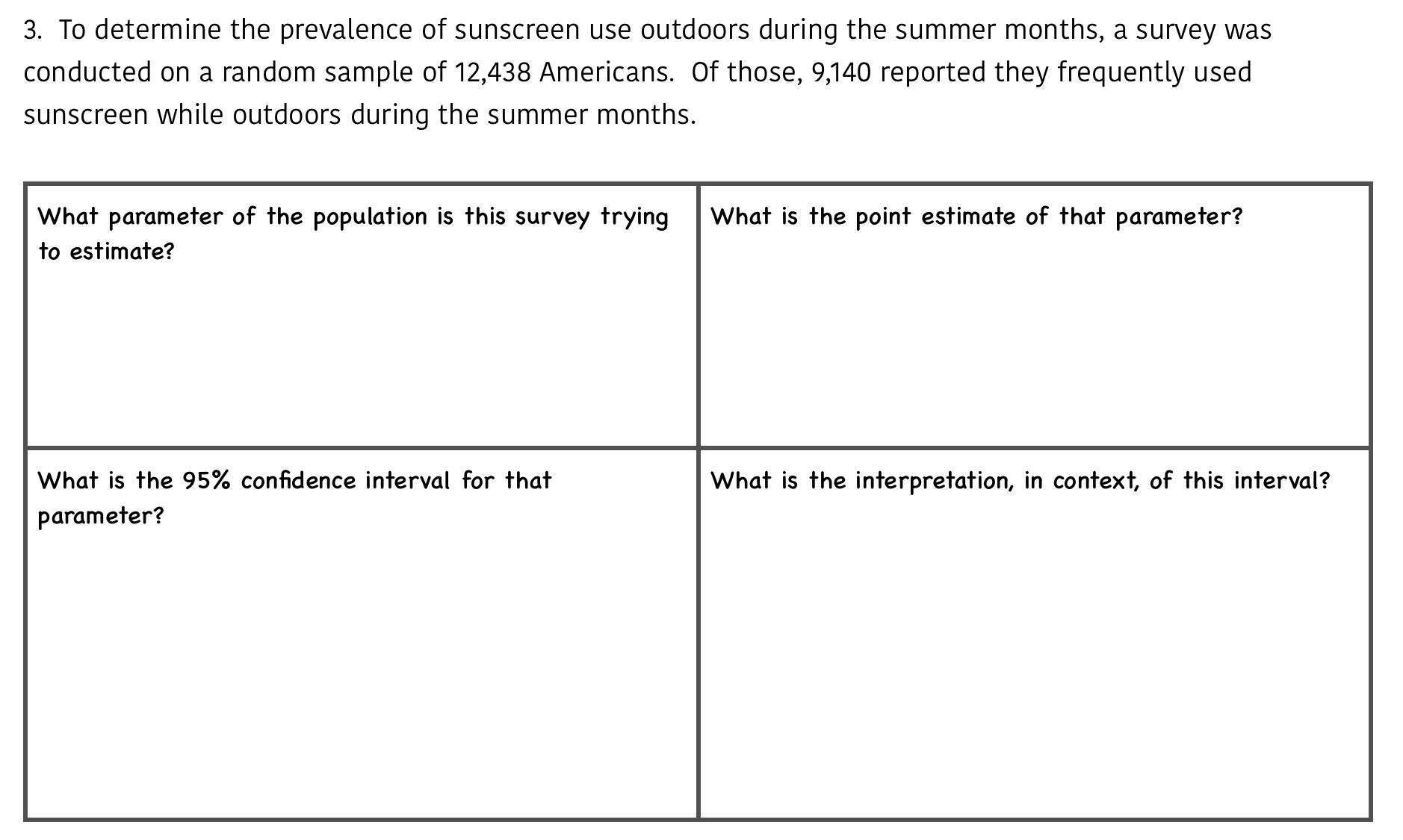
To determine the prevalance of sunscreen use outdoors during the summer months, a survey was conducted on a random sample of 12,438 Americans. Of those, 9,140 reported they frequently used sunscreen while outdoors during the summer months.

What parameter of the population is this survey trying to estimate?

2

To determine the prevalance of sunscreen use outdoors during the summer months, a survey was conducted on a random sample of 12,438 Americans. Of those, 9,140 reported they frequently used sunscreen while outdoors during the summer months.

What is the point estimate of that parameter? Include your calculations with your final answer.

4

To determine the prevalance of sunscreen use outdoors during the summer months, a survey was conducted on a random sample of 12,438 Americans. Of those, 9,140 reported they frequently used sunscreen while outdoors during the summer months.

What is the 95% confidence interval for that parameter? Include ALL calculations needed to support this final answer.
1

To determine the prevalance of sunscreen use outdoors during the summer months, a survey was conducted on a random sample of 12,438 Americans. Of those, 9,140 reported they frequently used sunscreen while outdoors during the summer months.

What is the interpretation, in context, of this interval?

1

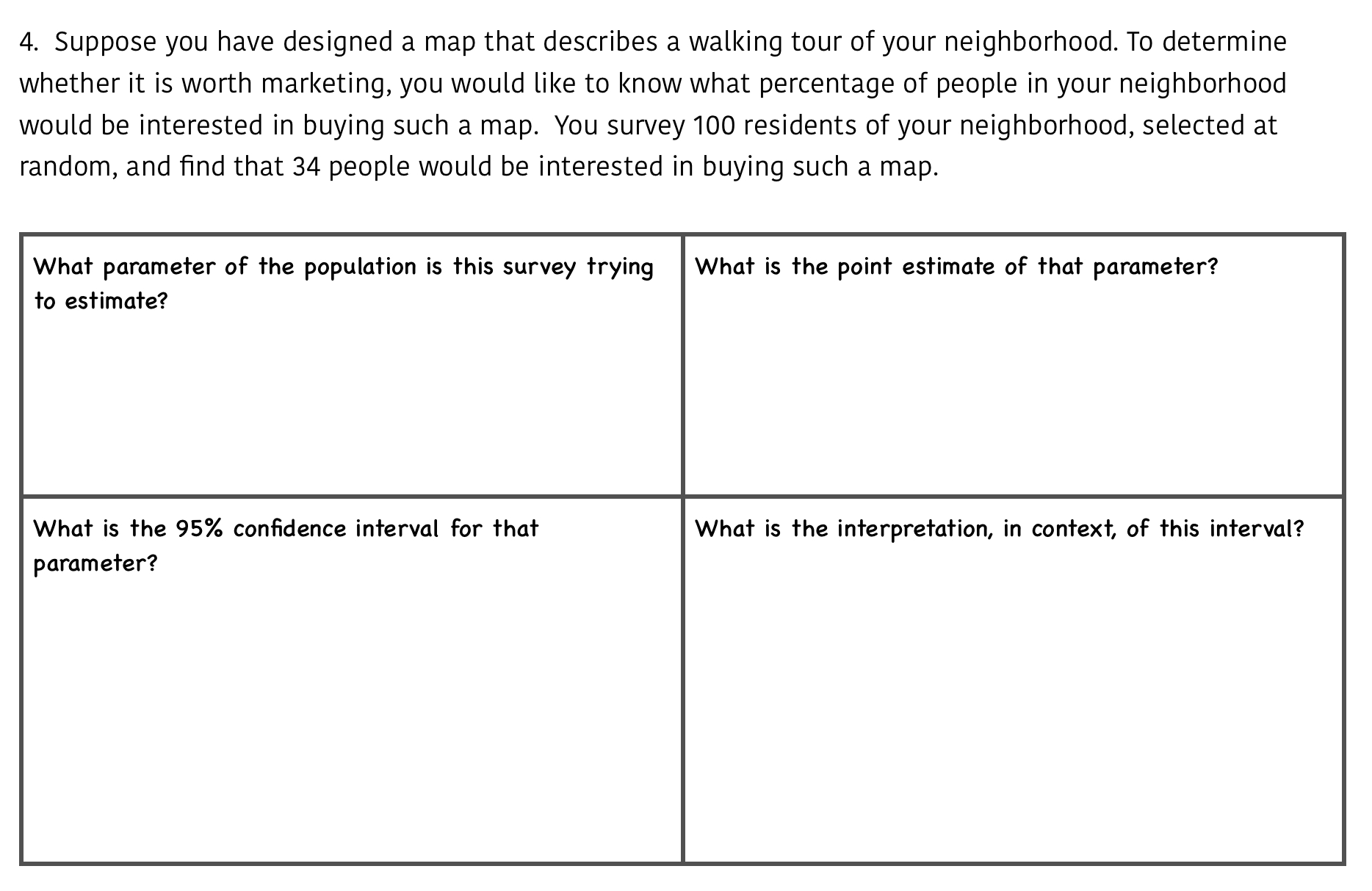
Suppose you have designed a map that describe a walking tour of your neighborhood. To determine whether it is worth marketing, you would like to know what percentage of people in your neighborhood would be interested in buying such a map. You survey 100 residents of your neighborhood, selected at random, and find that 34 people would be interested in buying such a map.

What parameter of the population is this survey trying to estimate?

2

Suppose you have designed a map that describe a walking tour of your neighborhood. To determine whether it is worth marketing, you would like to know what percentage of people in your neighborhood would be interested in buying such a map. You survey 100 residents of your neighborhood, selected at random, and find that 34 people would be interested in buying such a map.

What is the point estimate of that parameter? Include your calculations with your final answer.

4

Suppose you have designed a map that describe a walking tour of your neighborhood. To determine whether it is worth marketing, you would like to know what percentage of people in your neighborhood would be interested in buying such a map. You survey 100 residents of your neighborhood, selected at random, and find that 34 people would be interested in buying such a map.

What is the 95% confidence interval for that parameter? Include ALL calculations needed to support this final answer.
1

Suppose you have designed a map that describe a walking tour of your neighborhood. To determine whether it is worth marketing, you would like to know what percentage of people in your neighborhood would be interested in buying such a map. You survey 100 residents of your neighborhood, selected at random, and find that 34 people would be interested in buying such a map.

What is the interpretation, in context, of this interval?

1

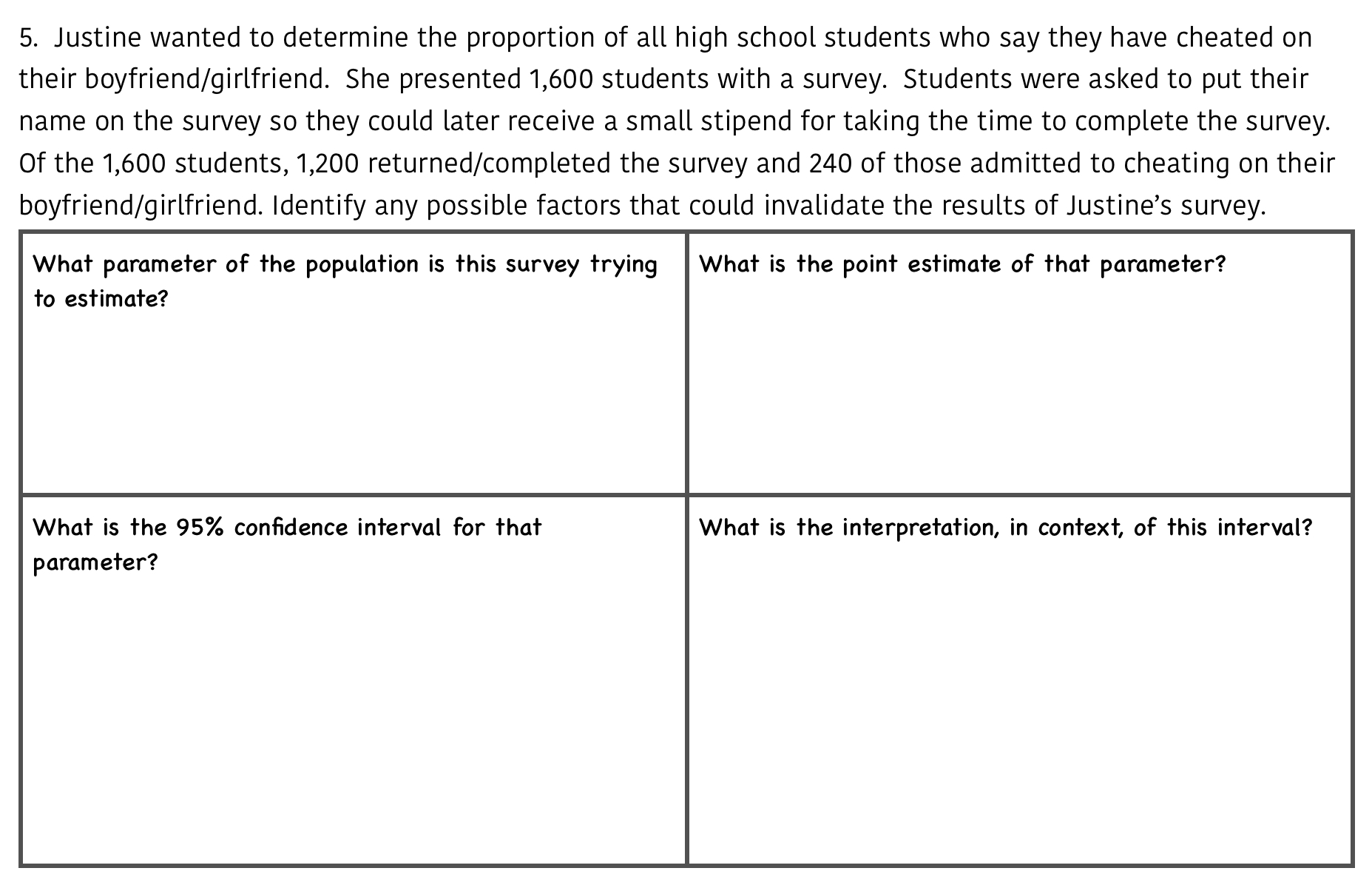
Justine wanted to determine the proportion of all high school students who say they have cheated on their boyfriend/girlfriend. 1,200 students returned/completed the survey and 240 of those admitted to cheating on their boyfriend/girlfriend.

What parameter of the population is this survey trying to estimate?

2

Justine wanted to determine the proportion of all high school students who say they have cheated on their boyfriend/girlfriend. 1,200 students returned/completed the survey and 240 of those admitted to cheating on their boyfriend/girlfriend.

What is the point estimate of that parameter? Include your calculations with your final answer.

4

Justine wanted to determine the proportion of all high school students who say they have cheated on their boyfriend/girlfriend. 1,200 students returned/completed the survey and 240 of those admitted to cheating on their boyfriend/girlfriend.

What is the 95% confidence interval for that parameter? Include ALL calculations needed to support this final answer.

1

Justine wanted to determine the proportion of all high school students who say they have cheated on their boyfriend/girlfriend. 1,200 students returned/completed the survey and 240 of those admitted to cheating on their boyfriend/girlfriend.

What is the interpretation, in context, of this interval? Include ALL calculations needed to support this final answer.

1

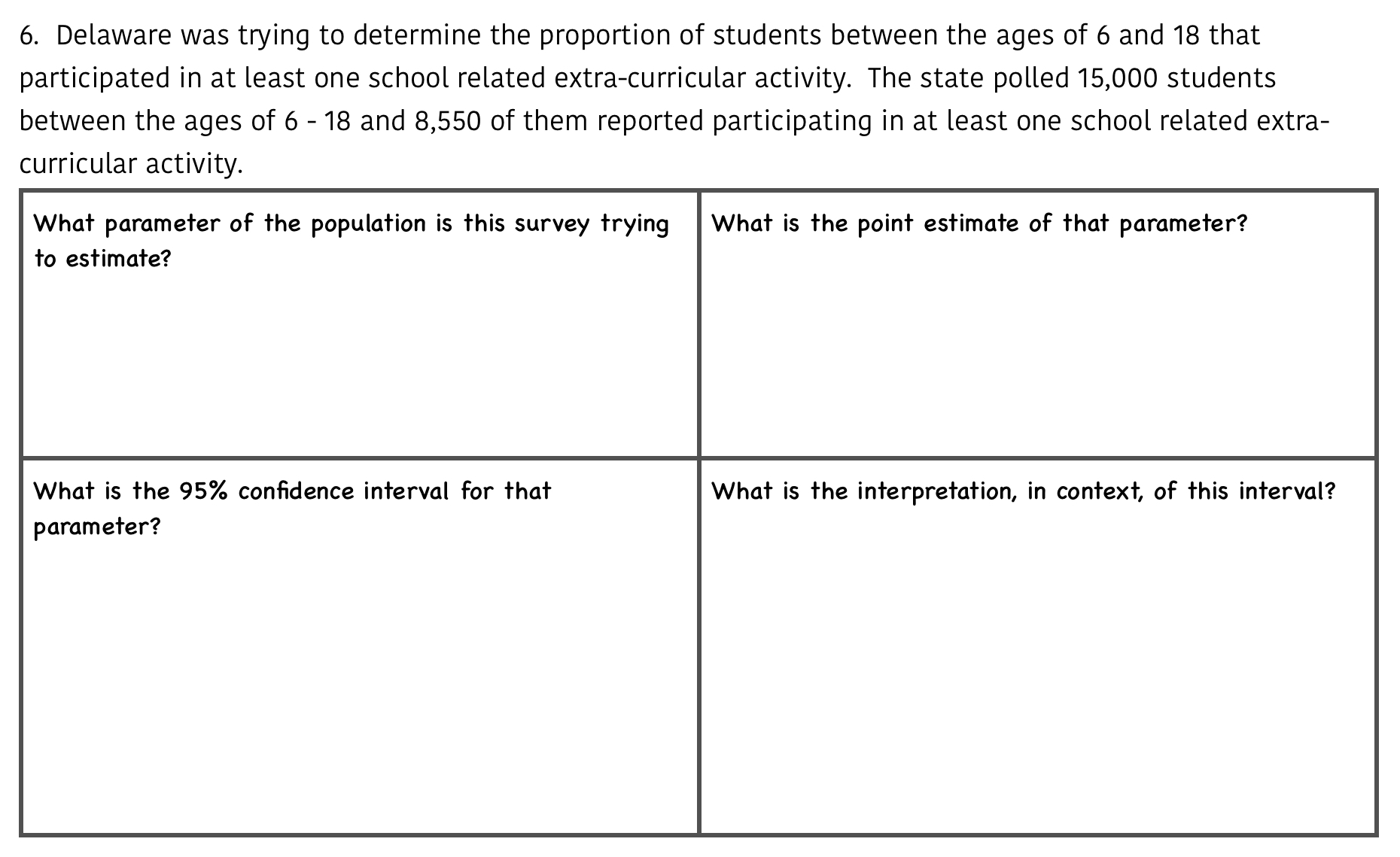
Delaware was trying to determine the proportion of students between the ages of 6 and 18 that participated in at least one school related extra-curricular activity. The state polled 15,000 students between the ages of 6-18 and 8,550 of them reported participating in at least one school related extra-curricular activity.

What parameter of the population is this survey trying to estimate?

2

Delaware was trying to determine the proportion of students between the ages of 6 and 18 that participated in at least one school related extra-curricular activity. The state polled 15,000 students between the ages of 6-18 and 8,550 of them reported participating in at least one school related extra-curricular activity.

What is the point estimate of that parameter? Include your calculations with your final answer.

4

Delaware was trying to determine the proportion of students between the ages of 6 and 18 that participated in at least one school related extra-curricular activity. The state polled 15,000 students between the ages of 6-18 and 8,550 of them reported participating in at least one school related extra-curricular activity.

What is the 95% confidence interval for that parameter? Include ALL calculations needed to support this final answer.

4

Delaware was trying to determine the proportion of students between the ages of 6 and 18 that participated in at least one school related extra-curricular activity. The state polled 15,000 students between the ages of 6-18 and 8,550 of them reported participating in at least one school related extra-curricular activity.

What is the interpretation, in context, of this interval?