Asemmisa {{asɛmmisaAhyɛnsode}}
7.

1. What is the name of the negative electrode in electrolysis; and what kind of ions is attracted to it?
a) Anode; Anions
b) Anode; Cations
c) Cathode; Anions
d) Cathode; Cations
Choose the correct word from the brackets to complete the paragraph below.
Electrolysis is (breaking down/ ionize) a substance using electricity. During electrolysis (ions/atoms) are converted into (ions/atoms) by reduction and oxidation reactions. At the cathode, which is the (positive/negative) electrode, the process of (oxidation/reduction) takes place. In this electrode (cations/anions) are converted into (elements/ions) by (gaining/loosing) electrons.
All ionic substances in any state will conduct electricity
In the electrolysis of molten sodium Chloride, Sodium forms at the cathode and Chlorine at the anode.
The negative electrode is called the anode

During the electrolysis of molten zinc bromide. What is seen at each electrode?


The table shows some observations about the reactivity of various metals (represented by different letters) with dilute hydrochloric acid.
Put the metals in order of reactivity from the most reactive to the least reactive
D
B
A
C
What happens to carbon monoxide into the blast furnace?
a. It is a reducing agent and oxidizes iron oxide
b. It is reduced by iron oxide and converted into carbon dioxide
c. It is oxidized by limewater
d. It is oxidized by iron oxide so it is a reducing agent
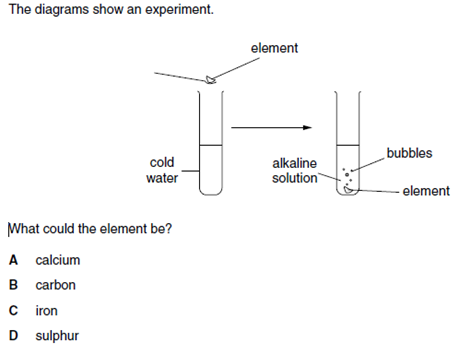
a.Explain why lithium when added to water with universal indicator turns the water into a blue color.
b. Write a word equation for this reaction
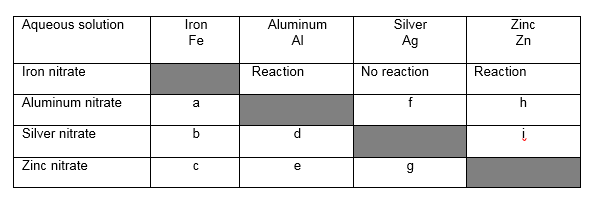
Categorize each of these letters into Reaction or No reaction by dragging them
a
b
c
d
e
f
g
h
i
Reaction
No reaction
What is the use of limestone in the blast furnace?
Removing all of the impurities produces pure iron which is much harder
Impure iron straight from the blast furnace isn´t much use as it is too bendy
Name one type of reaction we have seen in this unit AND give an example
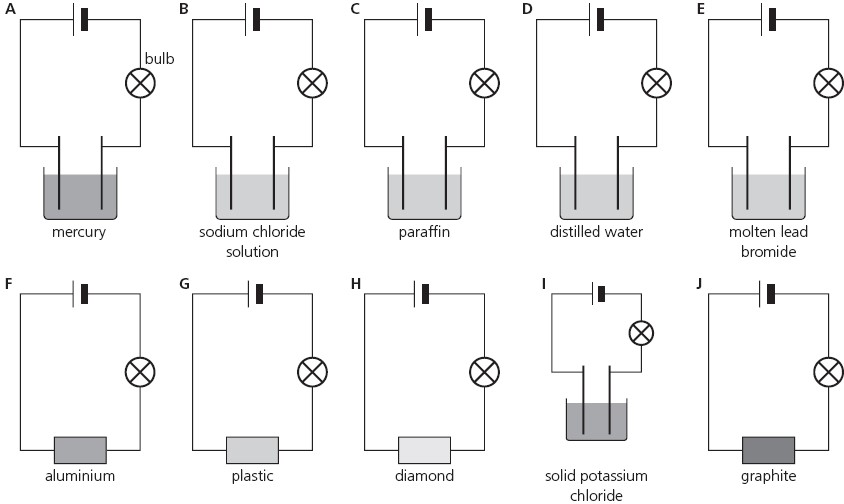
For A–J below, circle choose the letter if the bulb will light