1
1
1
1
1
1
1
1
1
1
1
1
1
1
1
1
1
1
1
1
Choose the correct case and usage for the underlined noun.
Mīlitēs magnā cum fortitūdine pugnābant.
fortitūdō, fortitūdinis, f.: strength
Choose the correct case and usage for the underlined noun.
Ego amīcum meum verbīs laesī.
verbum, verbī, n.: word
laedō, laedere, laesī, laesus: to hurt, harm
Choose the correct case and usage for the underlined noun.
Puerī cum patruō prope curriculum sedēbant.
curriculum, curriculī, n.: racetrack
Choose the most accurate Latin form to complete the sentence.
Tūne _________________________ accēpistī?
Did you receive the letter?
epistula, epistulae, f.: letter
Choose the most accurate Latin form to complete the sentence.
Aurīga _________________________ nocuit, ubi mētam circumībat.
The charioteer harmed the horses, when he was going around the turning post.
noceō, nocēre, nocuī, nocitūrus (+ dat.): harm
equus, equī, m.: horse
Choose the most accurate Latin form to complete the sentence.
Licet _________________________ in caupōnā pernoctāre.
It is allowed for the soldier to spend the night in an inn.
mīles mīlitis, m.: soldier
Choose the most accurate Latin form to complete the sentence.
_________________________ ad urbem redīre necesse erat.
It was necessary for father to return to the city.
pater, patris, m.: father
Choose the most accurate Latin form to complete the sentence.
Pater _________________________ in Asiā est.
The boy's father is in Asia.
puer, puerī, m.: boy
Choose the adjective form that agrees with the underlined noun.
Patrēs puerōrum _________________________ in Asiā erant.
puer, puerī, m.: boy
trīstis, trīstis, trīste: sad
Choose the adjective form that agrees with the underlined noun.
Patrēs cum puerīs _________________________ ad Asiam iter faciunt.
puer, puerī, m.: boy
trīstis, trīstis, trīste: sad
Choose the adjective form that agrees with the underlined noun.
Puella mātrem _________________________ reprehendit.
māter, mātris, f.: mother
īrātus, īrāta, īrātum: angry
Choose the adjective form that agrees with the underlined noun.
Fīlia mātris _________________________ ancillam reprehendit.
māter, mātris, f.: mother
īrātus, īrāta, īrātum: angry
Translate the sentence.
Nōlīte nocēre virīs baculō, custōdēs!
noceō, nocēre, nocuī, nocitūrus (+ dat.): to harm
vir, virī, m.: man
baculum, baculī, n.: stick
custōs, custōdis, m.: guard
Translate the sentence.
Ubi pater hās rēs dīxerat, in tablīnum domūs iit.
hās: these
rēs, reī, f.: thing
dīco, dīcere, dīxī, dictus: to say
tablīnum, -ī, n.: study, office
domus, domūs, f.: home
eō, īre, iī, itūrus: to go
Choose the correct tense for the underlined verb.
Ubi pater hās rēs dīxerat, in tablīnum domūs iit.
rēs, reī, f.: thing
tablīnum, -ī, n.: study, office
domus, domūs, f.: home
eō, īre, iī, itūrus: to go
Translate the sentence.
Sī puerī sine custōde in urbem exierint, pater certē eōs pūniet.
sī: if
puer, puerī, m.: boy
sine (+ abl.): without
exeō, exīre, exiī, exitūrus: to go out
certē (adv.): certainly
eōs: them
pūniō, pūnīre, pūnīvī, pūnītus: to punish
Choose the correct case and usage for the underlined noun.
Sī puerī sine custōde in urbem exierint, pater certē eōs pūniet.
sī: if
puer, puerī, m.: boy
sine (+ abl.): without
exeō, exīre, exiī, exitūrus: to go out
certē (adv.): certainly
eōs: them
pūniō, pūnīre, pūnīvī, pūnītus: to punish
Choose the correct case and usage for the underlined noun.
Sī puerī sine custōde in urbem exierint, pater certē eōs pūniet.
sī: if
puer, puerī, m.: boy
sine (+ abl.): without
exeō, exīre, exiī, exitūrus: to go out
certē (adv.): certainly
eōs: them
pūniō, pūnīre, pūnīvī, pūnītus: to punish
Translate the sentence.
Hominēs scelestī, iniūstitiā īrātī, bona cīvium arripuērunt.
homō, hominis, m.: person
scelestus, -a, -um: wicked
iniūstitia, -ae, f.: injustice
īrātus, īrāta, īrātum: angry
bona, bonōrum, n. pl.: goods, possessions
cīvis, cīvis, m./f.: citizen
arripiō, arripere, arripuī, arreptus: to snatch, seize, steal
Translate the sentence.
Hominēs scelestī, iniūstitiā īrātī, bona cīvium arripuērunt.
homō, hominis, m.: person
scelestus, -a, -um: wicked
iniūstitia, -ae, f.: injustice
īrātus, īrāta, īrātum: angry
bona, bonōrum, n. pl.: goods, possessions
cīvis, cīvis, m./f.: citizen
arripiō, arripere, arripuī, arreptus: to snatch, seize, steal
Translate the sentence.
Cum praedōnēs bona virō scelestō tulerint, ad urbem redībunt.
cum (+ abl.): with; (without abl.): when
praedō, praedōnis, m.: robber
scelestus, -a, -um: wicked
bona, bonōrum, n. pl.: goods, possessions
ferō, ferre, tulī, lātus: to bring, carry
redeō, redīre, rediī, reditūrus: to return, go back
Translate the sentence.
Nōnnumquam pīrātae, quī cīvibus nocēre volunt, eōs capiunt.
nōnnumquam (adv.): sometimes
pīrāta, -ae, m.: pirate
cīvis, cīvis, m./f.: citizen
noceō, nocēre, nocuī, nocitūrus (+ dat.): to harm
volō, velle, voluī: to want
eōs: them
capiō, capere, cēpī, captus: to seize, capture
Translate the sentence.
Nōnnumquam pīrātae, quī cīvibus nocēre volunt, eōs capiunt.
nōnnumquam (adv.): sometimes
pīrāta, -ae, m.: pirate
cīvis, cīvis, m./f.: citizen
noceō, nocēre, nocuī, nocitūrus (+ dat.): to harm
volō, velle, voluī: to want
capiō, capere, cēpī, captus: to seize, capture
trahō, trahere, trāxī, tractus: drag
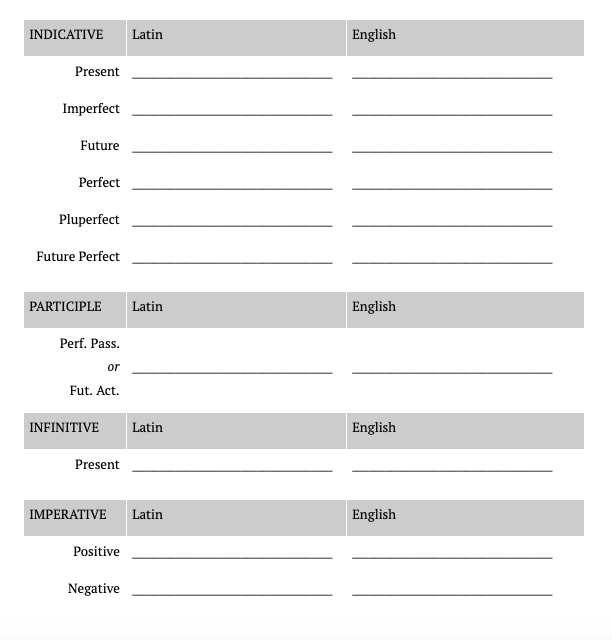
LATIN: PRESENT: 2nd person plural
trahō, trahere, trāxī, tractus: drag
ENGLISH: PRESENT: 2nd person plural
trahō, trahere, trāxī, tractus: drag
LATIN: IMPERFECT: 2nd person plural
trahō, trahere, trāxī, tractus: drag
ENGLISH: IMPERFECT: 2nd person pl
trahō, trahere, trāxī, tractus: drag
LATIN: FUTURE: 2nd person plural
trahō, trahere, trāxī, tractus: drag
ENGLISH: FUTURE: 2nd person plural
trahō, trahere, trāxī, tractus: drag
LATIN: PERFECT: 2nd person plural
trahō, trahere, trāxī, tractus: drag
ENGLISH: PERFECT: 2nd person plural
trahō, trahere, trāxī, tractus: drag
LATIN: PLUPERFECT: 2nd person pl
trahō, trahere, trāxī, tractus: drag
ENGLISH: PLUPERFECT: 2nd person pl
trahō, trahere, trāxī, tractus: drag
LATIN: FUT PERFECT: 2nd person pl
trahō, trahere, trāxī, tractus: drag
ENGLISH: FUT PERFECT: 2nd person pl
trahō, trahere, trāxī, tractus: drag
LATIN: PARTICIPLE*
*NOTE: Change ending from -us to -ī
trahō, trahere, trāxī, tractus: drag
ENGLISH: PARTICIPLE
trahō, trahere, trāxī, tractus: drag
LATIN: INFINITIVE
trahō, trahere, trāxī, tractus: drag
ENGLISH: INFINITIVE
trahō, trahere, trāxī, tractus: drag
LATIN: POSITIVE IMPERATIVE: plural
trahō, trahere, trāxī, tractus: drag
ENGLISH: POSITIVE IMPERATIVE
trahō, trahere, trāxī, tractus: drag
LATIN: NEGATIVE IMPERATIVE: plural
trahō, trahere, trāxī, tractus: drag
ENGLISH: NEGATIVE IMPERATIVE
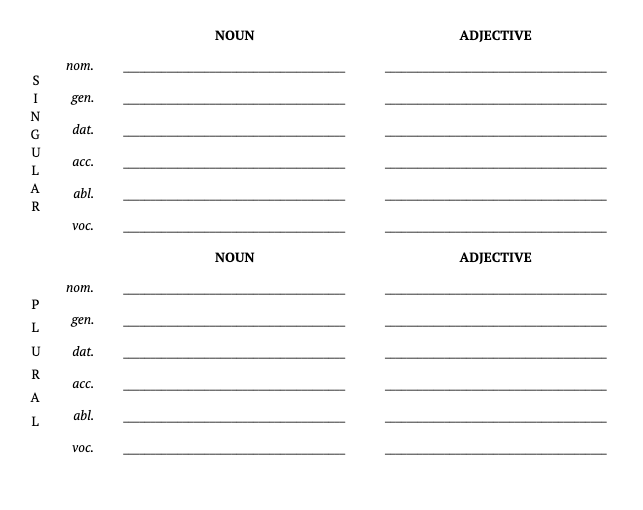
onus, oneris, n.: nominative sing
onus, oneris, n.: genitive sing
onus, oneris, n.: dative sing
onus, oneris, n.: accusative sing
onus, oneris, n.: ablative sing
onus, oneris, n.: vocative sing
onus, oneris, n.: nominative pl
onus, oneris, n.: genitive pl
onus, oneris, n.: dative pl
onus, oneris, n.: accusative pl
onus, oneris, n.: ablative pl
onus, oneris, n.: vocative pl
magnus, magna, magnum: nom sing
magnus, magna, magnum: gen sing
magnus, magna, magnum: dat sing
magnus, magna, magnum: acc sing
magnus, magna, magnum: abl sing
magnus, magna, magnum: voc sing
magnus, magna, magnum: nom pl
magnus, magna, magnum: gen pl
magnus, magna, magnum: dat pl
magnus, magna, magnum: acc pl
magnus, magna, magnum: abl pl
magnus, magna, magnum: voc pl
Choose the correct case and usage for the underlined noun.
Servī gladiōs mīlitibus tradiderant.
gladius, gladiī, m.: sword
mīles, mīlitis, m.: soldier
tradō, tradere, tradidī, traditus: to hand over
Choose the correct case and usage for the underlined noun.
Servī gladiōs mīlitibus tradiderant.
gladius, gladiī, m.: sword
mīles, mīlitis, m.: soldier
tradō, tradere, tradidī, traditus: to hand over
Choose the correct case and usage for the underlined noun.
Nōlīte nocēre virīs baculō, custōdēs!
noceō, nocēre, nocuī, nocitūrus (+ dat.): to harm
vir, virī, m.: man
baculum, baculī, n.: stick
custōs, custōdis, m.: guard
Choose the correct case and usage for the underlined noun.
Nōlīte nocēre virīs baculō, custōdēs!
noceō, nocēre, nocuī, nocitūrus (+ dat.): to harm
vir, virī, m.: man
baculum, baculī, n.: stick
custōs, custōdis, m.: guard
Choose the correct case and usage for the underlined noun.
Ubi pater hās rēs dīxerat, in tablīnum domūs iit.
rēs, reī, f.: thing
tablīnum, -ī, n.: study, office
domus, domūs, f.: home
eō, īre, iī, itūrus: to go
Translate the sentence.
Hominēs scelestī, iniūstitiā īrātī, bona cīvium arripuērunt.
homō, hominis, m.: person
scelestus, -a, -um: wicked
iniūstitia, -ae, f.: injustice
īrātus, īrāta, īrātum: angry
bona, bonōrum, n. pl.: goods, possessions
cīvis, cīvis, m./f.: citizen
arripiō, arripere, arripuī, arreptus: to snatch, seize, steal
Translate the sentence.
Hominēs scelestī, iniūstitiā īrātī, bona cīvium arripuērunt.
homō, hominis, m.: person
scelestus, -a, -um: wicked
iniūstitia, -ae, f.: injustice
īrātus, īrāta, īrātum: angry
bona, bonōrum, n. pl.: goods, possessions
cīvis, cīvis, m./f.: citizen
arripiō, arripere, arripuī, arreptus: to snatch, seize, steal
Choose the correct case and usage for the underlined noun.
Cum praedōnēs bona virō scelestō tulerint, ad urbem redībunt.
cum (+ abl.): with; (without abl.): when; NOTE: cum has two meanings; which one makes sense here?
praedō, praedōnis, m.: robber
scelestus, -a, -um: wicked
bona, bonōrum, n. pl.: goods, possessions
ferō, ferre, tulī, lātus: to bring, carry
redeō, redīre, rediī, reditūrus: to return, go back
Choose the correct case and usage for the underlined noun.
Cum praedōnēs bona virō scelestō bona tulerint, ad urbem redībunt.
cum (+ abl.): with; (without abl.): when; NOTE: cum has two meanings; which one makes sense here?
praedō, praedōnis, m.: robber
scelestus, -a, -um: wicked
bona, bonōrum, n. pl.: goods, possessions
ferō, ferre, tulī, lātus: to bring, carry
redeō, redīre, rediī, reditūrus: to return, go back
Translate the sentence.
Nōnnumquam pīrātae, quī cīvibus nocēre volunt, eōs capiunt.
nōnnumquam (adv.): sometimes
pīrāta, -ae, m.: pirate
cīvis, cīvis, m./f.: citizen
noceō, nocēre, nocuī, nocitūrus (+ dat.): to harm
volō, velle, voluī: to want
capiō, capere, cēpī, captus: to seize, capture