8.5_Conservation of Mass

Last updated over 4 years ago
14 questions
1

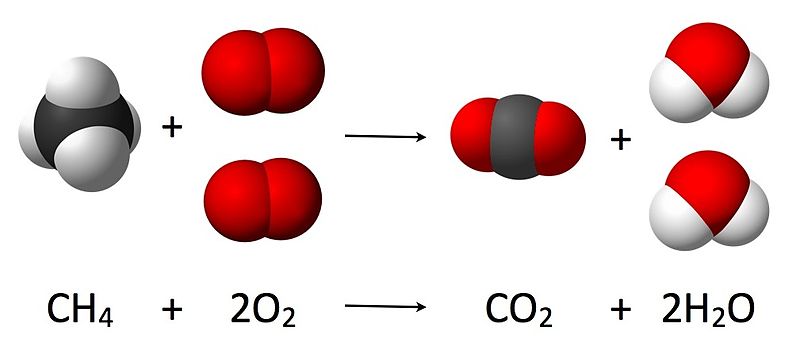
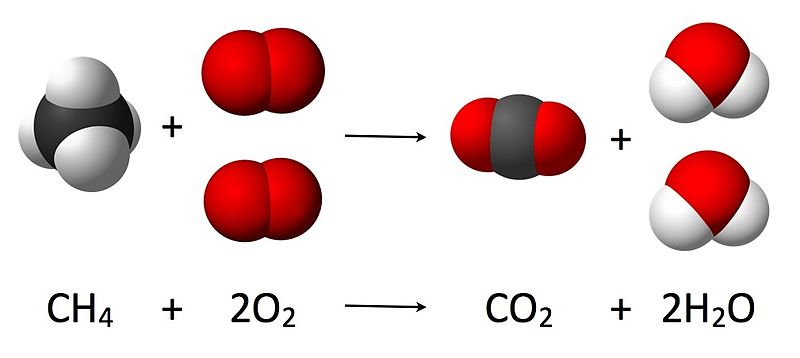
Take a look at the equation attached and answer the following questions.
Do Now: How many oxygen atoms are in the reactant side of this equation?

1

Do Now: How many oxygen atoms are in the product side of this equation?

1

Do Now: How many hydrogen atoms are in the reactant side of this equation?

1

Do Now: How many hydrogen atoms are in the product side of this equation?

1

Directions: Read the background text and then answer all questions labeled classwork. You will answer questions based on the four experiments that Lavoisier ran in order to prove his theory of Conservation of Mass.

Antoine Lavoisier was a French chemist who did most of his work between 1772-1786. He built a magnificent laboratory in Paris, France and invited scientists from around the world to come and visit. Lavoisier conducted numerous controlled experiments. He published two textbooks that helped organize chemistry into a comprehensible science. Based on his contributions to chemistry, Lavoisier is commonly known as the Father of Modern Chemistry.

Lavoisier’s most famous experiments involved the combustion of substances such as phosphorus, sulfur, and mercury. He proposed that air is composed of two parts, one of which combines with metals to form new products. This part was later named oxygen. Lavoisier believed that when a substance burns, oxygen from air combines with that substance to form a new substance. His experiments showed that the new product weighed more than the original substance by a mass equal to the amount of oxygen that reacted with the substance.

These experiments led to what is currently known as The Law of Conservation of Mass. This law states that mass can neither be created nor destroyed. It can only be converted from one form to another. Initially, Lavoisier’s conclusions were not accepted by the scientific world but they eventually led to a revolution in chemical thought. His work ultimately led to the basis of Dalton’s Atomic Theory.

Classwork: How did Lavoisier's work contribute to our understanding of the composition of air?
1

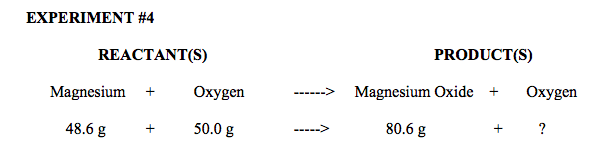
Directions: Answer each question with one word answers unless the question specifically says answer in a complete sentence.
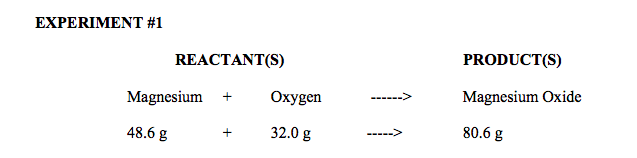
Classwork: How many grams of magnesium are on the reactants side? Include units of mass in your answer. Write your response to the 10ths place.

1

Directions: Answer each question with one word answers unless the question specifically says answer in a complete sentence.
Classwork: How many grams of oxygen are on the reactants side? Include units of mass in your answer. Write your response to the 10ths place.

1

Directions: Answer each question with one word answers unless the question specifically says answer in a complete sentence.
Classwork: What is the total mass of the reactants? Include units of mass in your answer. Write your response to the 10ths place.

1

Directions: Answer each question with one word answers unless the question specifically says answer in a complete sentence.
Classwork: What is the total mass of the products? Include units of mass in your answer. Write your response to the 10ths place.

1

Directions: Answer each question with one word answers unless the question specifically says answer in a complete sentence.
Classwork: How does this experiment support the theory of Conservation of Mass? Explain your answer in a complete sentence.

1

Directions: Answer each question with one word answers unless the question specifically says answer in a complete sentence.
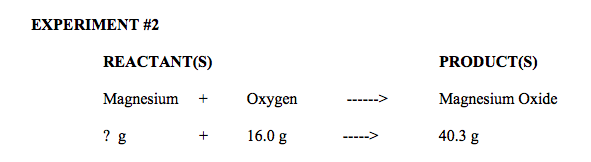
Classwork: Based on the Law of Conservation of Mass, predict the minimum amount of magnesium
that will react with all 16.0 grams of oxygen to produce 40.3 grams of magnesium oxide. Include units for mass in your answer. Write your response to the 10ths place.

1

Directions: Answer each question with one word answers unless the question specifically says answer in a complete sentence.
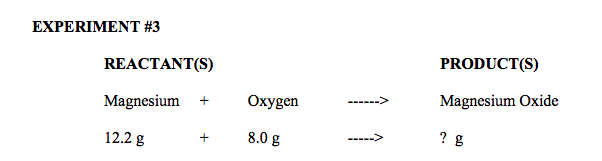
Classwork: Assuming that magnesium and oxygen will react completely with one another, predict
the mass of magnesium oxide that will be produced. Include units of mass in your response. Write your response to the 10ths place.

1

Directions: Answer each question with one word answers unless the question specifically says answer in a complete sentence.
Classwork: Predict the mass of oxygen that will be left over after the reaction of 48.6 grams of
magnesium with 50.0 grams of oxygen. Include units of mass in your response. Write your response to the 10ths place.

1

Exit Ticket: Explain the Law of Conservation of Mass in your own words. Answers with significant copy pasted parts will receive zero credit.