Log in
Sign up for FREE
arrow_back
Library
IB Bio Final 2020-21_VA cloned 6/10/2021
By William Ferzoco
star
star
star
star
star
Share
share
Last updated over 4 years ago
30 questions
Add this activity
1
1
1
1
1
1
1
1
1
1
1
1
1
1
Question 1
1.
The salt concentration inside an animal cell is 1.8 %. The salt concentration in the surrounding
medium becomes 5 %. What will be the likely response?
The cell will shrink from loss of water.
The cell will gain water from the medium.
The cell will remain unchanged.
The cell will lose salt to the medium.
2
zoom_in
1
Question 2
2.
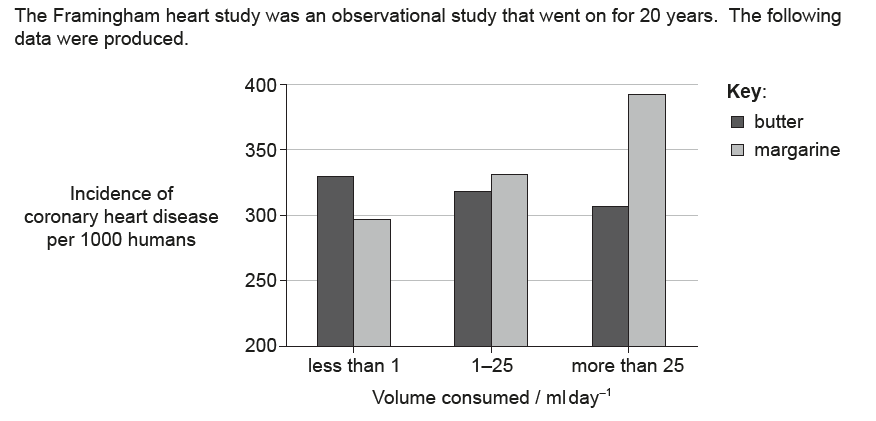
Which conclusion can be drawn, based on these data?
The more margarine consumed, the greater the incidence of coronary heart disease.
It is better to eat margarine than to eat butter.
Butter is a natural product whereas margarine is hydrogenated vegetable oil that leads to
coronary heart disease.
Margarine causes more heart related deaths than butter.
Question 3
3.
Which process causes ADP to change to ATP?
Anaerobic cell respiration
Protein synthesis
Hydrolysis
DNA replication
Question 4
4.
What occurs during meiosis but not mitosis?
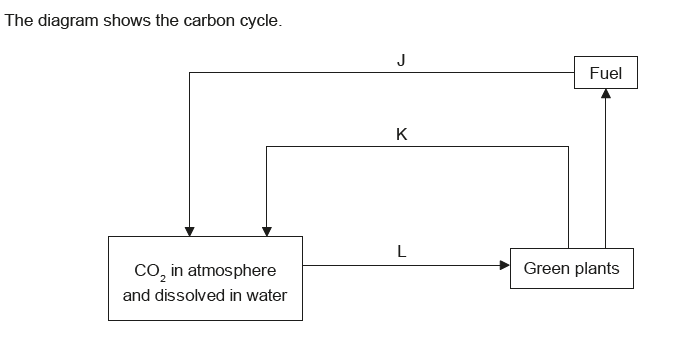
Centromeres split.
Spindles are formed from microtubules.
Homologous chromosomes pair up.
Chromosome number is conserved.
5
zoom_in
1
Question 5
5.
Which two processes correspond to the labelled arrows?
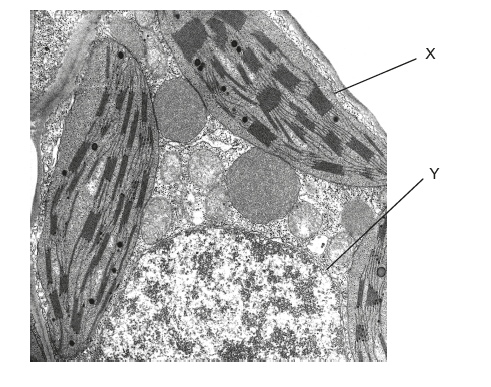
K is combustion and L is catabolism
J is anabolism and K is respiration.
J is combustion and K is respiration.
J is anabolism and L is catabolism.
6
7
zoom_in
1
1
Question 8
8.
Which sequence has the cells arranged according to their ability to differentiate, starting from the least able?
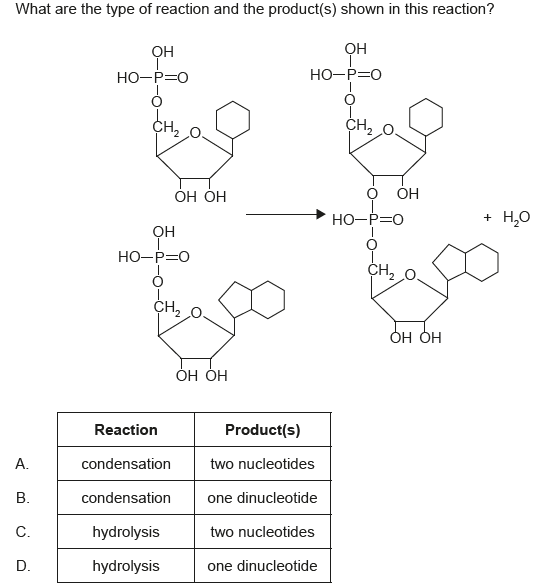
neuron, bone marrow, umbilical, embryonic
bone marrow, neuron, embryonic, umbilical
umbilical, embryonic, bone marrow, neuron
embryonic, umbilical, bone marrow, neuron
9
zoom_in
1
Question 9
9.
A
B
C
D
Question 10
10.
How many chromosomes are there in a cell during anaphase of mitosis, if the diploid number of the cell is 20?
10
20
40
80
11
zoom_in
1
Question 11
11.
A
B
C
D
12
zoom_in
1
Question 12
12.
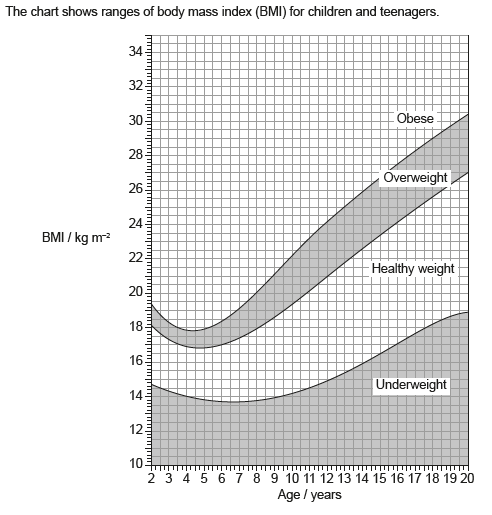
A 9-year-old boy has a height of 120 cm and weighs 28.8 kg. What weight category is he in according to his BMI?
Obese
Underweight
Healthy
Overweight
13
zoom_in
1
Question 13
13.
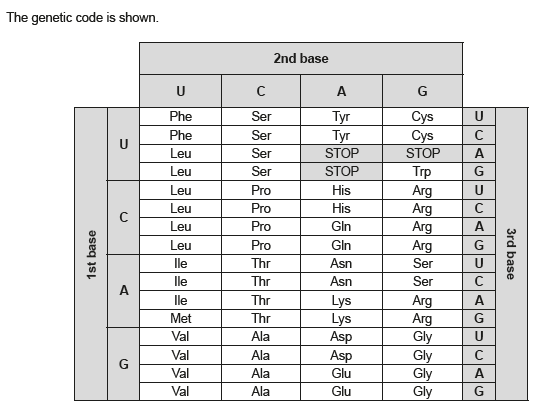
In a coding gene, the DNA triplet in the transcribed strand is changed from AGG to TCG. What would be the result of this change in the genome?
A non-functional protein
Termination of the polypeptide
No change in the protein
A different but functional protein
14
zoom_in
1
Question 14
14.
A
B
C
D
Question 15
15.
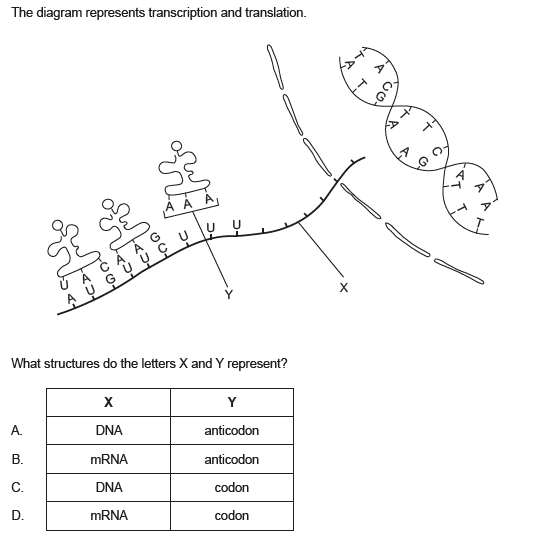
What is the reason for Taq DNA polymerase being used in the polymerase chain reaction (PCR)?
It does not denature at high temperatures.
It produces Okazaki fragments more rapidly.
It allows translation to proceed rapidly.
It works efficiently with helicase in PCR.
16
zoom_in
1
Question 16
16.
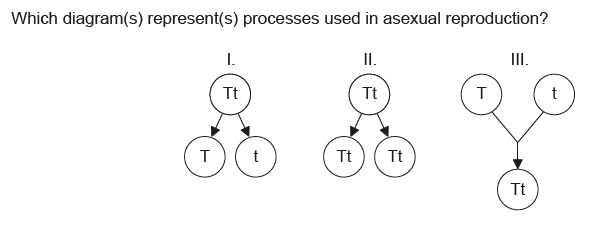
Which diagram(s) represent(s) processes used in asexual reproduction?
I only
I and II only
II only
I, II and III
17
zoom_in
1
Question 17
17.
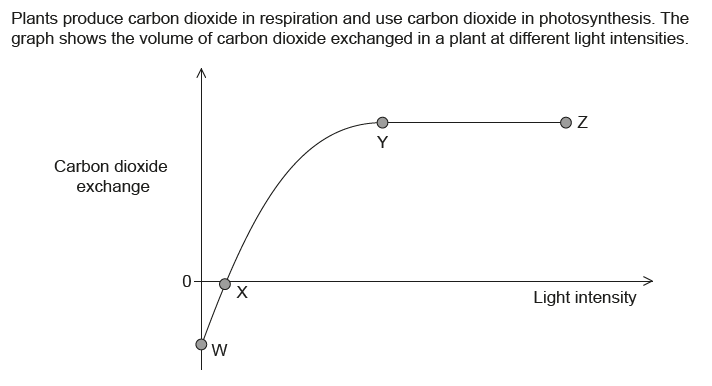
What is shown by the graph?
There is no photosynthesis between Y and Z.
There is more respiration than photosynthesis between W and X.
There is no photosynthesis between W and X.
There is more respiration than photosynthesis between Y and Z.
18
zoom_in
1
Question 18
18.
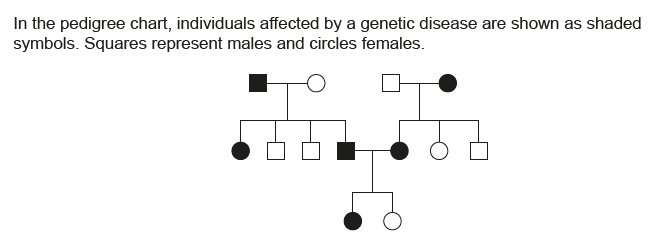
What is the mode of inheritance of the genetic disease?
Inherited as a dominant sex-linked allele
Inherited as a recessive autosomal allele
Inherited as a dominant autosomal allele
Inherited as a recessive sex-linked allele
Question 19
19.
Tall heterozygous pea plants were crossed and the resulting seeds grown. Out of 360 plants,
270 were tall and 90 dwarf. What describes the expected genotypes resulting from the cross?
Only 90 plants were homozygous.
All dwarf plants were homozygous.
All 270 tall plants were homozygous.
All 270 tall plants were heterozygous.
Question 20
20.
What are all the possible phenotypes of children born to a mother with blood group AB and a
father with blood group A?

AB, A and B
A and B
AB, A and O
AB only
21
zoom_in
1
Question 21
21.
I only
II only
I and II only
I and III only
Question 22
22.
How can a chi-squared test be used in ecological research?
To test whether two species tend to live together
To test whether one population of plants is taller than another
To test the effect of an abiotic factor on one plant species
To test whether one species is more tolerant to heavy metals than another
Question 23
23.
Under certain conditions, living organisms on Earth produce and release methane. What
favors the production of methane?
Forest fires
Dry conditions
Anaerobic conditions
High light intensity
Question 24
24.
The oceans absorb much of the carbon dioxide in the atmosphere. The combustion of fossil
fuels has increased carbon dioxide ocean concentrations. What adverse effect does this
have on marine life?
Heterotrophs consume more phytoplankton.
Phytoplankton have increased rates of photosynthesis.
Corals deposit less calcium carbonate to form skeletons.
Increased pH reduces enzyme activity in marine organisms.
Question 25
25.
What process best explains the formation of different pentadactyl limbs?
Selective breeding
Convergence
Adaptive radiation
Interbreeding
Question 26
26.
What would restrict evolution by natural selection, if a species only reproduced by cloning?
Mutations could not occur.
The offspring would show a lack of variation.
The offspring would be the same sex as the parent.
Too few offspring would be produced.
Question 27
27.
An animal has the following characteristics: bilateral symmetry, mouth but no anus, ribbon
shape. Which phylum does the animal belong to?
Annelida
Platyhelmintha
Mollusca
Cnidaria
28
zoom_in
1
Question 28
28.
A
B
C
D
29
zoom_in
1
Question 29
29.
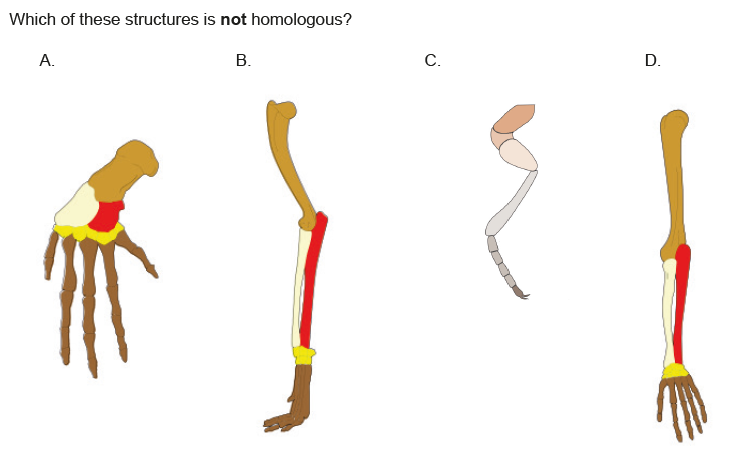
Which of these structures is
not
homologous?
A
B
C
D
30
zoom_in
1
Question 30
30.
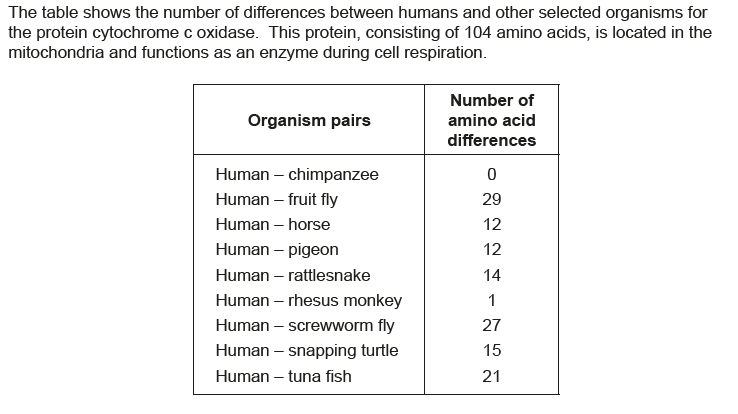
If the data were used to draw a cladogram, which chordates would be furthest apart from humans?
Horse because it is in the same class
Fruit fly because it has the most differences
Tuna fish because it is the chordate with the most differences
Chimpanzee because it has zero differences
Question 6
6.
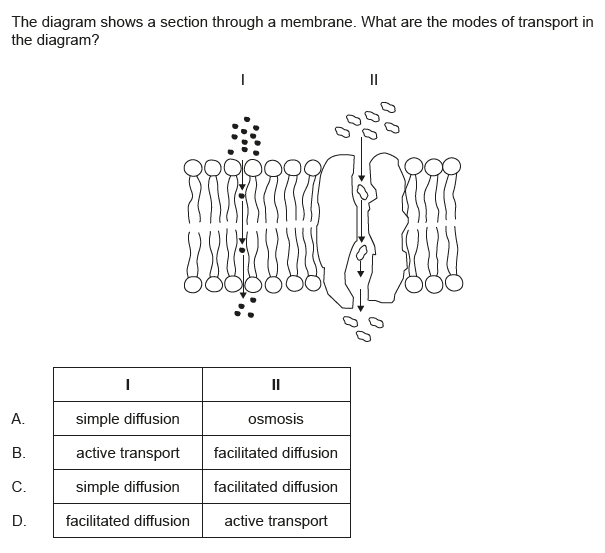
What is the name of the cell component labelled Y?
Golgi apparatus
Cytoplasm
A. Vacuole
Nucleus
Question 7
7.
Which feature of the cell in the micrograph is consistent with the endosymbiotic theory?
X contains 70S ribosomes.
Y contains 80S ribosomes.
X has a single membrane.
Y has a double membrane.