Mean Absolute Deviation

Last updated over 4 years ago
8 questions
The Mean Absolute Deviation (MAD) is a measure of how much a data set varies.

Example:
In the data set below, what is the mean absolute deviation?
1, 6, 8, 5, 5, 1, 2

Step 1: Compute the mean,x̅ .
First add all of the numbers in the data set together. Then divide by the total number of values in the data set.
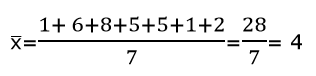
The mean x̅ , is 4

Step 2: Take each number in the data set, subtract the mean
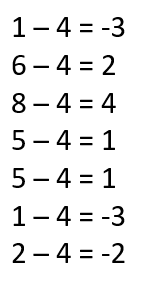
Step 3: Find the absolute value of each number. (Positive Value)
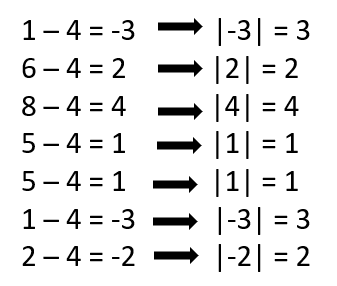
Step 4: Find the mean,x̅, of the new values.
First, add the numbers. Then, divide by the number of values.


The mean absolute deviation, MAD is 2.29.
Mean Absolute Deviation


1

Find the mean absolute deviation of
10, 7, 13, 10, 8

1

Find the mean absolute deviation of
110, 114, 104, 108, 106

1

Find the mean absolute deviation of
87, 75, 85, 77, 74, 82, 90, 88, 79, 81

1

Find the mean absolute deviation of
15, 17, 15, 17, 21, 17, 15, 23, 20, 18

1

Find the mean absolute deviation for the set below.

S= {85, 90, 68, 75, 79}

1

Sherrie just registered for her wedding. So far 6 items have been fulfilled on her registry. Find the mean price of the fulfilled items. $29, $58, $15, $129, $75, $22

1

Find the mean absolute deviation of the fulfilled items on Sherrie's registry. $29, $58, $15, $129, $75, $22

1

Find the mean absolute deviation for the set below.

S = {65, 90, 85, 70, 70, 95, 55}