Impulse and Momentum Unit Test

Last updated over 4 years ago
13 questions
You can type your answers in the answer space. If you want to use diagrams or equations for the conceptual questions, you may use the Show Your Work space: if you have a tablet, you can do your work directly in the space and if you do not, you can write out your solution on paper, image it, and insert the image of your work into the space. For the numerical calculation problems, you must show your work (using the technique described above), clearly indicating your answer with correct units, and then enter your numerical answer only (no units) in the answer space.

You will have 90 minutes from the time you started to complete the test.
4

Two expensive physics carts (made by Aston Martin), having equal mass, approach each other at the same speed in a head-on collision. There is no friction as they move along (hence the expense). They stick together on impact and remain stationary at the point of impact. Does this situation mean that momentum has been lost during this particular collision? Respond with supporting arguments which apply the concepts of impulse and momentum.

4

Lucas and Marcus throw identical tennis balls towards a building at the same speed. Lucas' ball stikes the wall, bouncing back at 1/2 its original speed. Marcus' ball smashes a window and continues through at 1/2 its original speed. Did the two ball experience the same impulse when in contact with the wall and window? Justify your answer using the concepts of impulse and momentum.

4

When the second stage of a two-stage rocket is separated from the first stage by a small, intentional explosion, explain what happens to the two stages in terms of impulse, and compare the magnitudes of the impulses on the two stages. Begin by defining impulse.

4

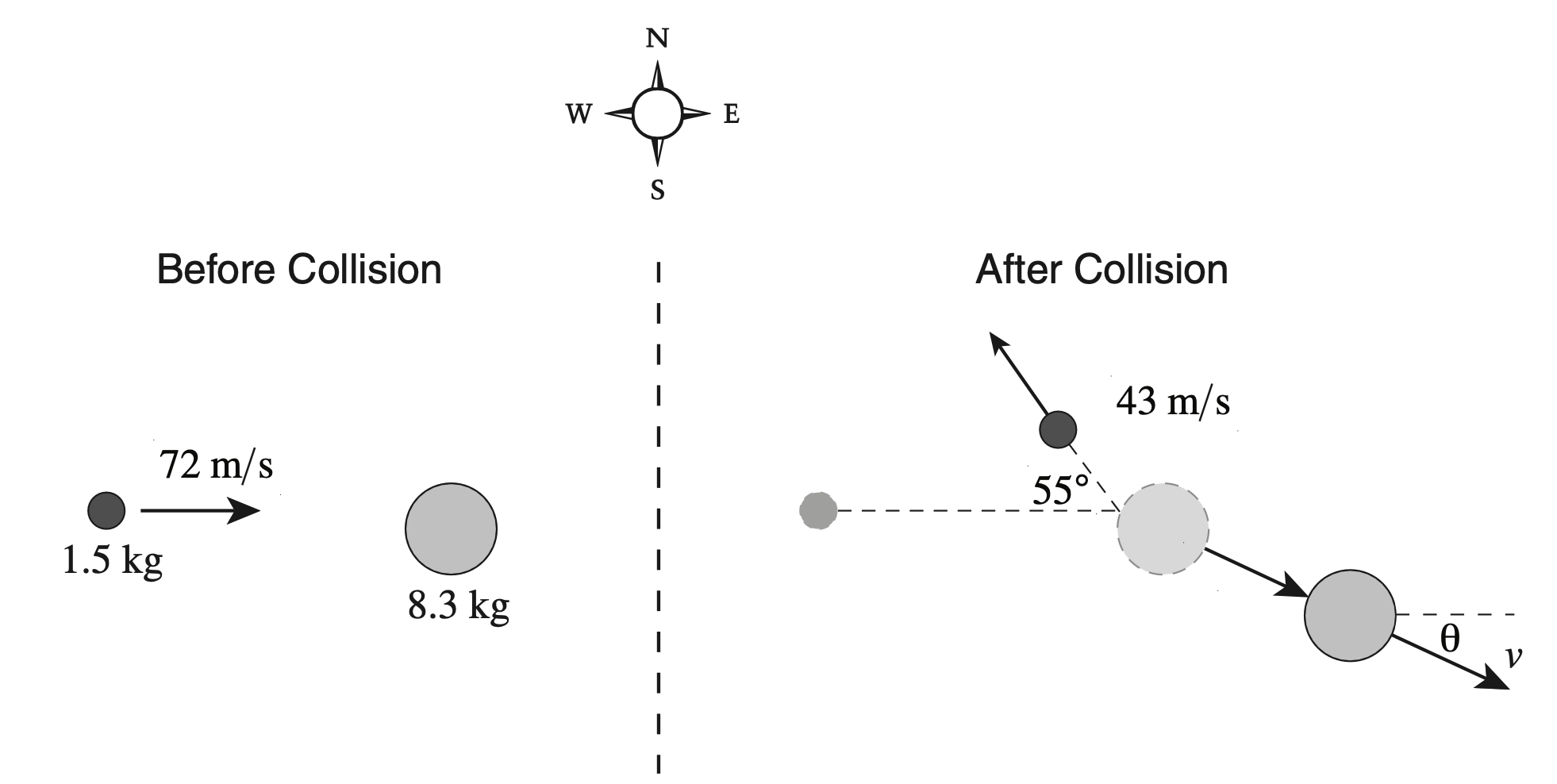
A 1.5 kg ball was moving due east at 72 m/s and collided with a stationary 8.3 kg wooden sphere. The ball rebounded at 43 m/s in the direction 55° north of west. What was the speed of the wooden sphere after the collision?
2

hat was the direction of the wooden sphere after the collision in Question 4? (Give the angle theta)

3

A 5.30 kg wagon is moving at 2.00 m/s to the right, when a 0.180 kg blob of putty, moving in the same direction, strikes the back of the wagon and sticks to it. What will be the speed of the wagon (and putty) after the collision?

3

For the situation in Question 6 above, suppose the wagon had been struck by a bouncy ball rather than putty, and the ball bounces back to the left after the collision. How would the speed of the wagon compare with your answer to Question 6? Use the concepts of impulse and momentum to explain your prediction.

4

A 0.45 kg ball strikes a wall at 5.7 m/s and 65° from the normal, and rebounds with the same speed and angle to the wall. The ball's contact time with the wall was 0.22 s. What was the magnitude of the impulse on this ball?

1

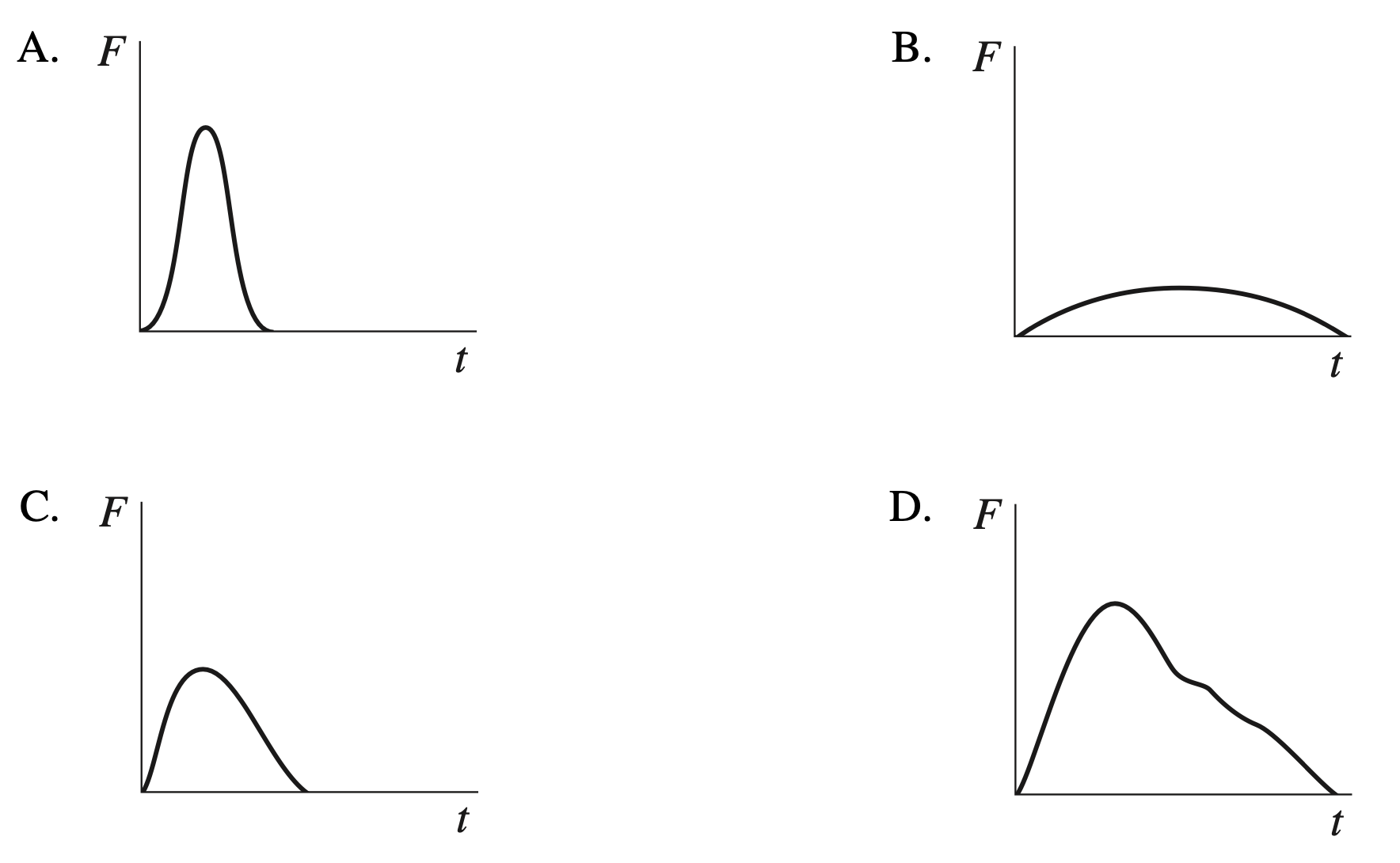
An object experiences a varying force as shown in the following F-t graphs. Which graph shows the largest change in momentum?

1

A 0.15 kg ball moving at 40 m/s is struck by a bat. The bat reverses the ball’s direction and gives it a speed of 50 m/s. What average force does the bat apply to the ball if they are in contact for 6.0 x 10⁻³ s?

1

A 5.0 kg ice block is sliding along a smooth floor at 1.0 m/s west when a 0.20 N force directed east acts on it for 4.0 s. What is the magnitude of the block’s final momentum?

1

A 900 kg car travelling at 12 m/s due east collides with a 600 kg car travelling at 24 m/s due north. As a result of the collision, the two cars lock together and move in what final direction?

1

Inside the International Space Station, a 60 kg astronaut holding a 4.0 kg space-cat (both initially at rest relative to the space station) throws the cat at 10 m/s relative to the space station. A 50 kg astronaut, initially at rest, catches the angry cat. Both astronauts were floating free of any suport structures. What is the speed of separation of the two astronauts?