AP Lesson 1.2 - Mass Spectroscopy

Last updated over 3 years ago
10 questions
Note from the author:
This is an AP Chemistry Assignment on Mass Spectroscopy.
NOTES!
Background:
When John Dalton proposed the first formal atomic theory, he stated “Atoms of the same element are identical.” Today we know that is not true—many elements contain several different isotopes, or atoms that differ in mass. Mass spectroscopy is the principle technique used to study isotopes. It is used to both “count” and “weigh” atoms in a sample, just not in the traditional sense.

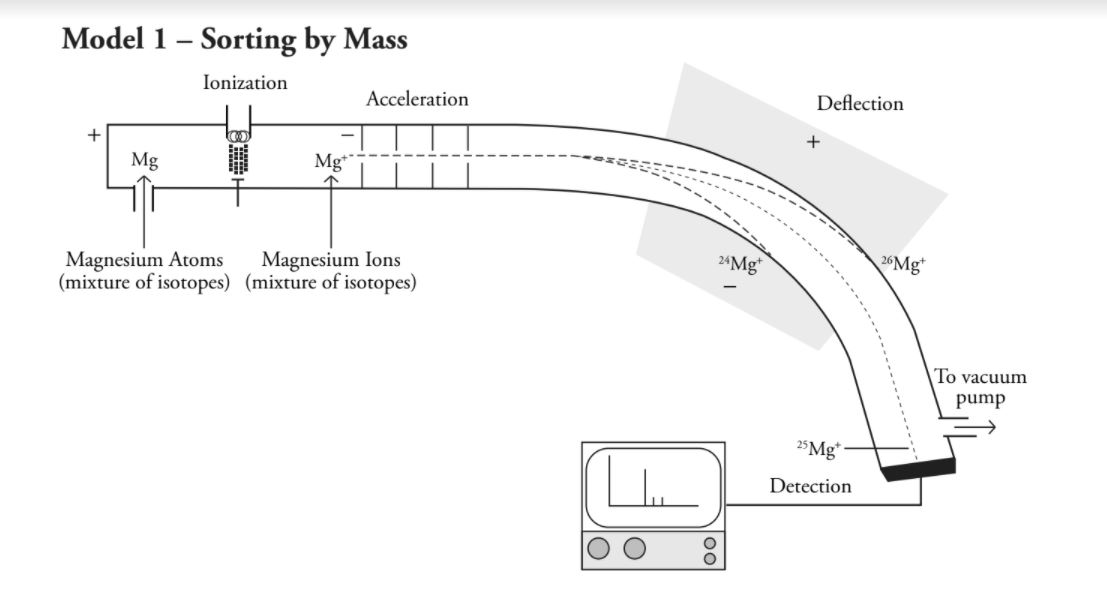
The mass spectrometer can be used to find the average atomic mass of atoms. Essentially, the mass spec is a curved tube that has a vaporizer, an ionizer, a magnet, and a detector at the end (See Figure 1). The machine works by first vaporizing a sample injected into it. Next, the sample is ionized (giving it a charge) as it passes through a stream of electrons. Once in an ionic state, the sample particles are accelerated through the tube by a set of magnets. Because of their momentum, ions with greater mass will not change their path as much as smaller ions. At the end of the tube is a detector. The detector identifies the mass of each particle by its path and creates a graph showing the relative abundance (how much) of each isotope is there. In this way the mass spectrometer can determine mass and the relative abundance of each isotope in the sample.
Watch this video on HOW MASS SPECTROSCOPY WORKS!

4

What four processes occur inside a mass spectrometer?

4

Match the four processes (on the right) to the following descriptions. (Click and Drag the descriptions to the correct processes)

Draggable itemCorresponding Item
Ions move through a series of charged plates to form a narrow bean of high speed particles with equal kinetic energy.
Detector
Ions are attracted to the negative side of an electromagnetic field causing separation of the mixture based on mass and charge.
Deflection
Ions collide with a metal plate. Electrons are transferred from the metal to the ion, producing a current and thus a signal to a computer.
Ionizer
Electrons are knocked off sample particles to form (mostly) +1 ions.
Accelerator
2

When a sample is injected into the mass spectrometer, do the atoms or molecules turn into positive or negative ions? Justify your answer with at least two pieces of evidence from Model 1.

1

Based on your new learning of Mass Spectroscopy, what causes a sample to become separated?

NOTES!
The key to mass spectrometry is that all of the particles go into the deflection chamber with the same kinetic energy. They do not, however, have the same mass/charge ratio (m/z). Although most of the ions formed are +1 ions, their masses are different. Therefore, the amount of deflection they experience by the electromagnet is different. The strength of the electromagnet can be varied so only particles with a particular mass/charge ratio can make it to the detector. Other particles collide with the metallic sides of the instrument, are neutralized, and then removed by the vacuum pump. The machine is calibrated using carbon-12 isotopes which are, by definition, exactly 12 amu (12.0000000…amu)
1

Consider the following ions formed in a mass spectrometer. Rank the ions in terms of their degree of deflection by the electromagnet from least to greatest. (Click and Drag each ion to its correct ranking where 1 is the least deflected and 3 is the most deflected)
19F1+ 16O1+ 17O1+

  1. 17O1+
  2. 16O1+
  3. 19F1+
NOTES!
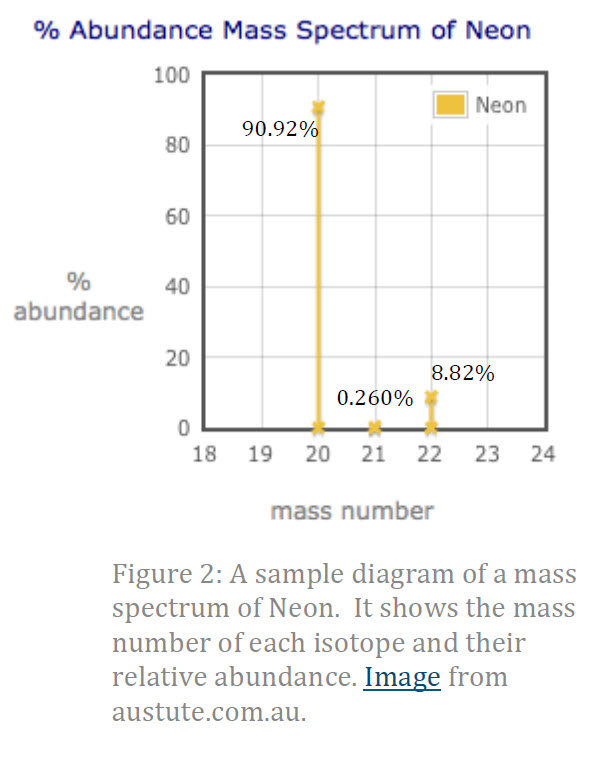
In Mass Spectrometry, a computer creates a graph of isotope mass and relative abundance. See Figure 2.
Since the tallest (most abundant) line is for mass number 20, it can be deduced that neon’s average atomic mass is closer to 20.
These graphs can also be used to calculate the average atomic mass using this equation:


For example: To calculate the average atomic mass of Neon from the Mass Spec data:

3

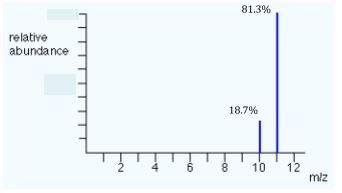
Consider this mass spectrum for the element boron below.
  1. How many naturally occurring isotopes does boron have?
  2. Calculate the atomic mass of boron-­‐ check your answer with the atomic mass on the periodic table. Show your work!
  3. How does boron’s atomic mass compare with the mass numbers of its isotopes?

3

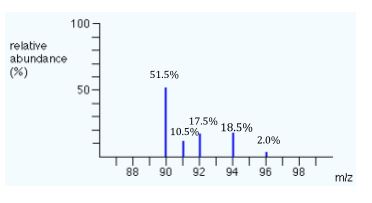
Consider the mass spectrum for zirconium.
  1. Which isotope is most abundant?
  2. Which isotope is least abundant?
  3. Predict, what will the atomic mass of zirconium be: (multiple choice)
a. 93.5 u
b. 92 u
c. 90.5 u

1

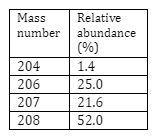
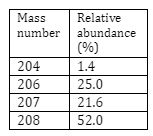
  1. Lead has four naturally occurring, stable isotopes. The table shows their masses and relative abundances.


Draw a mass spectrum for lead, based on the data in the table:

1

Calculate the atomic mass of Lead. Show your work!

2

Challenge Question:

Carbon has two naturally occurring isotopes, carbon-12 and carbon-­13. Its atomic mass is
12.011 u. Based on this data, calculate the relative abundances of each of carbons isotopes. Show your work and give your answer with 3 sig figs.