Wherever the question requires you to use the "show your work" feature, you must answer the question on paper. DO NOT COMPLETE THESE QUESTIONS ON FORMATIVE.
At the end of the assessment you will attach a scanned pdf of your written answers to the assignment in Google classroom.
2 HOURS - 100 MARKS
Wherever the question requires you to use the "show your work" feature, you must answer the question on paper. DO NOT COMPLETE THESE QUESTIONS ON FORMATIVE.
At the end of the assessment you will attach a scanned pdf of your written answers to the assignment in Google classroom.
SECTION A: ORGANIC CHEMISTRY (30 Marks)
Question 1
1.
Question 2
2.
1
12
1
4
2
1
2
4
SECTION B: ENERGY, RATES AND EQUILIBRIUM (30 Marks)
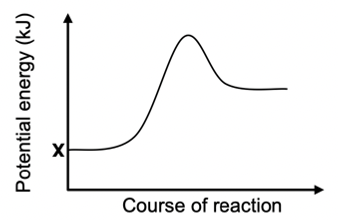
The potential energy diagram for a chemical reaction is shown below.
1
1
1
Question 14
14.
Consider the following chemical reaction:
Ea (forward) = 156 kJ.mol-1
Ea (reverse) = 175 kJ.mol-1
1
1
1
2
Consider the following chemical reaction at equilibrium in a closed container:
2
2
1
3
Chemical equilibrium 1
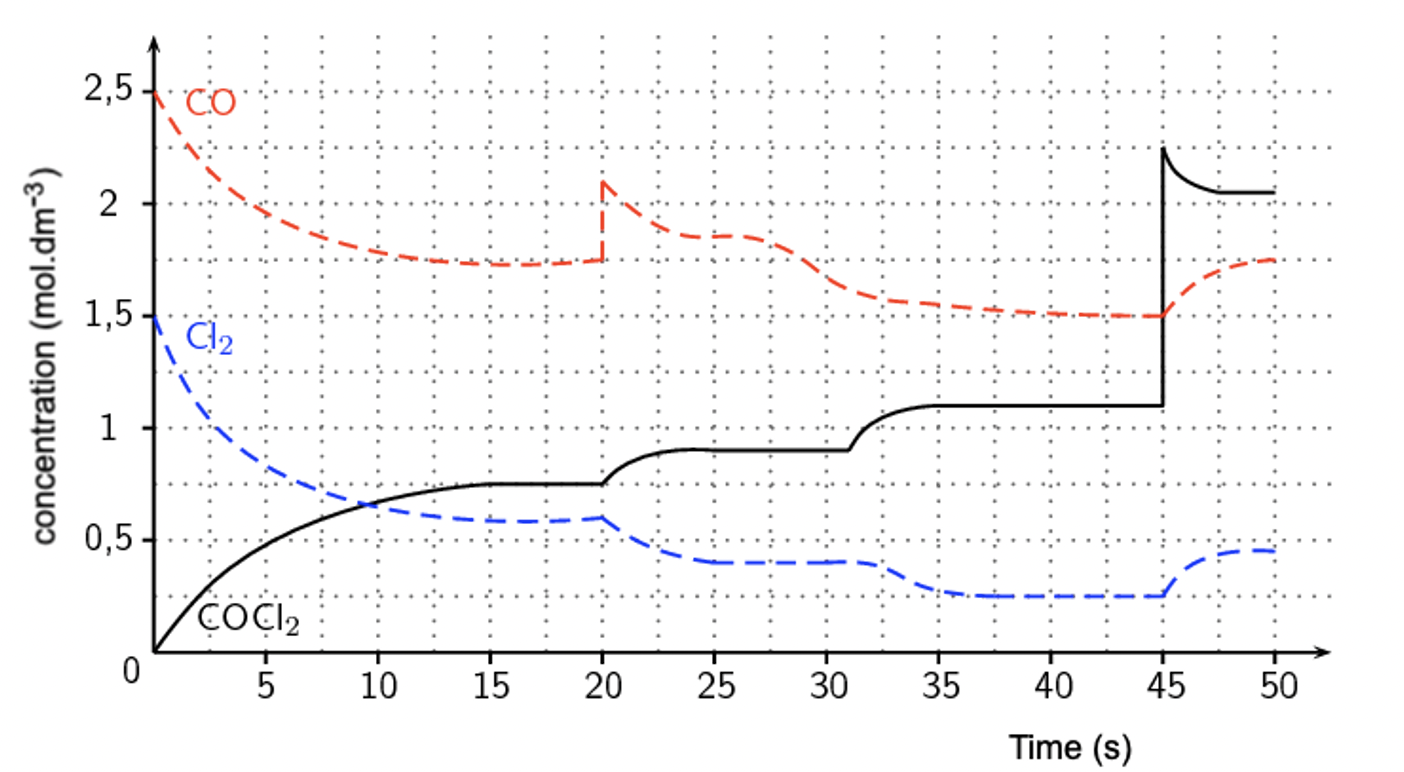
Consider the following concentration vs time graph:
1
3
Chemical equilibrium 2
Carbonyl bromide, COBr2 decomposes into carbon monoxide and bromine according to the following balanced equation:
Initially COBr2(g) is sealed in a 0,5 dm3 container and heated to 80 ºC. The reaction is allowed to reach equilibrium at this temperature. The equilibrium constant for the reaction at this temperature is 0,19. At equilibrium it is found that there is
3,1 g of CO(g) in the container
8
1
SECTION C: ACIDS AND BASES (40 Marks)
Question 27
27.
Question 28
28.
Question 29
29.
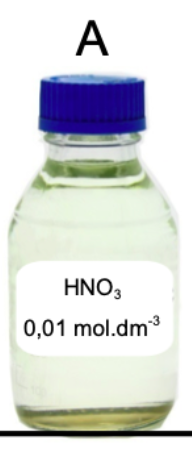
1.5 Consider Solution A:
1
1
1
Consider the following equation at 25 ºC:
H2SO4 + 2H2O ⇌ SO42- + 2H3O+
1
2
3
1
1
pH and Kw
Kw = [H3O+][OH-] ∆H < 0
1
1
1
1
1
3
1
1
1
1
In this laboratory procedure, 25 cm3 of the hydrochloric acid is placed into glassware B with a few drops of indicator.
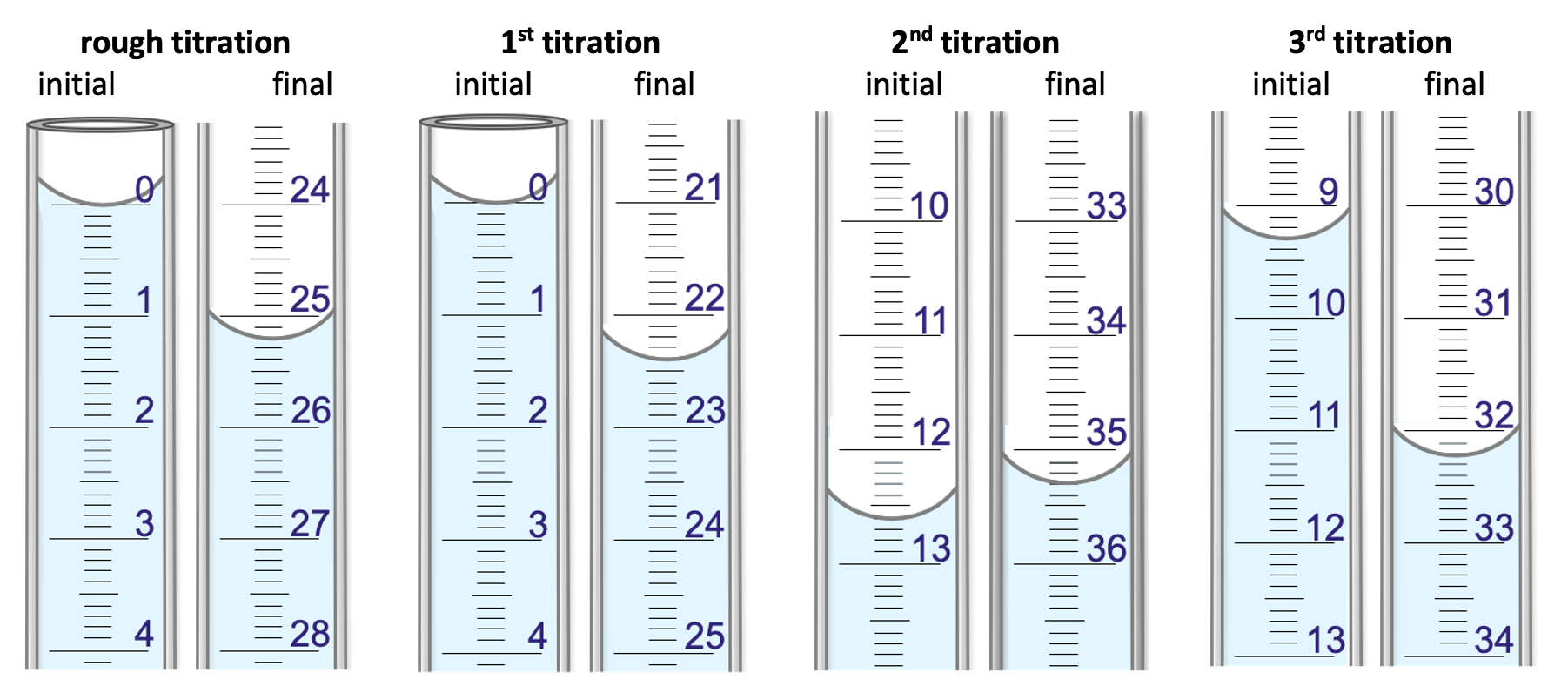
The barium hydroxide is placed into glassware C. After performing an initial “rough” titration, three titration attempts are performed. The following diagrams show sections of glassware C with the initial and final readings for each attempt:
6
To recap - in this titration:
Glassware B contained25 cm3 of the hydrochloric acid of concentration 0,2 mol.dm-3
Glassware C contained the barium hydroxide solution
6
2
Which one of the following will rapidly decolourise bromine water?
Identify the two reactants needed to make ethyl butanoate
butanol
butane
ethanoic acid
ethanol
ethane
butanoic acid
Organic reactions
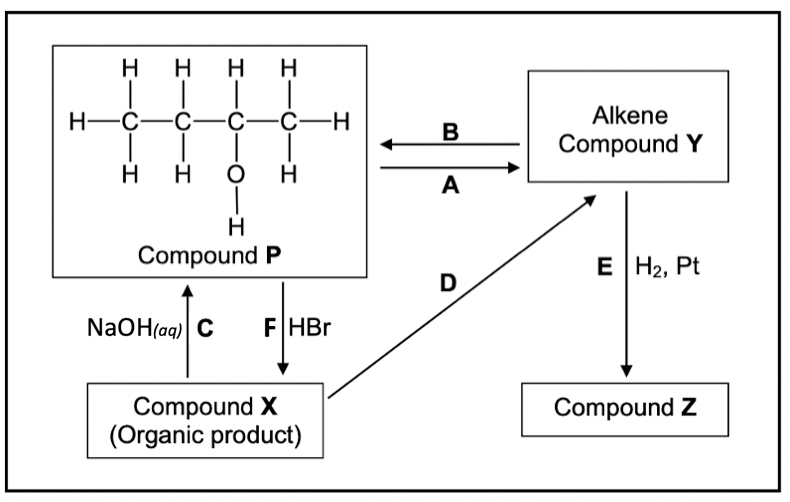
Consider the flow diagram showing how an alcohol (compound P) can be used to prepare other organic compounds. The letters A - F represent different organic rections. X, Y and Z are organic compounds.
Question 3
3.
Identify the functional group of Compound P.
Question 4
4.
Question 5
5.
To which homologous series does compound X belong?
Question 6
6.
Using STRUCTURAL FORMULAE, write down the balanced equation for reaction B.
Question 7
7.
Write down the IUPAC name of compound X
Question 8
8.
Write down the molecular formula of the inorganic reactant needed for reaction D
Question 9
9.
Write down the IUPAC name of compound Z.
Question 10
10.
Using molecular formulae, write a balanced equation for the complete combustion reaction of compound P
Question 11
11.
Question 12
12.
Question 13
13.
The role of a catalyst in a chemical reaction is to increase the ....
activation energy
heat of reaction
rate of the reaction
yield
Question 15
15.
Question 16
16.
What is the change in enthalpy for the forward reaction in kJ.mol-1? Write only the number, no units.
Question 17
17.
What is the change in enthalpy for the reverse reaction in kJ.mol-1? Write only the number, no units.
Question 18
18.
What is the change in enthalpy for the reverse reaction in kJ? Write only the number, no units.
Question 19
19.
Write a Kc expression for this reaction
Question 20
20.
Question 21
21.
Question 22
22.
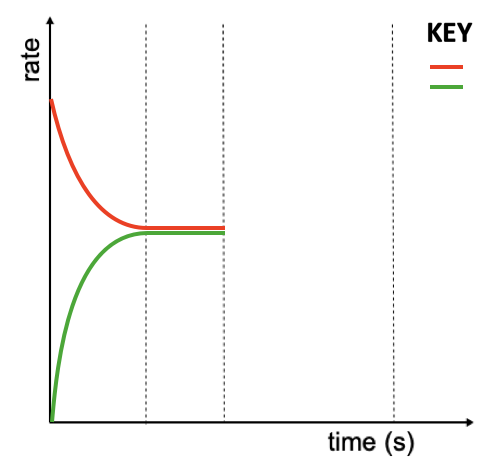
Redraw and complete the following rate graph illustrating the effect of reducing the volume of the container on reaction rate as the system adjusts to reach a new equilibrium. Be sure to complete the key. (if you don't have coloured pens then use solid line and dotted line)
Question 23
23.
Write the balanced chemical equation for the forward reaction
Question 24
24.
Question 25
25.
Calculate the equilibrium concentration of the COBr2(g). Show ALL working out.
Question 26
26.
Consider HSO-4 and select all the statements which apply.
Its is a strong acid
Its conjugate base is SO42-
It dissociates fully
Its conjugate acid is H2SO4
It is polyprotic
It is an ampholyte
It is a good electrical conductor
Which one of the following solutions has the highest pH? All of the solutions have a concentration 0,1 mol.dm-3
Na2CO3(aq)
HNO3(aq)
NH4Cl(aq)
CH3COOH
Order the following Ka values in order from strongest acid to weakest acid:
1 x 10⁻⁵
0,8
2 x 10⁻¹
1 x 101
1 x 10⁻²
Question 30
30.
Question 31
31.
Question 32
32.
Question 33
33.
Question 34
34.
Calculate the concentration of hydronium ions if originally [H2SO4] = 0,1 mol.dm-3.
Question 35
35.
Hence, calculate the concentration of hydroxide ions at equilibrium.
Question 36
36.
Question 37
37.
Question 38
38.
Question 39
39.
Question 40
40.
Question 41
41.
Titrations
A titration is performed using hydrochloric acid of concentration 0,2 mol.dm-3 and a solution of barium hydroxide Ba(OH)2.
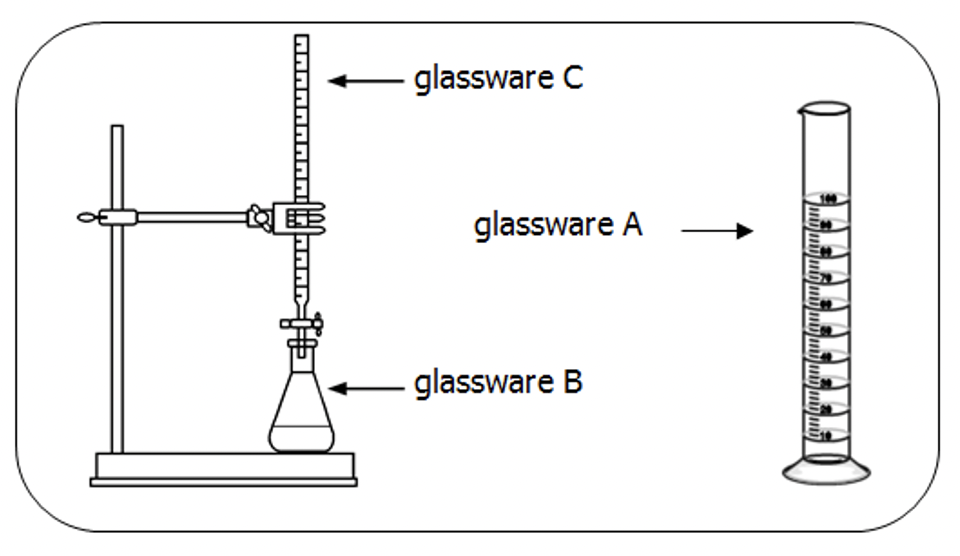
The apparatus used in this titration is shown below:
Question 42
42.
What is the name of the chemical reaction that takes place during a titration?
Question 43
43.
Write a balanced chemical equation for this reaction
Question 44
44.
Question 45
45.
Identify glassware A
Question 46
46.
Identify glassware B
Question 47
47.
Identify glassware C
Question 48
48.
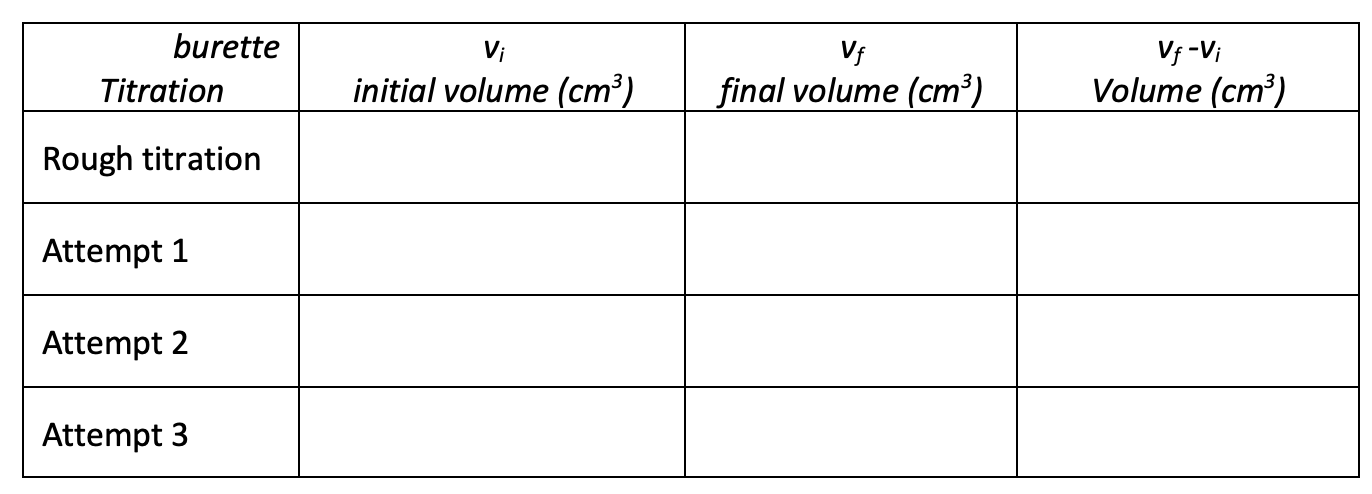
a) Redraw and complete the following table.
b) Calculate the average volume of barium hydroxide used.
Question 49
49.
a) Calculate the number of moles of hydrochloric acid that reacted. Express answer in 4 decimal places.
b) Calculate the number of moles of barium hydroxide that reacted. Express answer to 4 decimal places
c) Calculate the concentration of the barium hydroxide solution. Express answer in 2 decimal places
Question 50
50.
Identify the general type of reaction and the specific type of reaction occuring for A - F
ADDITION
SUBSTITUTION
ELIMINATION
CONDENSATION
Halogenation
Hydration
Hydrohalogenation
Dehydrohalogenation
Dehydration
Hydrolysis
Dehalogenation
Hydrogenation
Dehydrogenation
No special name
Reaction A
Reaction B
Reaction C
Reaction D
Reaction E
Reaction F
X represents the potential energy of the products formed during the reverse reaction
True
False
This graph could represent the change in potential energy for the following reaction:
True
False
This graph could represent the change in potential energy for the combustion of methane
True
False
Is this reaction exothermic or endothermic?
exothermic
endothermic
More HgO(s) is now added to the container at constant temperature. How will the forward and reverse reaction rates be affected?
increases
decreases
remains the same
Forward reaction rate
Reverse reaction rate
Now the volume of the container is decreased. How will the concentration of O2 (g) have changed once the new equilibrium has been reached?
decreased
increased
no change
How do the rates of the forward and reverse reactions compare at the following times?
Forward is faster than reverse
Reverse is faster than forward
Rates are equal
At 5 s?
At 23 s?
At 42 s?
Which one of the following correctly describes the Kc value when the equilibrium is reached at a lower temperature?
Kc > 0,19
Kc < 0,19
Kc = 0,19
What is the concentration of hydronium ions?
1 x 10⁻² mol.dm-3
0,02 mol.dm-3
1 x 10-12 mol.dm-3
1 x 10-14 mol.dm-3
What is the concentration of hydroxide ions?
1 x 10⁻² mol.dm-3
0,02 mol.dm-3
1 x 10-12 mol.dm-3
1 x 10-14 mol.dm-3
What is the pH?
1
2
3
4
5
Describe sulphuric acid as strong/weak acid/base
strong
weak
acid
base
What will happen to the pH if concentrated NaOH is added?
increase
decrease
remains the same
What will happen to the pH if water is added?
increase
decrease
remains the same
In pure water [H3O+] = [OH-] at any temperature
True
False
At 98 º C, the Kw for water will likely be:
1 x 10-14
5 x 10-15
1 x 10-15
5 x 10-13
The pH of pure water at 18 ºC is closer to:
5
6
7
8
How will Kw be affected if a few drops of KOH is added?
Kw increases
Kw decreases
Kw remains the same
Which solution is the standard solution?
hydrochloric acid
Ba(OH)2
Which titration curve best matches this titration?