Categorize the following into abiotic or biotic factors.
Categorize the following into abiotic or biotic factors.
Water

Spider

Mountain

Abiotic
Biotic
There are six criterion for life. This assignment is meant to exposure you to all six of the criteria for life.
There are six criterion for life. This assignment is meant to exposure you to all six of the criteria for life.
Categorize the following into abiotic or biotic factors.
Water
Spider
Mountain
Abiotic
Biotic
Categorize the following into abiotic or biotic factors.
Tim found that the soil in his garden has a pH of 4, which means that it is acidic.

An Acadian sea plant

Jerry found some bacteria growing on his mushrooms, which made them glow in the dark.

Oxygen needed to breathe
Abiotic factors (non-living)
Biotic Factors (living)
Categorize the following into abiotic or biotic factors.
Fish

Temperature

Streptococcus

Dead Fish

Carbon dioxide

Abiotic factors (non-living)
Biotic Factors (living)
During every moment of your life, trillions of chemical reactions are taking place in your body. The enzymes that control these reactions work best within a narrow range of conditions. One of these conditions is your internal body temperature, which should remain between 98.2 ℉ and 98.8 ℉.
If it rises only a few degrees, you could easily die from overheating. At temperatures over 106℉, many enzymes stop functioning. If your internal temperature falls below 80℉, your heart may fail.
Likewise, the levels of trace minerals in your body must stay within strict limits. For instance, if calcium levels are too high, you can slip into a coma. If they are too low, your heart beat becomes irregular.
You live in a constantly changing environment. Your body must cope not only with temperature changes but also with pollution, infection, stress, and many other conditions. Every change is a challenge to your body.
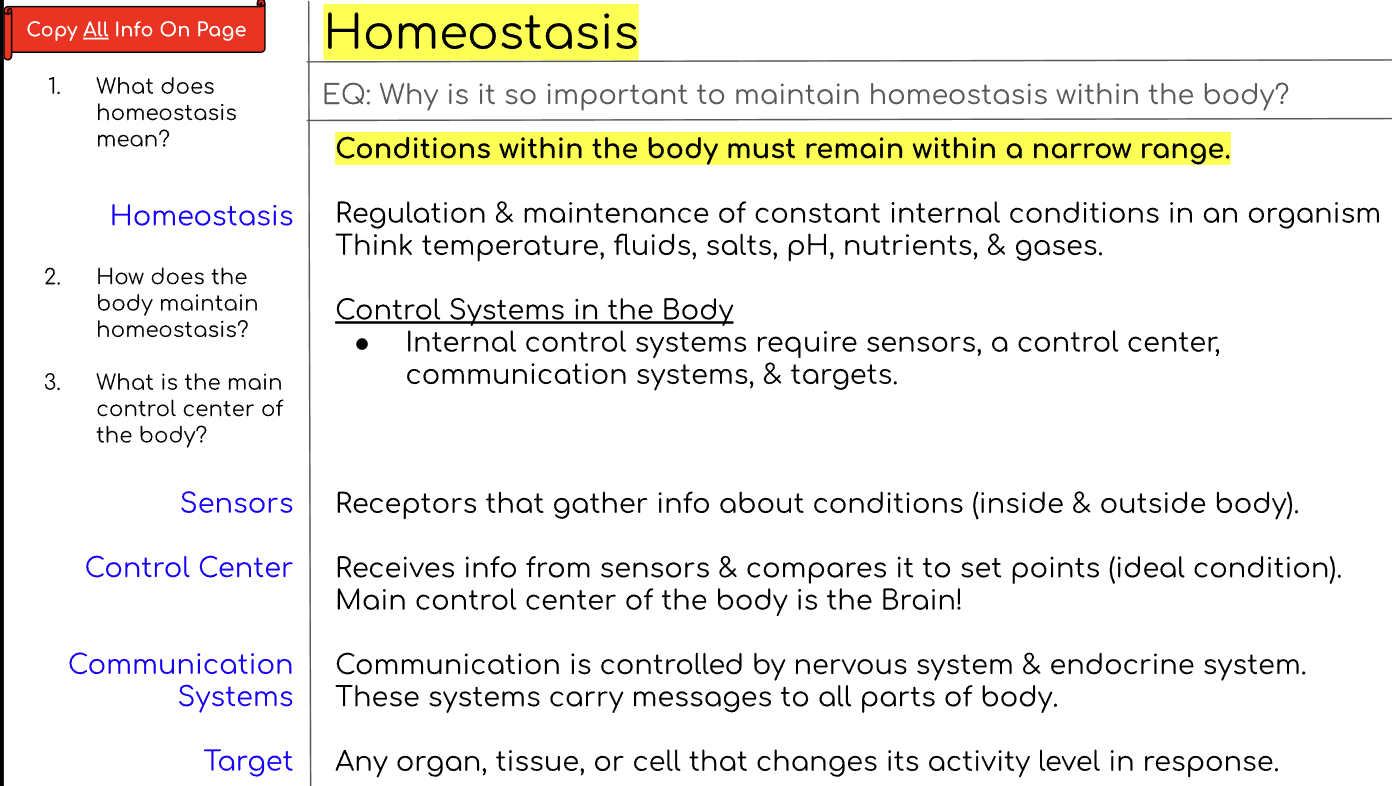
What keeps the human body from breaking down every time the internal or external environment changes?
(1 word answer)
A system to maintain homeostasis must have at least four parts that function together. Reference the iframe above and name these parts.
(_______, _______, _______, _______)
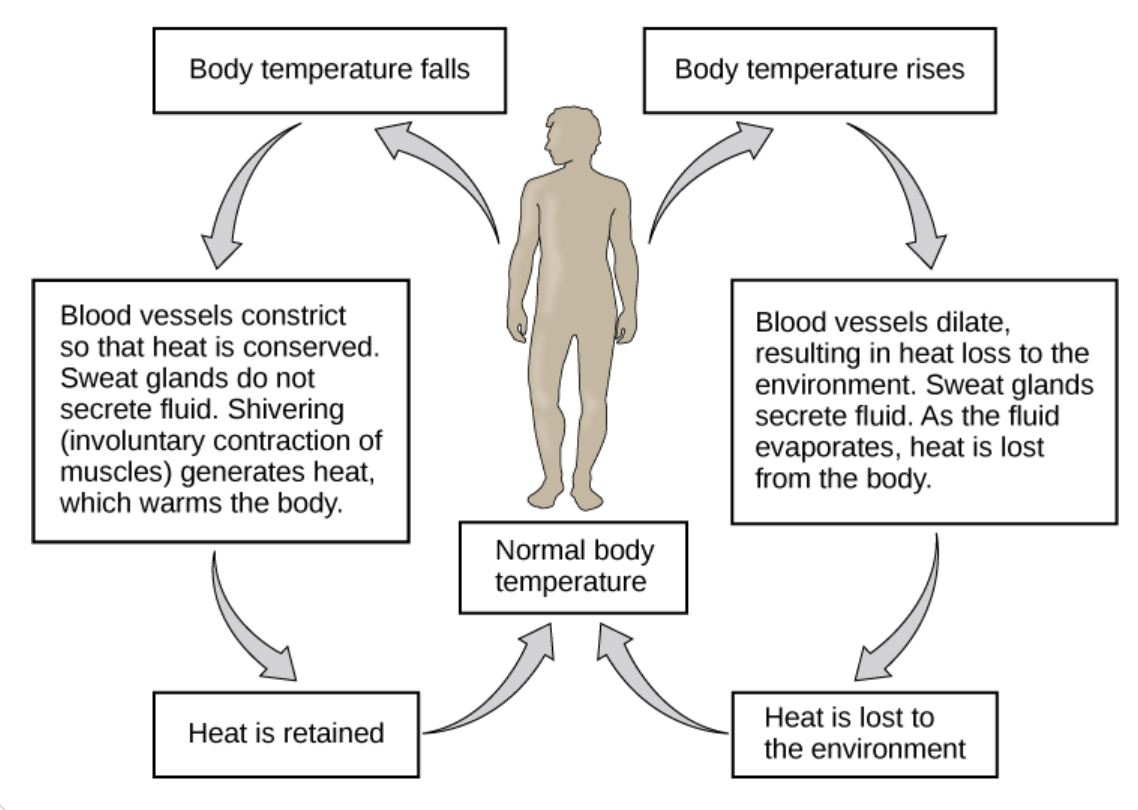
Looking at the image above, normal body temperature would be which part of the control system?
Hint: It "sets up" or creates a normal range that it always tries to maintain.
The table above describes the amino acid comparison between seven different animals. All of the amino acids compared are used to build the protein casein.
Which organism is most closely related to the whale?

Why do you think DNA evidence is the best evidence for determining how related organisms are?

Mrs. Chloe's class is learning about plant reproduction and how animals affect the probability of growth.
They are in groups of three and examining four different pictures of seeds. Use the pictures to answer the questions.
Which of the pictures above would bave specialized structures that would increase the likelihood of being pollinated by an insect?
Which of the following are SMALLER than a cell?
(Select all that apply)
What are tissues made of?
The skin is an organ which is made of billions of cells that are grouped together to form ________.
Not all living things have tissues, organs, and/or organ systems.
Which of the following is the MOST COMPLEX?
Celeste, Hudson, Naveah, and Silas are discussing what makes something alive or dead.
Celeste: Hey guys, here is what I think. Ok, so things that are dead do not move. But things that are alive do move all the time and you can see it. I also think things that are living can reproduce or make more of themselves but they always need another partner to do make that happen.
Hudson: Yeah, I guess I agree with that so far. You know what else though, living things have a bunch of cells, millions of them. They always have more than one cell in fact, it helps them survive.
Naveah: Yup, yup, my brothers are smart. you know what else. Living things grow, like my plant, it was smaller yesterday.
Silas: Do not forget, that all living things respond to their environment, like Nathaneal's plant. It moves to where the sun is.
Concept Review Questions (Answer Both A and B):
A) There are a total of three mistakes. What are the mistakes mentioned in their conversations above. What are they?
B) Celeste, Hudson, Naveah, and Silas almost mentioned all of the 6 criteria of life. Help them by mentioning the criteria they missed.
Look at the image very closely and make two qualitative observations.
A) Observations of osmoregulation in a freshwater environment.
B) Observations of osmoregulation in a saltwater environment.
Two major types of osmoregulation are osmoconformers and osmoregulators.
1. Osmoconformers match their body osmolarity to their environment . It can either be active or passive. By drinking in sea water, and actively excreting salt out from the gills, the fish will gain salt as it produces an isotonic urine.
2. Osmoregulators tightly regulate their body osmolarity which always stays constant and are more common in the animal kingdom. Osmoregulators actively control and move salt concentrations despite the salt concentrations in the environment. The gills actively uptake salt from the environment. Water will diffuse into the fish's body where the fish will excrete a very hypotonic urine to expel all the excess water.
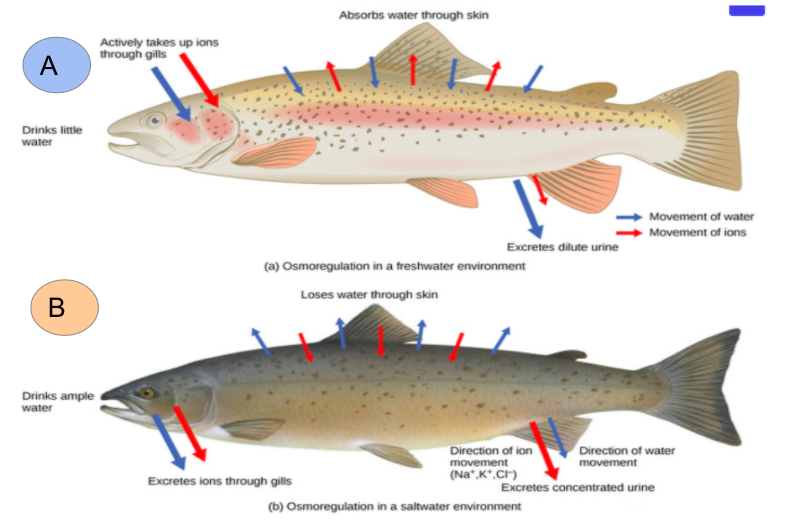
Based on the information above which image is most likely an osmoconformer (A or B). Explain why. Which image is probably an osmoregulator (A or B)? Explain why.
Helpful hints:
* Ions are any atoms or molecules (or you could say salts) with a postive or negative charge: Na+ and Cl- are examples of ions.
* Isotonic - a solution that is the same as the environemnt
* Hypotonic - a solution that contains less solutes (salts and ions) than the surrounding environment
* Hypertonic - a solution that contains more solutes (salts andand ions) than the surrounding enviroment.
Omsoregulation is an example of which form of the criteria of life?
Consider the same image in question 2. Based on what you can see in the image; which organism has evolved to rely on animal to spread it's seeds?
Which of the following statements best represents environmental factors influencing the growth of an organism.